
Create Senior Cohousing for Yourself (Psst! Here's How)

Living and growing older in community is gaining popularity for many important reasons. The alternative, living alone is expensive and more taxing on the environment (as compared to living in community and sharing resources). The resources that older adults need (or will need), like Meals on Wheels, are scarce or poorly funded. Loneliness and isolation is just as harmful as smoking 15 cigarettes a day. There is a revolution taking place and it’s proving to be a solution to our ever-looming challenge of housing adults 55 and older. This revolution, senior cohousing, is a movement to not only live in community, but to be proactive about one’s future, living in a place that is supportive. No matter how young you are, now is the time to take an active role in your aging process.

Mountain View Cohousing, Mountain View, CA
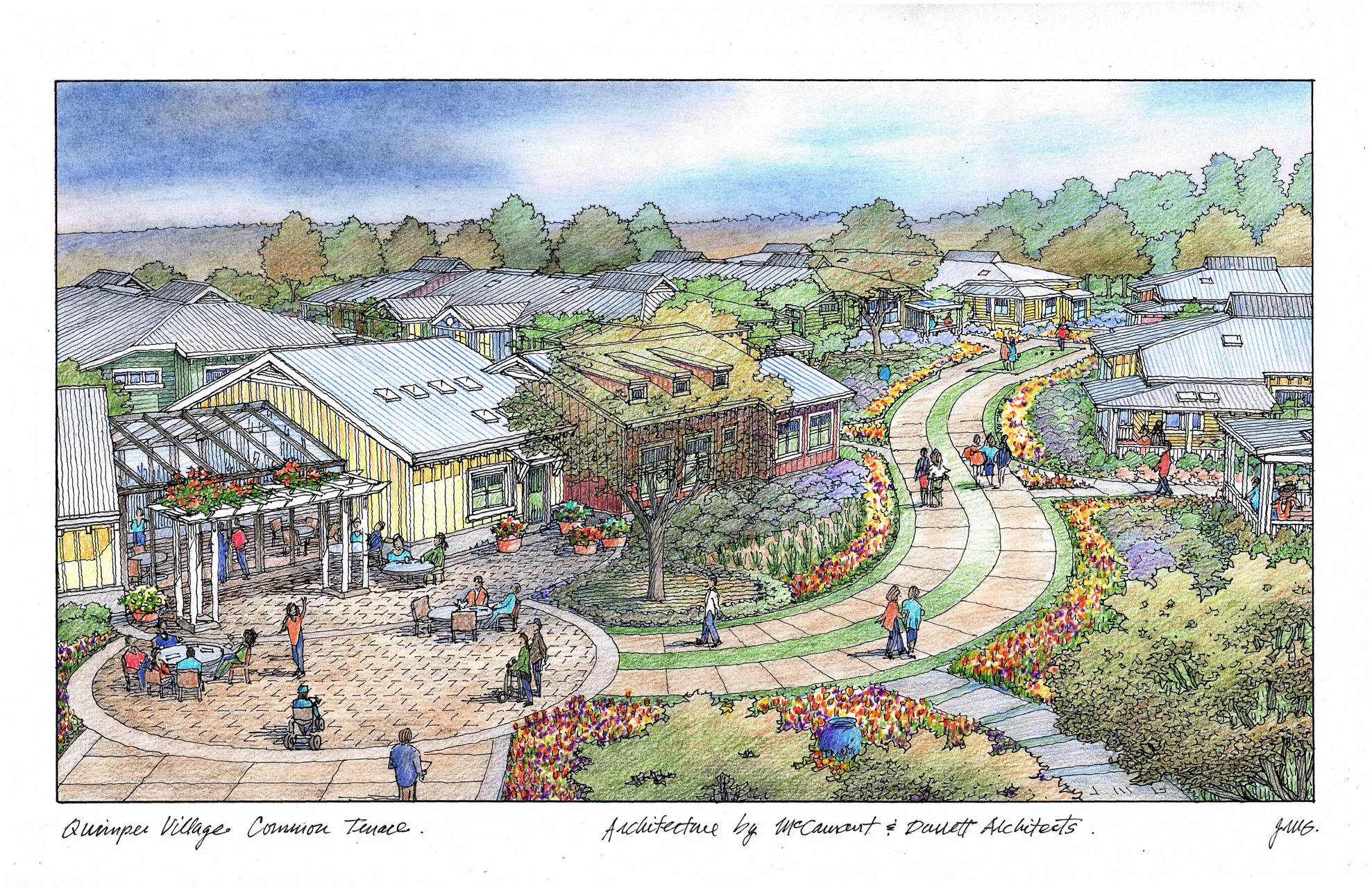
That sounds great, right? It might even inspire you to pick up a copy of The Senior Cohousing Handbook: A Community Approach to Independent Living, but what happens next? How do we move from dream to reality? Talking about solutions is futile if there is no action. Not walking-the-talk leads to frustration and, in many cases, wasted time and money. Action is needed and that is why McCamant & Durrett Architects and Quimper Village are joining forces to host a weekend intensive workshop on June 15, 16, and 17 on Bainbridge Island, WA.
Over three days, participants will spend time with cohousing expert Charles “Chuck” Durrett (McCamant & Durrett Architects) and the residents of Quimper Village, a Senior Cohousing group in Port Townsend, WA, learning how the Quimper Village Group made their project happen. In a small, intimate setting Quimper Villagers will discuss with participants what they did, how they did it, and lessons learned. Time will be spent talking about the financial, legal, and social considerations, plus how groups can market their project where they live. Those who attend will tour Quimper Village, meet the residents, and join them for common lunch.
What makes this different from other cohousing conferences? Cohousing Conferences are great for people to get a taste of what cohousing is. They offer perspectives across the board from people who are living in cohousing to those who are new to the concept. The feedback we hear from people who attend is that the information provided at the conferences is inspiring, but for those who already know about cohousing, it doesn’t get deep enough. Others are overwhelmed with theory and not enough action. Those interested aren’t getting the tools they need to actualize their projects. We’ve listened to your concerns and have designed the June Weekend Intensive to respond to them.
This is your opportunity to share your project with others — challenges, insights, and more — and get your questions answered by those who have successfully gone through the process of creating their own Senior Cohousing Community. Along with members of Quimper Village, Chuck will walk through how they would get cohousing in your town, if they were living there. Every voice will be heard, and all scenarios considered.

Silver Sage Cohousing, Boulder, CO
Concerned that you’re not old enough? The benefits of Senior Cohousing are best felt by those who live there and are part of it. By moving into a senior cohousing community before you need real assistance, you give yourself time to ease into it, to create bonds, to plan ahead with others. You are more willing to help your neighbor than a stranger, right? In cohousing, you have several neighbors each contributing the health of their community. Why would you want to wait for this when you can have it now?
“Cohousing is so much more than a sound bite,” says Chuck, cohousing architect and owner of McCamant & Durrett Architects, “this weekend will be all about setting older adults up for success in their hometown.”
The Senior Cohousing Weekend Intensive is open to 20 people who are ready to get their senior cohousing project going. If you have been thinking about starting your own senior cohousing, if you are looking for a site, or if you have a small group of interested people who are talking about living in a supportive neighborhood where you have a balance of private and community, then this is for you!
“I’m amazed at how people help each other out with immediate needs and take on tasks that they see need be done without being asked first. Although there are differences of opinion, it’s not acrimonious. We’re learning how to make it work,” says Pat Hundhausen, resident of Quimper Village, as she talks about how she is settling into cohousing. Pat helped to make Quimper Village a reality and will be one of the key moderators during the June event.

Finally, an opportunity to talk about solutions! The chance to work directly with cohousing experts and with cohousing residents on your project doesn’t happen every day. Think about your future, a future that’s more supportive, more economical, more environmentally-friendly, and more fun. Sign up for the Senior Cohousing Weekend Intensive before April 28 to take advantage of the Early Bird Discount!
More information at www.cohousingco.com/events/seniorintensive2018.
Article Review: A Cure for Disconnection

Review by Charles Durrett
Original article by Jennifer Latson in Psychology Today
You know that we’re getting somewhere when the renowned magazine Psychology Today publishes a feature-length 10-page article about the importance of personal connections. They refer to loneliness as a disease and warn that we are in the midst of an epidemic—and apparently to everyone’s surprise, it can be deadly. It’s a bigger risk factor than obesity or smoking 15 cigarettes per day. Yes, even the married with family might be lonely and today according to this article, it’s a bigger threat than obesity or smoking, because it’s “hidden in plain sight.”
It’s now time for a serious intervention, suggests a Harvard physician, and cohousing is cited as being an example of such an intervention—but more on that later.
It is now proven that lonely people die more frequently from every other disease as well. Loneliness is strongly correlated with dementia, Alzheimer’s, and most obviously, depression. The stress and anxiety caused by loneliness produces anger, which in turn increase loneliness. One woman told me that her widowed grandfather shot himself “because no one came to visit.” It happens.
Our need for connection is so hardwired that loneliness hurts just like a physical wound and has similar physiological properties to the pains of extreme hunger, thirst or injury and eventually people will medicate to ameliorate that loneliness wound, leading to other long-term issues. A teenager from Nevada City Cohousing once wrote, “I can’t imagine a coho teenager using drugs—they just don’t have any wholes in their heart.” Perhaps simplistic but important to pay attention to nonetheless.
Everyone is lonely once in a while, but sustained loneliness puts people on edge and overly vigilant about being judged or rejected, which actually sabotages their ability to connect. I’m going to argue that some people are proactive and don’t wait for symptoms—they set themselves up for success earlier in life. Some folks actually believe that they will never get lonely and that may or may not be true—people even get lonely in cohousing—just not for sustained periods of time.
Then there’s the fact that a higher percentage of Americans are living alone than ever before. For the first time in American history more women over 18 are living without a husband, than with a husband. Among other things our ability to listen and empathize with others diminishes which will end up making you even more alone. If there is anything that teaches you to listen and learn, it’s living in community. A lot of people look at a home’s closets and kitchen, but the key question is where do neighbors gather to discuss the issues of the day. That’s a much more important quality of life question. That’s where cohousing comes in—meaningful sustained contact makes quality of life a lot easier. That’s why just visiting a nursing home doesn’t mitigate loneliness. The bonds that come from being your authentic self with others takes time and is also what I believe cohousing is particularly good at. It seems that the best we can do is to create community.
“We need communities that deliberately foster close social bonds. There’s a growing cohousing movement in which residents share chores and tend to common spaces together… There are about 700 in Denmark (population 5 million) and 160 in the U.S. (population 350 million) and more are being built,” – Psychology Today.
Just getting together with individuals on occasion is not enough.
In conclusion, 40% of the American population is feeling lonely today compared to 20% in 1980. That skews our ability or interest in living sustainably and makes it easier to pervert the body politic—divide and conquer is simply easier in the absence of community. It seems that people have 1/3 as many to confide in than they did in 1985. It seems that loneliness, just like the disease described earlier, is in fact extremely contagious—and “then the social fabric unravels.”
Sardinians live three decades longer than Americans. Why? Connection. The key to mitigating loneliness is reciprocity—I’ll make dinner on Monday, you make dinner on Friday—that’s cohousing—and fosters deep meaningful relationships.

Finally—how did we get here? Social media has played a role—but moving around a bigger role. What has Congress done—passed legislation to continue to make hearing aids more accessible—probably a good idea. Loneliness is not a chronic disease, it can be cured, but like most diseases, the longer it goes untreated the harder it is to cure—then it can become chronic. Next steps—make more community.
Katie's Insights on "The Cycle of Life" as seen through the lens of cohousing
From CoHousing Solutions' newsletter published Dec 2017.

Advent Circle, Nevada City Cohousing
As we approach the Winter Solstice, I’ve been thinking of the full cycle of life we get to experience here in my intergenerational community, Nevada City Cohousing. I suspect that I am not the only one that finds this to be one of the more profound appreciations for living in community, for ourselves and for our children.
The Winter Solstice Spiral is a beloved tradition at Nevada City Cohousing that inspires contemplation on every stage of life...
In the last weeks my community has been holding so much love for so many. For one neighbor who recently died, too young as she was just in her early 50’s, the community has been there to support her and her family in any way we can. And in return she shared and taught us so much. Another neighbor mentioned that her mother, who lives a few blocks away, had become close with this woman, and that sharing her passing has opened up an opportunity to talk with her mother about death. “What a gift (our neighbor) has given me,” she tells me.
On a recent Saturday night, another neighbor held his 46th birthday party in the common house with a rock-and-roll band made up of his fellow junior high teachers. Softening us up, he fed the community tacos and his new home-brew, made from hops grown here and brewed in the common house. Can’t get much more local than that! And that also helped to soften any complaints about the rock and roll band later…good technique.

Breaking bread together is at the heart of cohousing.
And then Sunday afternoon, all the women of the community, from 3 to 80, gathered in the common house to celebrate another neighbor’s pregnancy. We are all so excited to have a new baby coming! We shared stories, wishes, cake and tea. One neighbor is coordinating our community quilt for the baby. Another neighbor is knitting blankets for the new baby, and the baby’s older brother, while she worries about her husband’s cancer returning.
In cohousing, all of these major life events can happen at home with much more support from the community.
Written by Katie McCamant of CoHousing Solutions.
Cohousing in Great Britain - a tipping point
Charles Durrett is a leading expert in cohousing, not only because he knows and understands the process, but because he has the experience to back it up. With over three decades of experience, Chuck lives the cohousing process and can work with others to realize it in themselves. His impact is worldwide, reaching far across the Big Pond, where cohousing is being embraced.
Watch this video featuring OWCH.
In 2010, Chuck and Katie went to Britain and energized what is now a strong and supported cohousing movement. Old Women’s Co-Housing (OWCH). OWCH had been trying to get started for almost ten years and were dangerously close to giving up. Sarah Berger, and the UK Cohousing Network organized to have Katie and Chuck meet with OWCH and Hanover Housing Association, the involved parties. They worked through the nitty-gritty details—two hours of which was spent on trust alone—and in the end, they were able to move forward with the project, knowing that each side was going to uphold their side of the agreement. They walked up the ladder until finally a contract was signed, the project designed, and, at last, built.
In total, Katie and Chuck spent eight days in the UK, which included giving five public presentations. These presentations helped OWCH and other groups gather more members and move forward with their projects. The process that OWCH used and most of the new groups use is outlined in The Senior Cohousing Handbook: A Community Approach to Independent Living. Their efforts stimulated over 20 projects, to date, to be built in the UK, many with the support of a government and society who knows the value of community.
Since then, resources like SAGE Cohousing International (SCI) have been introduced to North America to provide resources to seniors interested in senior cohousing. SCI is a nonprofit organization whose board is comprised of experts in gerontology, cohousing, development, and team management. For more information on SCI, click below.
OWCH members realized that they must be proactive about their future and what a bright future they have! It goes to show that, if you follow the cohousing process that is outlined already, getting your cohousing neighborhood designed and built is possible and much less work than reinventing the wheel. It is hard work, a thrilling ride, but the result is well worth the journey and it lasts for years to come.
Tale of Two Units
**Based on a letter from a former cohouser. Fictional names and places are used in this account.


Answer from Chuck:
Thanks very much for the very important note and observations. And yes, it’s true that in the book Happily Ever Aftering in Cohousing we talk a lot about establishing a minimum of committee participation of each participant in a given cohousing community. If you have the minimum participation (cook one common meal per month, belonging to at least two committees, and participate with your neighbors 30 hours per year in maintenance projects) then you wouldn’t be stuck with those who aren’t going to contribute and if you have stated minimums in your House Rules, then you don’t have to interview people as much (other than to be sure that they understand the minimums.) And, for sure, a palpable community makes the biggest difference in resales, but you’re in such a desirable neighborhood that you do need to aggressively do something to stem the ebb towards regular condos.
In Denmark the only units in cohousing that had a hard time selling were those that ebbed into regular condo land. In other words, of the 46 that we studied in great detail, the one where it was voluntary to cook, voluntary to be on a committee, etc., had a hard time selling units. It ebbed to that place that was dependent on a few busybodies, and broad and fair participation was not agreed on. And it ebbed to where females were doing more of the common cooking than males – just what they set out to avoid originally. Like in Denmark, the number one factor enhancing resale is, “Do you feel the palpable community.” The one in Denmark I refer to was neither fish nor fowl. It was neither cohousing or a regular condo. People want clarity so choose one and be that. Let people know what they are getting into. In that way you set the individuals coming in—and therefore the entire community—up for success.
Recently, one of the current Study Group 1 Facilitators asked a question similar to this during our training. I know it is a burning question for many who are interested in living in a community long-term, which is why I can’t emphasize enough that you embrace the cohousing culture that you create and set the community up for success long term.

Now in Denmark, almost half of the cohousing communities are limited equity coops, which means they can vet who comes in. That may or may not become the future here. In the meantime, we have to come up with interview provisions that help protect the community aspect and some semblance of affordability. In Berkeley, the cohousing self-imposed a 4.5% cap per year on equity. You can impose whatever covenants you want, but at the same time, you don’t want to limit the market too much. In Elder Spirit Cohousing, the third senior cohousing built in the U.S., when a unit is sold, 50% of the appreciation goes back to the community. It’s one way to best assure that you’re preserving affordability.
Other things that can be (and increasingly are being done):
1. The residents that live there (the community) gets first right of refusal and the unit is sold at appraised value. Then the community can sell it/rent it to whomever they choose. There is still an appreciation upside, just not as big. Since high functioning communities are a priority, the issue of huge appreciation is a real concern in this country and has made some cohousing communities unaffordable;
2. Serious, serious orientation. This is who we are and this is how we do things. This is best done with the Site, Common House, and Private House programs from the Participatory Design Process. Usually, someone from the membership committee discusses this in person with prospective buyer. Take them out for coffee;
3. Have a true elder in the group, someone who can talk directly about the norms and mores of your neighborhood. When I was a kid, going around making noise late into the night, I had at least one elder in the community sternly remind me that it was not acceptable at that hour. Similarly, I’ll never forget the time that we had a prospective buyer who suggested that he couldn’t cook for his neighbors on a monthly basis. Betty, an elder in the community walked him to the door and kindly said, “Jim, there’s an entire world out there for people who don’t cook for their neighbor. Here we cook for our neighbor.” Thank goodness Betty was at dinner that night or we might have been stuck with Jim;
4. These days, most cohousing communities, like Nevada City Cohousing, ask everyone to sign a participation agreement (I will cook, I will belong to two or more committees, etc.) Then we have four or five elders in our community who remind us all to play our part in making this community work long term.
The conversation needs to be amped up around this. Something needs to be done to best assure that people moving in are on board to contribute to the community. Some groups, like Berkeley Cohousing took it upon themselves to implement the cap, and those are the groups who seem to always be filled with happy, caring, neighborly community.

As we roll into the holiday season, we are surrounded by community. So much work to be done to get ready for the next party, cleaning up from the last, or maybe shovel the snow from the pathways. When you live in community, it is essential that everyone chips in -- it makes the load a lot lighter and the members much happier knowing that they have support.
The tragedy of the commons is real, but can be handily mitigated. No one moves into cohousing to take advantage of their neighbor but it does happen. To ensure that every community member is contributing, minimum participation must be agreed upon before moving in, as described at length in the book Happily Ever Aftering in Cohousing. The prosperity and longevity of cohousing depends on it.