
Village Hearth Cohousing Ground Breaking
On Monday, October 29, 2018, Village Hearth Cohousing made monumental progress for the future of older adults in the LGBT community. They broke ground on their cohousing project, which means more than simply building a house. When built Village Hearth Cohousing will signify the success of a group of people who, together, designed the neighborhood of their dreams, one that is supportive and fun, where they know and trust each other. A community where they can be themselves.

Image courtesy of Village Hearth Cohousing
In celebration of the event, Charles Durrett, Principal Architect of McCamant & Durrett Architects had some words to say. McCamant & Durrett Architects was the architecture firm hired by Village Hearth Cohousing.
“On this occasion, one can be encouraged by the trajectory cast. That is especially true when those that you have learned to appreciate and to work with have set their sights on goals and are steadily making deliberate progress in that direction. In the case of Village Hearth, it seems that the only way that one can possibly predict the future is to in fact create it.
“Village Heath is well on its way. As the architect whose job it was to synthesize the needs, wants and desires of this group of discerning and capable co-creators, I’m happy to see each step move forward on the path to fruition. And I’m proud to be a part of it.” - Charles Durrett.
The seminal book came out in July 1988, 30 years ago

Written by Charles Durrett
Thirty years ago last month the book, Cohousing: A Contemporary Approach to Housing Ourselves, that introduced cohousing (and the word cohousing) to the US and the English speaking languages arrived at our doorstep in Berkeley California. An 18-wheeler from the printers in Tennessee negotiated our not-so-big residential street and un loaded 3,200 hundred brand new shiny blue, full-color books. Jim, the driver, his wife and trucking partner, and their ten-year-old “home schooled” daughter helped us unload the boxes of twenty books each and put them into our basement. Self-taught, (including Danish and writing), Self-published, self-designed, and now self-distributed. We had loans to payback, so we packaged them out at night after work. Seventy-six copies one night, went into our home-made packaging using scrolls of paper from various cohousing workshops that we had already begun having. Seventy-six copies to be shipped out the next day. Luckily word had already got out. People wanted the book, from Little Rock, Arkansas to Boston to Alaska to the far corners of everywhere.

Cohousing in Denmark.
It took so long to do that first book. Kate and I were introduced to cohousing in the fall of 1980 while attending the University of Copenhagen. Went back in 84/85 to write the manuscript (by hand), and then wrote and wrote, and wrote until it went to the printers in the early spring of 1988. Katie went back to Tennessee that spring to check the printing proofs — that’s how hands on this book was.
Then in August we went a green politics conference in the Sierras and noticed that one speaker after another was from Davis, California. So that following Monday, I jumped into our not-so-new Volvo and tooled the 70 miles to downtown Davis on that hot still August day. Stopped by a half dozen bookstores in that college town, all of them took the book on consignment or through the nation-wide book distributor that we had luckily negotiated to also distribute the books when bookstores called to order it.

The kids of Muir Commons today.
I went right over to the Village Homes Community Center and rented that out for a September Public Presentation. Then with flyers on every bulletin board in town, and flyers planted in the books in the various bookstores we started to get some real traction. No one had heard the word “cohousing” yet, so it was an uphill climb.
Then we met a couple, Kevin and Linda Cloud, that were willing to help organize the upcoming public presentation, and to help get the word out locally. We got all of the free calendar listings that we could.
About 80 people showed up. Katie and I took turns presenting, like we always did in those days. At the end of the presentation, the head of Davis City Planning Commission stood up to ask a question, but mostly to make a statement. “The next application for any large-scale multi-family housing project in Davis should include a cohousing community, right,” she said. Of course, we answered, “Yes.”
A developer planning a new 200+ housing project was also in the room and she knew it. This just goes to show that to find the right partners, you need to get the word out there. But that’s a story for another article. We knew that the first community in the U.S. had to work well for this model to catch on. So after some finagling, we got ourselves positioned to be the architects to design the site plan, the common house and the houses with the entire group. That lovely community is Muir Commons and they moved in in the summer of 1991.
Muir Commons received considerable press and we were off to the races in the U.S. It was the first model cohousing project built in North America and it remains a model project today. The availability of a comprehensive discussion, the book, model projects, millions of hours, and the covey of professionals who, with dedication and integrity, and non-profit organizations have impelled cohousing along. Now we have many more. We are well on our way to 200 cohousing communities in North America and well on our way to making cohousing a known option for housing, communities, and neighborhoods, exemplifying how neighbors can relate to each other and cooperate with and support each other in America.
Anyway, at 55 more projects, hopefully model communities and many more by others, the rest is history. But in this case this history of cohousing in North America is just the beginning.

The book has been revised and is now called, Creating Cohousing: Building Sustainable Communities, and can be purchased through our website.
This is a Hot Topic
Written by Charles Durrett
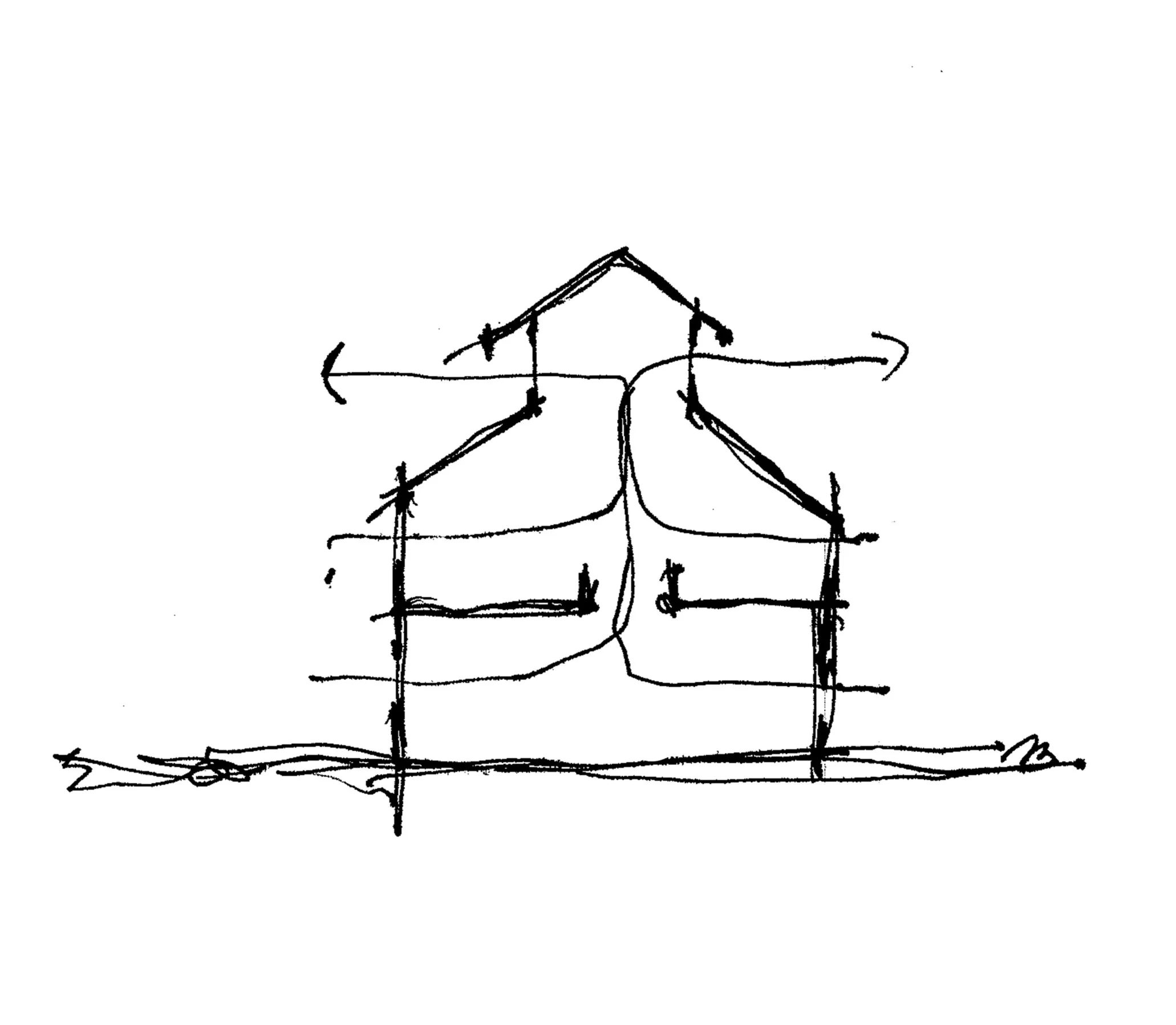
I know for a fact that if you have to have air conditioning, you have to have it—it’s a cultural thing. It’s our habit or as cultural anthropologist Robert Bellah puts it, it’s a “Habit of the Heart”, and if your house is designed poorly, it’s physiological. So, I’m not going to try to talk anyone out of air conditioning, we’ll do air conditioning if the group wants it—but I’m happy to report that most groups that don’t really need it have chosen to not have it installed and challenge us to accomplish cool houses through passive cooling (inherent in the building) which we embrace.
Time magazine just reported that air conditioning has become the number one cause of global warming world-wide, greater than transportation, greater than house warming, greater than industry. Ironically, of the 2.8 billion people along the equator, those that need it the most, only 8% have air conditioning. The rest of us, in the U.S. and Japan, for example—about 90% have it. The good news is that cohousing groups get to create their own houses and therefore respond to their own priorities. That’s why those houses perform so well from a passive cooling point of view.
We, for example, make sure to use enough mass so that if the night temperature gets down to 70 degrees Fahrenheit the house gets to 71 degrees Fahrenheit or 72 degrees Fahrenheit by morning and that the high temperatures of the day, even when it’s 100 degrees Fahrenheit outside the interior of the house doesn’t get above 76 degrees Fahrenheit in the late afternoon.
There are hundreds of tricks to achieve passive cooling and we employ them all, because of all the clients that we work with, no one wants to walk their eco talk more than cohousers—to a point. In other words, it has to work. And if it doesn’t then there has to be a back-up like an entirely interior A.C. that you can put in your bedroom at night but keeps the white noise (a hum) internal to the house so that neighbors can simply keep their windows open (and uses less than 10% as much energy.)
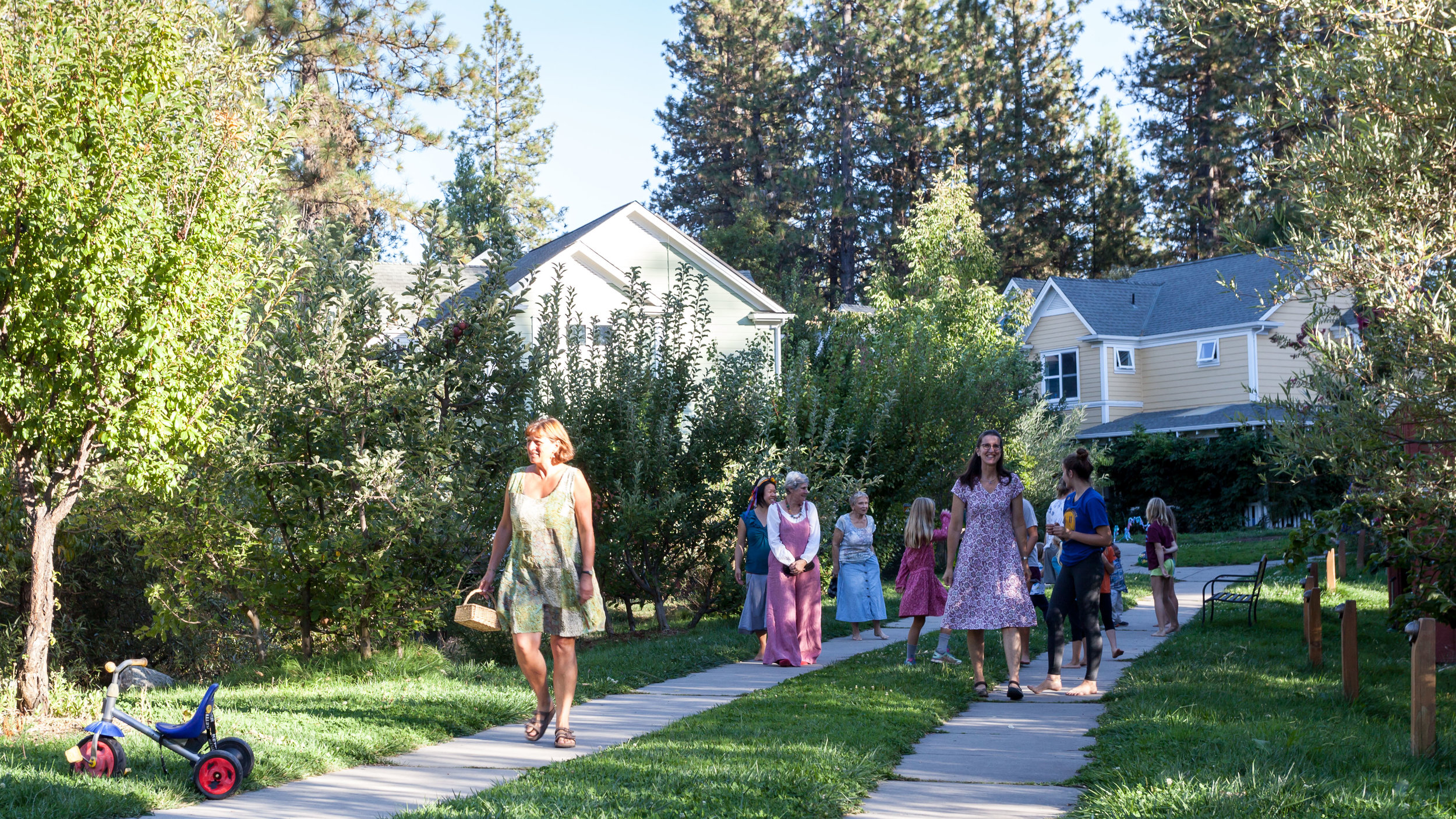
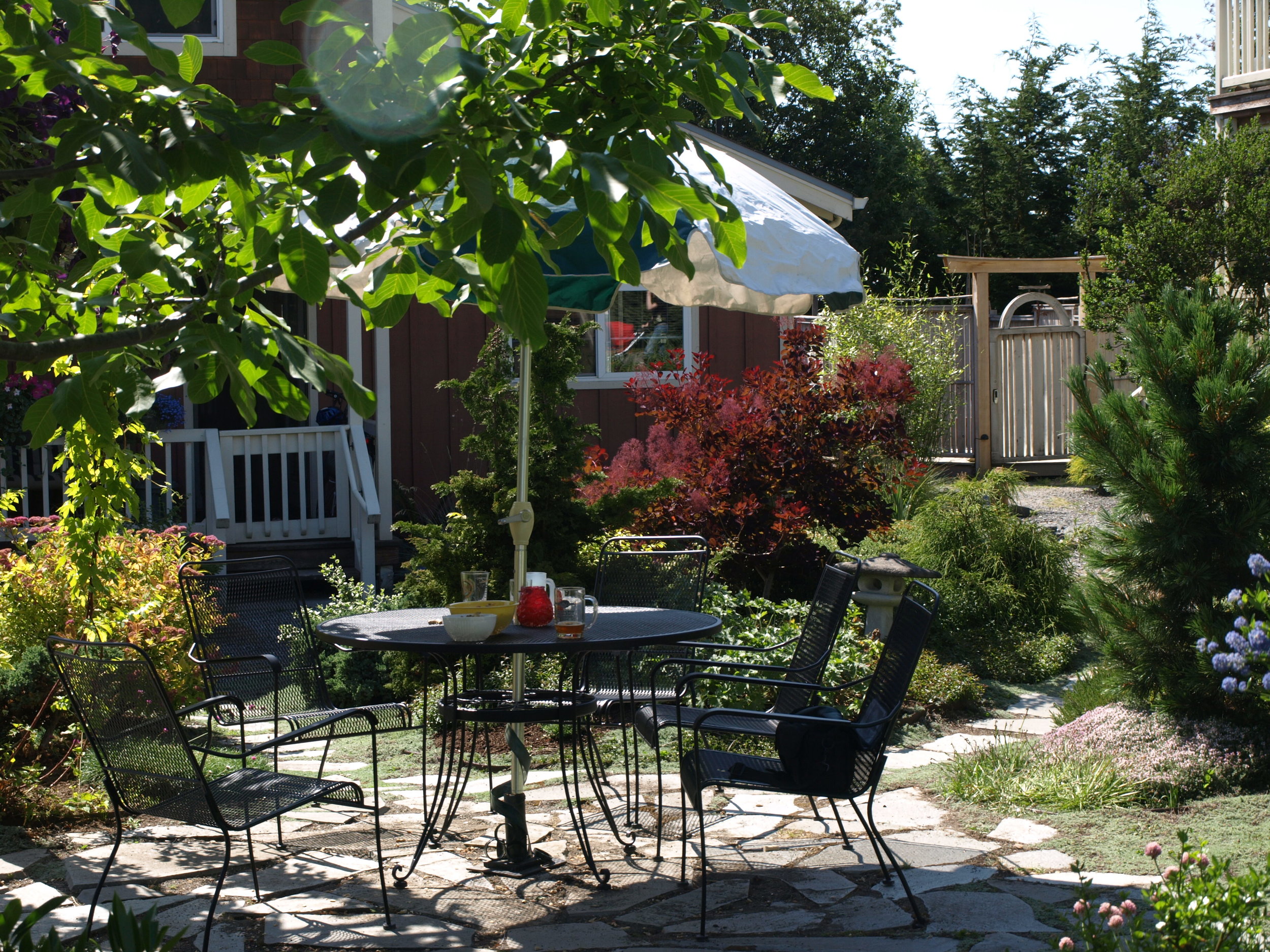
Examples of passive cooling include sparse pavement/more lawn, shaded gathering nodes, shade trees, and porches with well-designed overhangs. All of these contribute to a more enjoyable experience in one's private home and the common space.
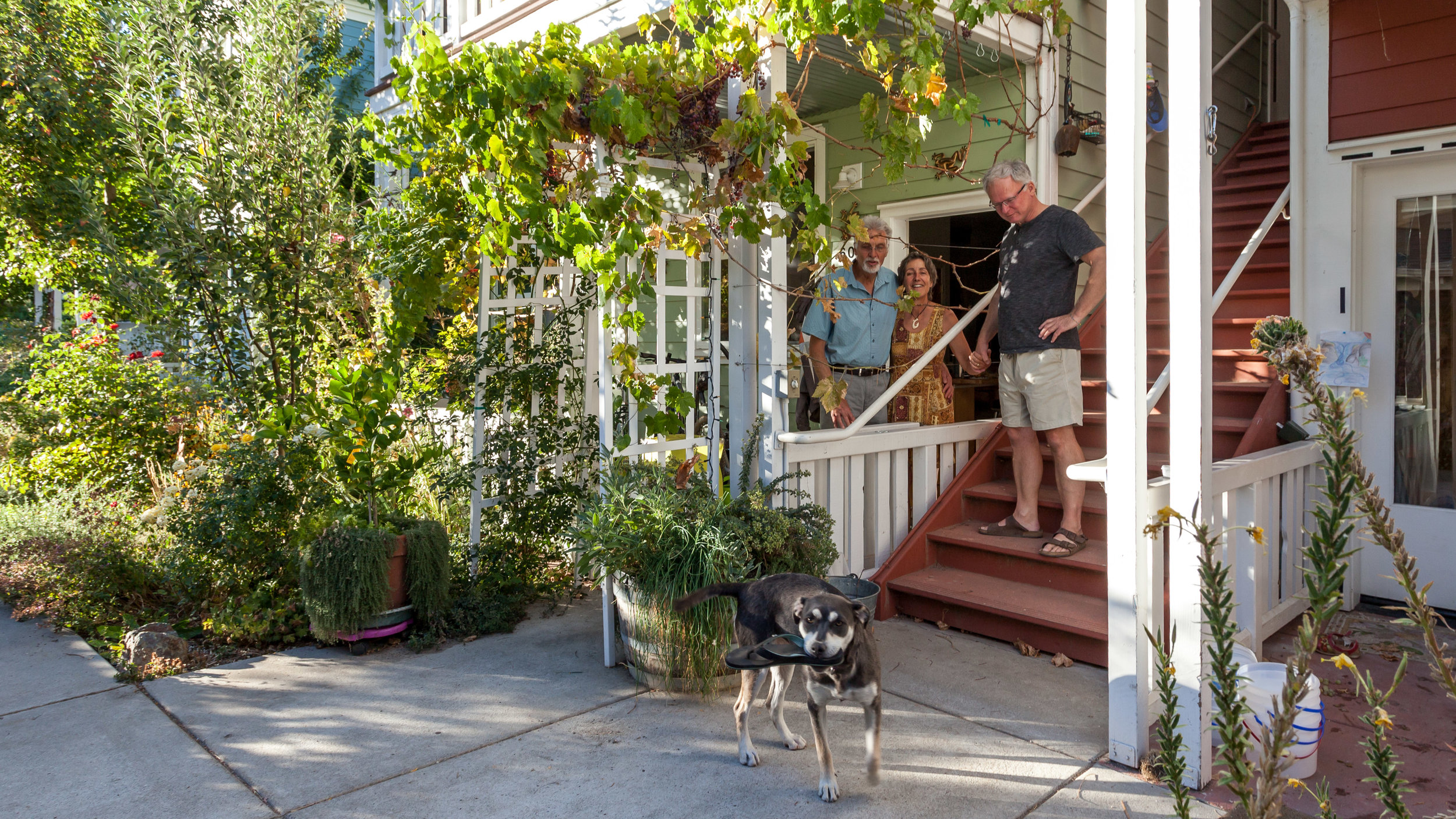
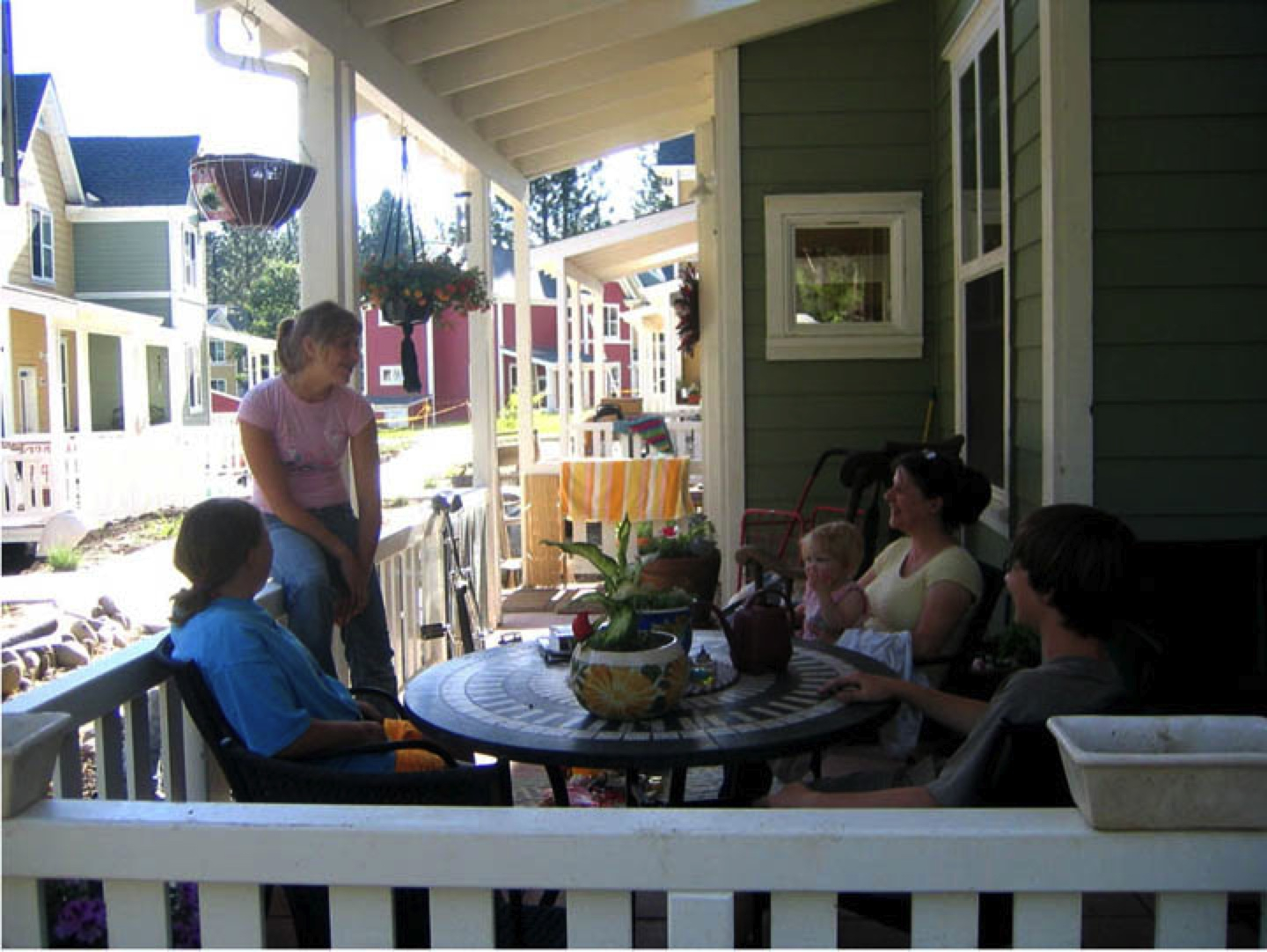
To give you some idea of how cultural it is, we rented a house while our current state-of-the-art, passively cooled cohousing was being built. We didn’t turn on the air conditioning until our daughters 15th birthday party on August 2nd. A dozen 14, 15, and 16-year old young ladies showed, so, we turned on the air conditioning. Jessie, our daughter, said “Hey, I didn’t know we had an air conditioner”, the air conditioner went on every day after that, although she never complained about the heat before. It’s so easy to flip a switch. Before that we’d sit on the front porch in the evening, and let the rocking motion create a breeze, or the porch ceiling fan cooled us, amongst other things like a glass of iced tea.
I’ve yet to read an essay or any rationalization as to why it’s ok to cool our house to warm the planet. Invariably someone will invoke the plight of the Bangladesh people and them standing in waist-high water in the downtown streets after a routine storm. And, of course, the more the planet warms, the more that happens and the more we need A.C. And it’s not just Bangladesh, it could be Quebec, where more than 70 heat related deaths have occurred this summer.

Our cohousing 34 houses were built with zero air conditioning (in a part of California where nothing is built without air conditioning). But it’s not just a conscious design decision it is a series of conscious life style issues. Passive cooling comes up at least once a week at common dinner in the summer. When do I close my windows? When do I close the shades? Which window shades? When do I turn on the whole house fan? For how long? When do I use the ceiling fan (whenever you’re in the room)? When do I turn it off (whenever you’re not in the room)? Yes, it’s a topic, an easy one, which gets you in touch with your neighbor and your climate. We do have air conditioning in the common house, and once (in 12 years) 21 folks spent the day there. This was the year that a heat wave killed 35 Californians (2/3 of whom had air conditioning but were too fried to turn it on). I know that it could possibly cramp your style to work and play in the common house for one day out of 12 years—but not if you can imagine what the rest of the world is giving up to make A.C. so convenient for us.
I find that you can’t be righteous about this stuff, but that you don’t have to be. When you watch cohousing groups work this stuff out, you believe that they are willing to imagine that it can be worked out and that’s the beginning of getting the job done.

Indirect lighting, efficient insulation, high ceilings, and an open floor plan contribute to passive cooling in the Common House.
In some cases, groups don’t want to take the risk and put in a mini-split or similar, but I’m happy to report that many folks, like some in Fresno, California, say that they still haven’t used their air conditioning in ten years. A.C. is an increasing problem, but I love working with people who want to be at least part of the solution.

Large efficient windows let light in without heating the space.
If we can’t get cohousers to scale back their air conditioning usage then we’re toast! But my experience is that we can.
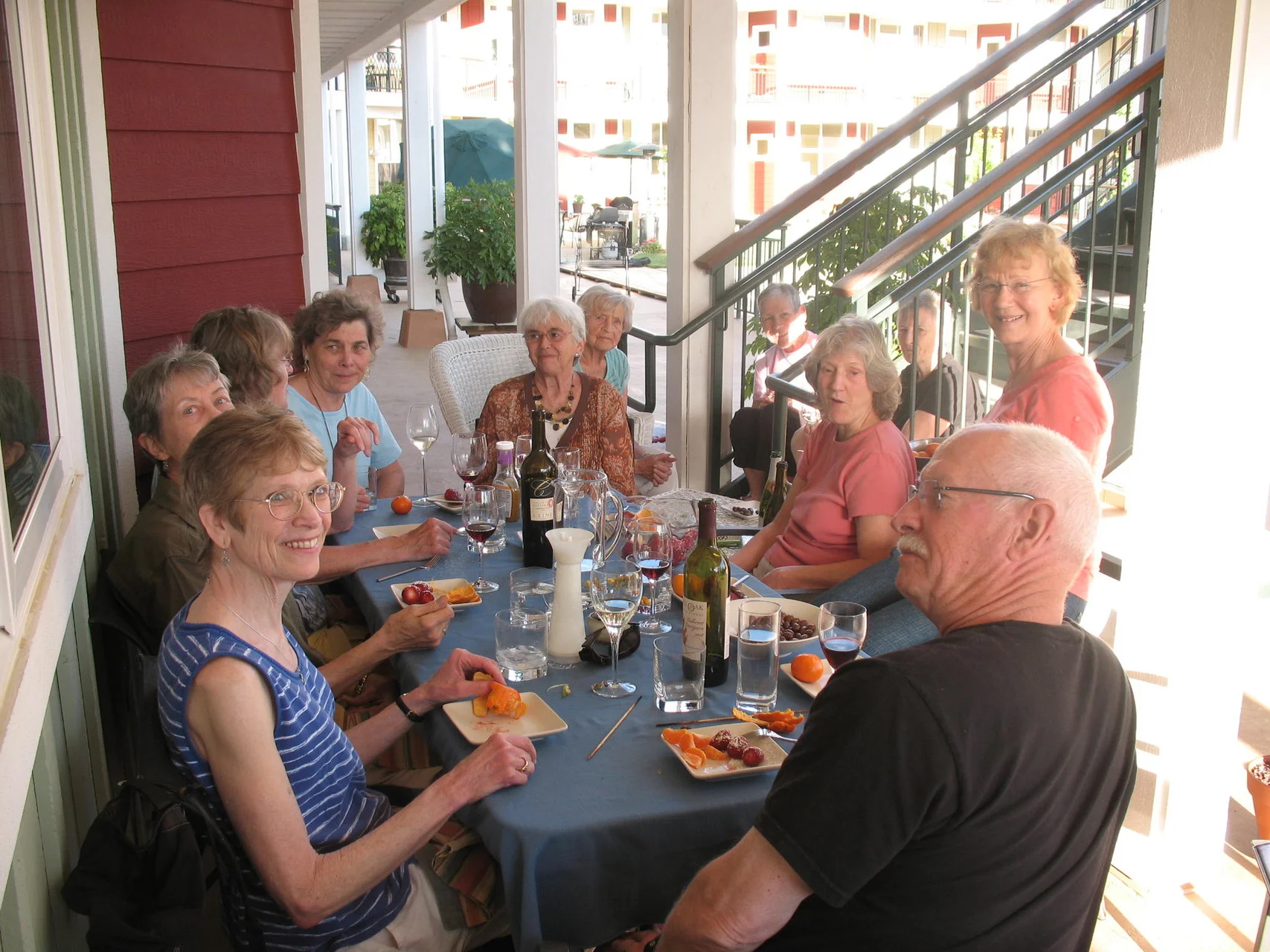
A New Look at Getting Older: Inspiring Adults 55+ at the Northeast Cohousing Conference

Wolf Creek Lodge, Grass Valley, CA. Architecture by McCamant & Durrett Architects
Older adults are discovering the value of taking control of their lives. Socially, financially, and environmentally it makes sense to live near people who care about you, but until you can work with others to create this scenario, it is just a good idea and nothing else. Senior cohousing communities, and groups inspired by cohousing, grow from that need to move things forward into a collective of organized and forward-thinking activists. The result far exceeds expectations, in many cases.
Being organized is being in control. While senior living facilities are taking steps to support their residents more than ever before, they still cannot offer what senior cohousing groups can. One way to begin this process is by taking Study Group 1 (Chapter 7 of The Senior Cohousing Handbook: A Community Approach to Independent Living ). After SG1, senior cohousing groups go through a series of workshops which develop cohesiveness and clarity within, along with setting expectations and later co-designing the community of their dreams. It is important to note at this point that none of this can happen without the group being on the same page and out of denial. Cohousing communities aren’t created by one visionary, but by many who share in the vision and, through consensus and being prepared, can decide what is best for all.
The result is a neighborhood that not only symbolizes their desire to take an active role in their aging scenario, but also their commitment to supporting, listening to, and living in community with each other. Learn more about senior cohousing at the Northeast Regional Cohousing Conference September 21 – 23, 2018. Cohousing expert, Charles Durrett, will lead Senior Cohousing 101, an all-day intensive exploring an effective solution to senior housing.
The intensive is limited to 20 people, so early registration is encouraged. Sign up here:
https://cohousingassociationoftheunite.regfox.com/northeast-cohousing-summit
Senior Cohousing 101 will explore the senior cohousing movement, both concept and its history, and why it is gaining popularity and proving to be a great solution to the senior housing challenge in the U.S. today. Participants will view examples of senior cohousing communities and, through group activities and discussion, will discover solutions for supporting themselves and their community age in place successfully.

For more information and an in-depth look at senior cohousing, Durrett and McCamant & Durrett Architects will be hosting an online facilitator training for Study Group 1 Aging Successfully. This 10-week course will begin Oct 10 with meetings once per week to learn how to organize local efforts for seniors, by seniors, in their area. Those interested in becoming a facilitator should contact Lindy at lindy.sexton@cohousingco.com.
Thank you Kelly-Moore Paints

Kelly-Moore Paints, we want to thank you for your donation to SAGE Cohousing International and to do so, we’d like to feature a current senior housing project of McCamant & Durrett Architects (another sponsor of SAGE) that is nearing completion.
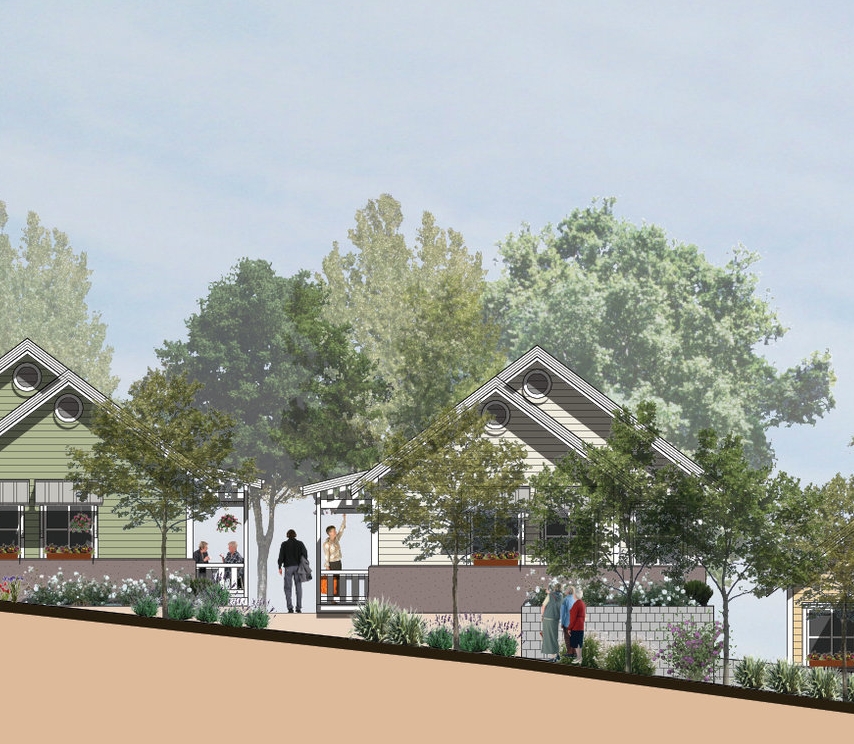
These images are of Kelly-Moore Paints delivering to a 70-unit senior housing neighborhood in Napa County, Northern California. This village will house those who are currently homeless, or at risk of being so, including 22 veterans, providing them a safe and supportive community, a roof over their head, and the privacy that everyone deserves. The exterior walls, now painted, give the future neighborhood dimension and warmth. It means the project is one step closer to be finished and we are excited to see this!


McCamant & Durrett Architects is focused on well-being through community and together with SAGE, we are dedicated to bringing this to older adults regardless of affordability. Through a very deliberate design, the community acts as a catalyst to bring residents together, to greet one another on the pathway, to share meals together. Once residents have moved into their beautiful homes, they will have the opportunity to experience their neighborhood coming to life. They will be inspired to help one another and accept the support of those next door.
By supporting SAGE Cohousing International, you support projects like this one and give the residents a positive future outlook. Kelly-Moore Paints, we look forward to continuing to grow our partnership, one that supports housing seniors who need it.
If you would like to explore a partnership with SAGE Cohousing International, please contact them at info@sagecohousinginternational.