
How Cohousing Adds To The Collective Good
Written by Jessie Durrett, daughter of cohousing experts and authors Charles Durrett and Katie McCamant.
In this very insightful essay, originally written in 2017, Jessie describes how growing up in cohousing positively influenced how she relates in the larger world. Thank you Jessie, for sharing your childhood experience with readers.
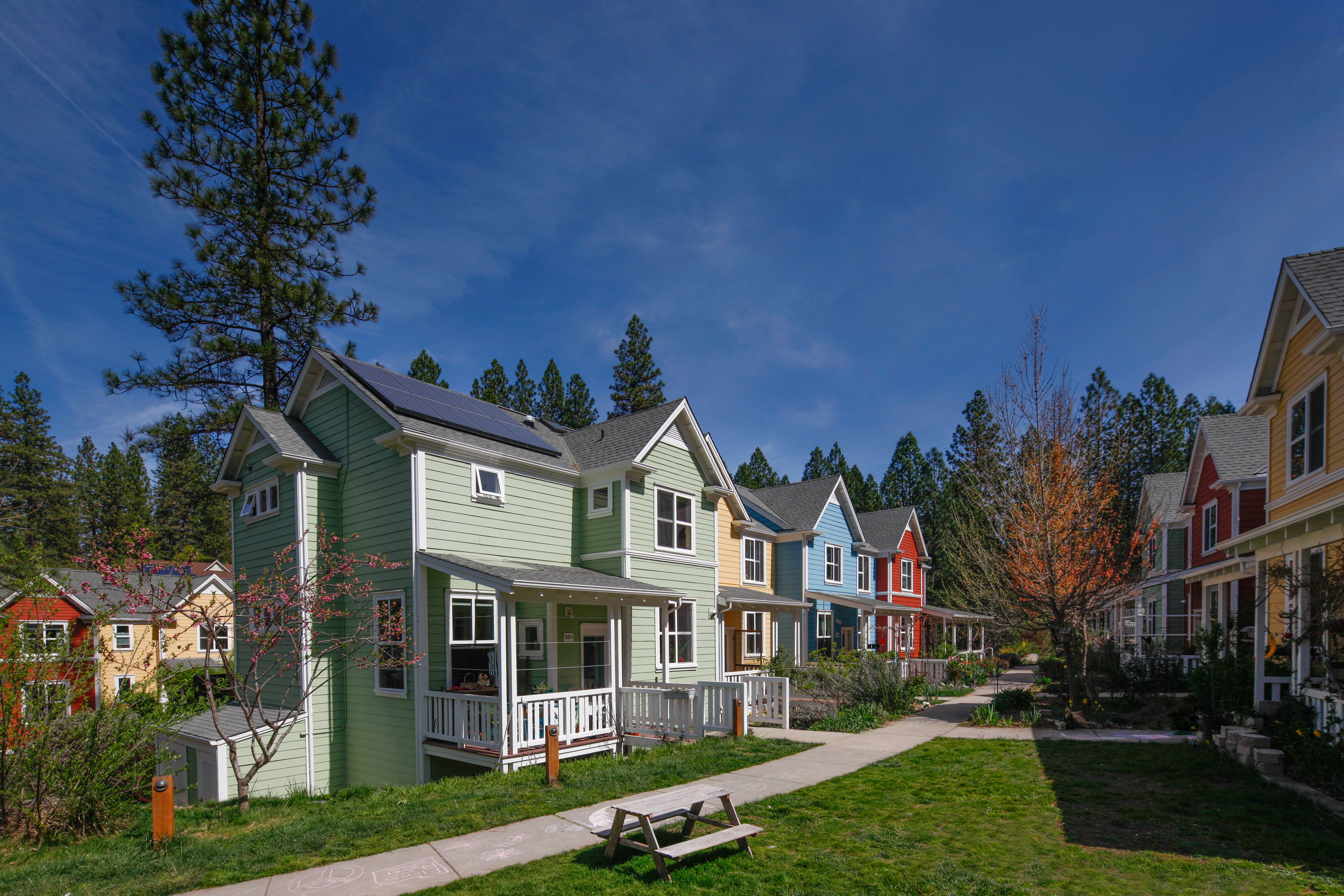
Nevada City Cohousing, Nevada City, CA
I am a big-picture thinker who contemplates how intersecting issues and policies affect real people, whether they share my office or are caught in a civil war on another continent. I take an inquisitive, enterprising, and collaborative approach to solving problems in my own life, broader community, and work.
I largely attribute my intellectual curiosity and prioritization of the collective good to my upbringing in cohousing (an intentional, intergenerational neighborhood of clustered private homes where people share meals and amenities). From an early age, I was participating in lively discussions about the Iraq War and cooking dinner for forty of my neighbors. Joining finance and landscaping committee meetings showed me the challenges and opportunities of building consensus and participatory decision-making. As a twelve-year-old, I advocated for community meal times that accommodated my athletic practice schedule and the needs of families with toddlers. My neighbors encouraged me to explore my interests, taught me about their careers, and invited me to their churches. Cohousing provided an exceptional venue for me to nurture my aspirations to effect positive change locally and globally.

Nevada City Cohousing, Nevada City, CA
Beyond living in cohousing, my parents dedicated their careers to designing, developing, and championing this type of multifamily housing. With them, I visited construction sites, attended planning commission meetings, and spent time with cohousing groups in Denmark, Japan, New Zealand, Austria, and Canada. Working in my parents’ office in high school, I compiled media stories and promoted cohousing to policymakers. Realizing the benefits that cohousing provided to me, I now lead workshops at national cohousing conferences on how to create a culture in which children can thrive. Community was the foundation of my upbringing, which explains the value I put on interpersonal skills and my conviction to advance the public good.
My desire to build community transcends personal, professional, and educational settings. As a Student Senator and Resident Advisor in college, I led efforts to improve the health services available on campus, arranged service projects, and worked to create inclusive learning and living environments. I have also become a leader within the ultimate frisbee community. After captaining my college team and playing for a club team in Washington, DC, I co-founded and captained a new women’s club team. We started from scratch in 2015 and quickly sold our vision to coaching staff and the hundreds of players who tryout each season. Today, we are ranked 27th in the country. I take pride in our collective drive and contributions to the national women’s ultimate scene. I have also fostered local community while thinking globally as chair of the Young Professionals in Foreign Policy’s gender discussion group in Washington, which analyzes gendered implications of conflict and informal mining in West Africa, among other topics.
The values and skills I learned through my unique upbringing in cohousing help me take on complex challenges in both personal and professional situations. As I advance my career in foreign policy, my deep-seated dedication to community will continue to inform my interests and decisions.
Original post from Alice Alexander can be found by following this link.
Remembering Pat Hundhausen
Original written by Pat’s family
Patricia Peters Hundhausen (1941 - 2018) - With family and friends by her side, Patricia Moore Peters Hundhausen passed away peacefully on December 1, 2018. She is survived by her husband, David; three children—Ellen (Robert Triebold) , Anne Catherine (Tim Shamey) and Christopher (Angela Taylor); three grandchildren—Kyra, Kelsey and Lily; and other relatives and countless friends. Although she is gone, Pat’s legacy of creating loving communities of people endures.
Born in Rochester, New York, on January 11, 1941 to Rachel Moore Cushman Peters and Stanley Bruce Peters, Pat grew up in Kent, Ohio and graduated from Kent State University High School in 1959. She completed a B.S. in speech and English education at the University of Wisconsin, Madison in 1964. She met David in 1965, when she appeared in several plays he directed at the University of Wisconsin Manitowoc Center. Having discovered more than an artistic match in each other, they married in 1966.
Pat started as an English teacher at Central Middle School in Waukesha, Wisconsin. In 1969, David and Pat moved to Madison for David’s graduate studies. In 1971, they moved back to Waukesha. To combat chronic fatigue syndrome, Pat learned transcendental meditation, which she faithfully practiced until her death. Motivated to serve others, she became a special education teacher at Summit House, a residential treatment center for emotionally-disturbed children in Oconomowoc, Wisconsin.
Pat earned a master’s degree in special education at the University of Wisconsin, Whitewater in 1974. She then began a distinguished 21-year career as a special education administrator and teacher, including serving a term as the president of a state-wide organization for special education teachers and administrators. She was the principal of a school she created at St. Rose’s Residential Treatment Center for Adolescent Girls in Milwaukee. While there, Pat implemented many innovative changes, including the development of a partnership with UW-Whitewater to provide St. Rose as a practicum site for
special education graduate students. She then served as the principal of St. Aemilian’s Residential Treatment Center for Adolescent Boys in Milwaukee. In 1986, Pat returned to the Waukesha Public Schools as a special education teacher until her retirement in 1996.
Pat and David were life partners and best friends. After retirement, they traveled extensively, touring and meeting people on 6 continents and 20 countries. Anyone who knew Pat will attest to her eye for capturing the people, places and moments of her travel in photographs. She often used her photos to stitch together descriptive narratives that brought others with her on her journeys.
In 2006, Pat and David moved to Port Townsend. There, they found a community of like-minded people in the Quimper Unitarian Universalist Fellowship (QUUF), many of whose members were aging. This got Pat thinking about how she could spend her final years living in an old-fashioned neighborhood rather than a retirement home. She envisioned building a community where people could age in place with the love and support of their neighbors. Drawn to a Danish co-housing model, Pat and David led a presentation at QUUF and Pat facilitated a course called “Aging Successfully.” Ultimately, Pat’s vision culminated in Quimper Village, a 28-unit, 42-person $10.2 million senior co-housing community that opened in November, 2017. It is the first senior co-housing development in Washington State and has since become a national model.
Pat touched the lives of her family, colleagues and friends. Those who knew her best fondly remember her as having endless curiosity, an artistic sensibility, a sharp wit, empathic listening skills and a passion for peace-keeping and helping others. Aside from her family, Pat leaves behind circles of close-knit friends from Wisconsin, QUUF, and Quimper Village who will dearly miss her calming presence, wisdom and friendship.
Pat’s memorial service will be held at 2 p.m. on Saturday, January 26, 2019 at Quimper United Universalist Fellowship, 2333 San Juan Avenue, Port Townsend, WA 98368. In lieu of flowers, contributions can be sent in Pat’s memory to establish a memorial grove of birch trees to honor deceased members of Quimper Village. Please send contributions, payable to “Quimper Village,” to Quimper Village, 3105 Sage Lane, Port Townsend, WA 98368.
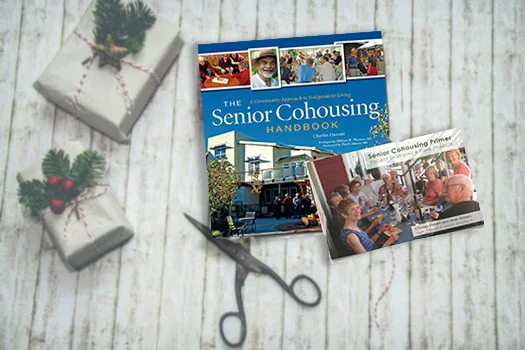
Give the Gift of Cohousing for the Holidays!

Look no further for your gift giving this holiday season! The Senior Cohousing Handbook: A Community Approach to Independent Living is a classic cohousing book and is used worldwide as a guide to getting senior cohousing projects started and sustaining them for decades to come. Senior Cohousing Primer: Recent Examples and New Projects is a perfect companion to The Handbook, giving folks an easy to understand look at the senior cohousing movement today. Together, these books are the first step to getting a senior cohousing project started in your area.
For a limited time, MDA will gift wrap the books for you, signed by Chuck Durrett, and drop ship them to your loved one’s upon request! This offer extends through Dec 17 and is valid in the U.S. only. Please contact Holly at MDA.admin@cohousingco.com to place your order if you live outside of the U.S.
Village Hearth Cohousing Ground Breaking
On Monday, October 29, 2018, Village Hearth Cohousing made monumental progress for the future of older adults in the LGBT community. They broke ground on their cohousing project, which means more than simply building a house. When built Village Hearth Cohousing will signify the success of a group of people who, together, designed the neighborhood of their dreams, one that is supportive and fun, where they know and trust each other. A community where they can be themselves.

Image courtesy of Village Hearth Cohousing
In celebration of the event, Charles Durrett, Principal Architect of McCamant & Durrett Architects had some words to say. McCamant & Durrett Architects was the architecture firm hired by Village Hearth Cohousing.
“On this occasion, one can be encouraged by the trajectory cast. That is especially true when those that you have learned to appreciate and to work with have set their sights on goals and are steadily making deliberate progress in that direction. In the case of Village Hearth, it seems that the only way that one can possibly predict the future is to in fact create it.
“Village Heath is well on its way. As the architect whose job it was to synthesize the needs, wants and desires of this group of discerning and capable co-creators, I’m happy to see each step move forward on the path to fruition. And I’m proud to be a part of it.” - Charles Durrett.
The seminal book came out in July 1988, 30 years ago

Written by Charles Durrett
Thirty years ago last month the book, Cohousing: A Contemporary Approach to Housing Ourselves, that introduced cohousing (and the word cohousing) to the US and the English speaking languages arrived at our doorstep in Berkeley California. An 18-wheeler from the printers in Tennessee negotiated our not-so-big residential street and un loaded 3,200 hundred brand new shiny blue, full-color books. Jim, the driver, his wife and trucking partner, and their ten-year-old “home schooled” daughter helped us unload the boxes of twenty books each and put them into our basement. Self-taught, (including Danish and writing), Self-published, self-designed, and now self-distributed. We had loans to payback, so we packaged them out at night after work. Seventy-six copies one night, went into our home-made packaging using scrolls of paper from various cohousing workshops that we had already begun having. Seventy-six copies to be shipped out the next day. Luckily word had already got out. People wanted the book, from Little Rock, Arkansas to Boston to Alaska to the far corners of everywhere.

Cohousing in Denmark.
It took so long to do that first book. Kate and I were introduced to cohousing in the fall of 1980 while attending the University of Copenhagen. Went back in 84/85 to write the manuscript (by hand), and then wrote and wrote, and wrote until it went to the printers in the early spring of 1988. Katie went back to Tennessee that spring to check the printing proofs — that’s how hands on this book was.
Then in August we went a green politics conference in the Sierras and noticed that one speaker after another was from Davis, California. So that following Monday, I jumped into our not-so-new Volvo and tooled the 70 miles to downtown Davis on that hot still August day. Stopped by a half dozen bookstores in that college town, all of them took the book on consignment or through the nation-wide book distributor that we had luckily negotiated to also distribute the books when bookstores called to order it.

The kids of Muir Commons today.
I went right over to the Village Homes Community Center and rented that out for a September Public Presentation. Then with flyers on every bulletin board in town, and flyers planted in the books in the various bookstores we started to get some real traction. No one had heard the word “cohousing” yet, so it was an uphill climb.
Then we met a couple, Kevin and Linda Cloud, that were willing to help organize the upcoming public presentation, and to help get the word out locally. We got all of the free calendar listings that we could.
About 80 people showed up. Katie and I took turns presenting, like we always did in those days. At the end of the presentation, the head of Davis City Planning Commission stood up to ask a question, but mostly to make a statement. “The next application for any large-scale multi-family housing project in Davis should include a cohousing community, right,” she said. Of course, we answered, “Yes.”
A developer planning a new 200+ housing project was also in the room and she knew it. This just goes to show that to find the right partners, you need to get the word out there. But that’s a story for another article. We knew that the first community in the U.S. had to work well for this model to catch on. So after some finagling, we got ourselves positioned to be the architects to design the site plan, the common house and the houses with the entire group. That lovely community is Muir Commons and they moved in in the summer of 1991.
Muir Commons received considerable press and we were off to the races in the U.S. It was the first model cohousing project built in North America and it remains a model project today. The availability of a comprehensive discussion, the book, model projects, millions of hours, and the covey of professionals who, with dedication and integrity, and non-profit organizations have impelled cohousing along. Now we have many more. We are well on our way to 200 cohousing communities in North America and well on our way to making cohousing a known option for housing, communities, and neighborhoods, exemplifying how neighbors can relate to each other and cooperate with and support each other in America.
Anyway, at 55 more projects, hopefully model communities and many more by others, the rest is history. But in this case this history of cohousing in North America is just the beginning.

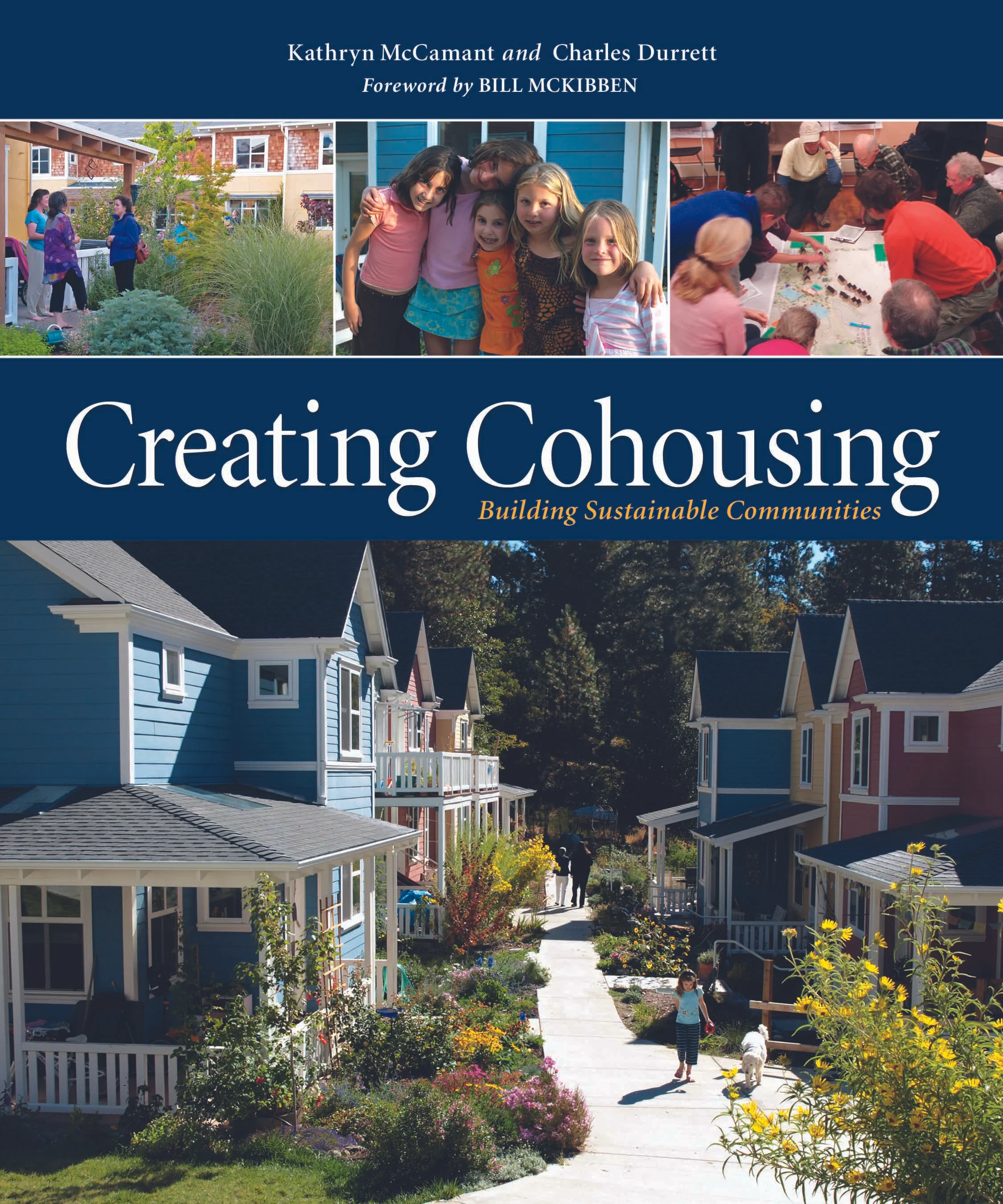
The book has been revised and is now called, Creating Cohousing: Building Sustainable Communities, and can be purchased through our website.