
Why Cohousing is Beneficial for Older Adults
Guest blogger Elise Morgan offers her thoughts on the value of cohousing, with a special focus on senior cohousing benefits.
Sharing the rent when in college or just starting out in your career is not uncommon. The lure of better accommodation and a shared responsibility for expenses is often the main driver for students to enter this kind of living arrangement. But what about the older generation? Many retirees are now considering cohousing for a wide range of reasons, not least of all the health benefits it can deliver. Below we take a look at why cohousing is beneficial for older adults.

Village Hearth Senior Cohousing residents in Durham, North Carolina enjoy a community dinner together.
The benefits of cohousing for seniors
Cohousing isn’t just about cutting down on expenses, although that can certainly help when we retire and are learning to live off our investments or a lower pension income. The myriad benefits of this arrangement are becoming more widely recognized in America and not before time either.
In many other cultures, the older generation is cared for by the younger; making multigenerational homes more common. This works to support the health and wellbeing of seniors. In our western culture, this is less common and could be a contributing factor to the growing health concern for America – loneliness.
Loneliness has been shown to contribute to poor health, increasing the risk of heart attacks, strokes, depression, anxiety and a host of other physical and mental illnesses. Cohousing provides the perfect antidote to loneliness – giving seniors a community of people who share spaces, look after one another and genuinely care about their neighbors..

Many senior cohousing communities provide for the activities residents design into the community. Shown here, active gardeners in Mountain View Senior Cohousing, California.
Freedom, independence and support
In senior cohousing communities, everyone becomes a caregiver, and receiver. Unlike an assisted living care home, there is no round the clock care. Instead, cohousing communities rely on a system of codependency. If someone can’t make it to the shop for groceries, another can take care of this. Similarly, if someone is heading away on holiday and needs a neighbor to watch their place another member of the community can do this and even ensure pets and gardens are looked after. These caring communities provide both support and freedom to the individuals within them.
The peace of mind and companionship provided to each member of the community is both an emotional benefit and one that aids physical health too. The meaningful relationships that are a necessity for cohousing communities to work provide the best solution to the health problems associated with loneliness. Community members still have the freedom they imagined for their retirement years without the isolation and higher risk of health issues that were unlikely to be part of their plans.
Cohousing arrangements have democratic decision making processes in place of hierarchical ones, meaning that each member of the community is encouraged to vote on how the spaces are managed. Community activities, additions to amenities, and care-taking duties are just a few of the areas where voting may be required. Activities that help build social capital are also common - pot luck dinners, movie nights and parties all provide opportunities for residents to get together socially and build friendships.

Cohousing offers as much privacy as you want, with as much interaction as you want.
Each individual within a cohousing situation still has their own personal space. These spaces can be decorated to an individual’s tastes and provide the necessary space for quiet activities or time alone. Home decor decisions, choices of furniture such as seating, bedroom furniture and mattresses that match their comfort needs are theirs alone. However, good cohousing communities ensure both personal and communal areas incorporate universal design concepts throughout all areas of a cohousing complex to support their aging habitants and some level of co-care for residents.
Although cohousing is still a relatively new trend in America, over 160 cohousing communities exist and a further 130 are being developed. For seniors looking to downsize and improve their health in their later years, cohousing is a lifestyle choice worth considering.
About the Contributor
Elise Morgan is a freelance writer from North Carolina who loves writing about realty, home design, and contemporary new ways to incorporate sustainability in our everyday lives. In her free time, she enjoys practicing yoga, and trying out new hole-in-the-wall restaurants around town.
THE BEST OF BOTH WORLDS: THE PROMISE OF COHOUSING
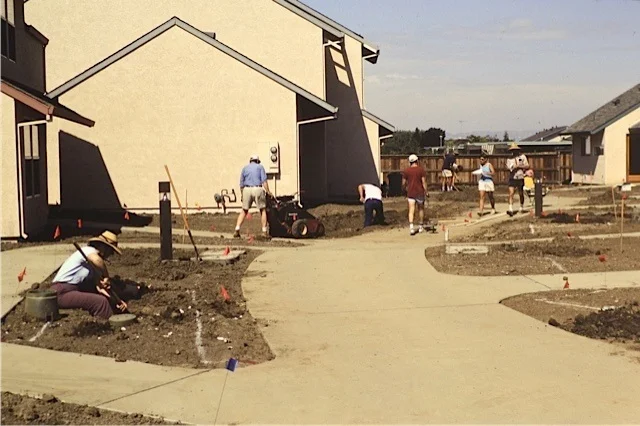
Muir Commons in 1991, credit Laurie Friedman
An article shared by filmmaker John de Graaf

Architect Charles Durrett and filmmaker John de Graaf are working on a film that tells the cohousing story through cohousing residents first-person observations. Photo, Pamela Biery.
Charles Durrett may be the best kind of entrepreneur, offering a product designed to address some of the biggest problems we face in America. With the tireless zeal of a much-younger man, the 63-year old Nevada City, California architect is always on the move, selling a concept called “cohousing” to audiences across the United States. Tall and lanky, but slightly stooped by a back problem he has had since childhood, Durrett describes his product as “the best of both worlds.” “With cohousing,” he says, “you can have as much privacy as you want and as much community as you want, and it has a lot of other advantages as well.”
There are now more than 150 cohousing communities scattered across the American landscape, primarily in the western states. Durrett has been a designer of 50 of them. When he started promoting the idea, there were none. He and his former wife, Katie McCamant, met in the early 1980s at the University of Copenhagen, where they were both architectural students. They returned to the United States determined to help spread the cohousing concept (they coined the term), which the Danes had developed in 1972.
The concept is simple: groups of people come together to design their own community, which includes private dwellings (single homes, apartment complexes and townhouses), each self-sufficient if small, with their own kitchens. But a large “common house” serves the entire community. Meals are offered there to everyone several nights a week. The common house has its own kitchen, and often, various meeting rooms, recreation or exercise rooms, children’s playrooms and other amenities including games and books, and a couple of guest rooms for visitors.
Members of the community are expected to cook at least once a month and share other everyday maintenance chores. Cars are kept outside the main living area, allowing for safe open space for children. Decisions are made wherever possible by consensus. Residents can spend as much time with others in the common spaces as they choose, always with the nearby option of privacy in their own homes.
Durrett and McCamant were impressed by the joy and sense of social connection they witnessed in Danish co-housing communities. The idea was slow to catch on there initially, but after a Danish TV documentary explored the subject, the number of cohousing communities mushroomed. Now the country of five million people boasts 700 such communities.
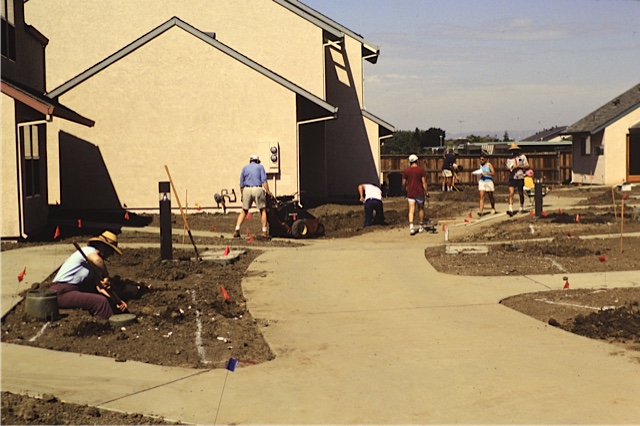
Muir Commons in 1991. Muir Commons in Davis, California was America’s first Cohousing community. Photo by resident, Laurie Friedman.
MUIR COMMONS: AMERICA’S FIRST CO-HOUSING COMMUNITY
Back in the US, Durrett and McCamant started promoting cohousing with lectures and a handbook. Together with friends, they planned a cohousing community in Emeryville, California, near their home in Berkeley. They moved into it in 1992. But by then, another California city, its plan developed together with McCamant and Durrett, was already boasting a functional community. It was easier and quicker to get permits and loans for the project in Davis, a city known for its commitment to sustainability (and its Danish-like propensity for bicycling!), and Muir Commons Cohousing opened there in 1991.
I am currently producing a film on cohousing, featuring Durrett and four communities in the Sacramento area. With photographer Doug Stanley, of “America’s Deadliest Catch” fame, I visited Muir Commons recently. Two of the original residents, Jane McKendry and Laurie Friedman, showed us around. Old photos of Muir Commons under construction show a place devoid of trees and greenery, but after 28 years the homes are almost invisible behind the lush canopy of trees, shrubs and flowers that offers welcome shade in Davis’ steamy summer climate, where temperatures commonly hit 110 degrees. Lines of bicycles, the Davis staple, can be seen throughout the community. Jane and Laurie showed us the orchard, which provides fruit for the entire community, and the small but robust garden plot. And with her husband, Ray, Jane played a mean folk guitar for us; many residents, she said, have similar skills that they share freely with others.
The early Muir Commons rang with the voices of children, but there are fewer of them now because most of the original residents, happy with their living arrangements, have stayed put and are nearing retirement or older. Their kids have moved on. A lovely, tree-shaded children’s playground on the property sat empty while we were there. But new families will be coming, Jane said. In keeping with Davis’ environmentalism, Laurie showed us the shed filled with bicycles, and the parking lot outside the community. Many parking spaces include electric charging stations.
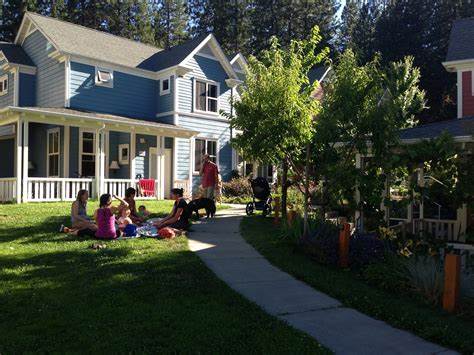
Nevada City Cohousing is a truly multi-generation community. Photo by Charles Durrett.
THE BENEFITS OF CO-HOUSING
From Muir Commons, we moved on to Nevada City’s Coho community, where Durrett and McCamant now live. Set on the edge of an impossibly charming Gold Rush town, it’s a beautiful village of pastel individual homes, a modern airy common house, and even a shared swimming pool. Flowers are everywhere. At Coho, many of co-housing’s benefits were clear. An array of solar panels heats all the homes and common space and produces a surplus of electricity for the power company, PG & E, keeping electricity bills low and sometimes even resulting in rebates. Children played happily in the pool, on the walkways and on the terrace of the common house. Several residents provided testimonials to the value of living there.
Stuart and Margaret Matthews family spoke of how there were numerous friendly neighbors to help look out for their two small children. Nancy Newman described the sense of support older residents received, especially at the passing of a spouse. Ingrid Holman, a single mother originally from Germany, told of the help she received in raising her 13-year old son, Christophe, who obliged us by masterfully playing “Pirates of the Caribbean” on the piano, and gushed eloquently about living in cohousing and having many friends so close by.
Interestingly, Ingrid first learned of cohousing ten years earlier when she picked up Robert Zeuner, an elderly man who was hitchhiking in the next-door town of Grass Valley. She offered to take him home and he told her he lived in the Nevada City cohousing community. She knew nothing about it but was intrigued—it seemed like something she might find in her native Europe—and Robert offered to show her around. Ingrid was hooked and found a rental in the community not long after. She’s been there ever since and is now buying her own place. Robert, meanwhile, lives right across from her, with his partner Bruce. They’ve become fast friends.
Coho boasts an attractive garden of vegetables and flowers, on the site of an abandoned hydraulic gold mine. Tony Finnerty, one of the gardeners, told us that the entire area was a maze of tall manzanita bushes and rocky ground when the community was built 15 years ago. The soil and compost had to be brought in. Signs in the garden let residents know when crops are ready and they are free to pick what they need. James, another resident, showed us the common workshop out by the parking lot, where he often crafts furniture. With such facilities, residents don’t need to own all their own tools, another cost-saving advantage of cohousing.

Conference room and library at McCamant & Durrett’s Nevada City office. Photo by Pamela Biery
SOCIAL CHANGE ARCHITECT
Doug and I visited with Chuck Durrett in his downtown Nevada City office, on the second floor of an old building dating to the 1800s. The office is small and filled with blueprints, artists’ conceptions of co-housing communities and the three-dimensional models Durrett loves. Christine Fantle, one of his assistant architects who also lives at Coho, showed me photos of many cohousing communities the firm had designed.
Durrett grew up in the nearby gold mining town of Downieville, a picture postcard village that attracts tourists as lamps do moths. He loved the feeling of growing up in a village where everyone knew everyone else, he says, and he’s found it again in cohousing. He bemoans the fact that when counterculture hippies discovered the Nevada City area in the late 1960s, they built their homes scattered all through the nearby woods. He remembers a Native American friend criticizing that pattern of settlement. “You white people build all over hell and back,” the friend told Durrett, “and you have no concept of the village.”
Cohousing offers a different model, much more sustainable than the counterculture’s, where people had to drive to get anywhere. Cohousing residents drive much less than typical Americans and use far fewer resources, especially water. And the Coho community is much safer from wildfires, a new normal in the age of climate change, than rural dwellers are.
But Durrett is clear: the biggest benefit of cohousing is that it offers community in an age of separation, when much of America suffers from loneliness and subsequent depression, often dangerously staved with opioids. This is particularly true for seniors, the fastest rising segment of the cohousing population in the US. Many senior co-housing communities are now being built. We visited one such community, Wolf Creek Lodge in neighboring Grass Valley, California. Like many cohousing villages, it has about 60 residents, but all are getting along in years.

Wolf Creek Lodge Senior Cohousing, Grass Valley, California.
SENIOR COHOUSING
When we were there, two couples were competing against each other in a lively game of petanque, a French sport much like bocce ball. Their neighbors sat on the steps of the common house, cheering them on. Durrett says seniors encourage each other to be active; in such communities it’s easy to find a partner to go walking with. It keeps everybody younger, and regular social contact with other residents provides an antidote for the chronic loneliness that a recent study showed 40 percent of senior Americans suffering from. Wolf Creek Lodge is an apartment-style complex with two wings radiating in a V from the common house. Every home has a porch where residents can look out at the neighbors, who they all know well, and shout out, “Hey, do you want to visit?”
Jacque Bromm, a youthful looking woman who loves to travel, showed us her beautiful apartment (more like a condo since she owns it) filled with memorabilia from her trips. Books about John Muir and the nearby Sierra Nevada mountains lay on her coffee table. Jacque loves the sense of community at Wolf Creek, but also the opportunity to travel knowing that neighbors will watch her home. Her friend, Casey Travis, a painter, uses her equally lovely apartment as a studio as well as a home. She says she gets lots of support for her artwork from other residents, who have many special talents of their own to share.
Wolf Creek residents are giving back to the town of Grass Valley, helping its parks’ department construct a trail down to and along the nearby burbling creek. We walked down 200 steep steps to the creek with Bob Branstrom, a resident and project leader. Eventually, switchbacks and pavement will make the trail accessible to all of the seniors in the community, even those in wheelchairs.
THE FUTURE
At the end of our trip, we went with Charles Durrett to Fair Oaks, a Sacramento suburb, where a new community of townhouses is being built. We visited with a young couple, Andrew May and Rachel Yamada, who are excited about moving in (with daughter, Freya and Rachel’s mother), to the home they were watching being built. It’s one of many cohousing communities now under construction, but Durrett wants there to be a lot more, and as soon as possible. He’s excited by many of the new communities, including one in American Canyon, California full of small houses for homeless veterans. Durrett is deeply interested in ways to make cohousing more affordable for the poor and to increase diversity of all kinds. Many cohousing residents are activists with a liberal bent, but after a visit to new project in Stillwater, Oklahoma Durrett says conservatives are taken with the idea as well.
He’s not Pollyannaish about it, however. Cohousing isn’t for everyone. You have to be willing to work with others, compromise, and, especially, listen to each other, sometimes during long meetings. That was the hardest part for Durrett to get used to, having grown up like the rest of us in an individualistic culture where if you don’t like something you just walk away. “I’ve come to realize that other people have some good ideas too,” he says with a smile. Some people never adapt to the consensus approach and drop out, but the attrition rate is dramatically less than that of other American communities. The great majority of residents stay on, happily. Creating a cohousing community can be tough in other ways. Groups looking to establish a community may quarrel over what land to purchase and some, especially in areas where the idea is new, may wait a long time for city permits and bank loans.
But the trend is distinctly positive and establishing the communities is getting easier. Charles Durrett and Katie McCamant saw the future in Denmark in 1980. Cohousing’s offer of community as well as privacy, has proven immensely popular and offers a way out of the lonely, unsustainable housing patterns that have for too long been the norm in American life.
John de Graaf has produced dozens of award-winning documentaries including the PBS hit, Affluenza. He is currently directing The Best of Both Worlds, a short film about co-housing.
You can support this film by visiting www.gofundme.com/cohousing-film and making a tax-deductible contribution.

Muir Commons Cohousing in Davis California today. Photo by Laurie Friedman.
Cohousing For Seniors: A Solution for Today
Charles Durrett is busy. He has been designing, teaching and building cohousing communities in the United States since he brought the concept here from Denmark with Kathryn McCamant some three decades ago, but this year things are different. “Instead of working on demonstrating the value of cohousing, our firm is occupied keeping pace with a number of communities under development. I’m also just completing a new book to help others initiate their own cohousing community.” observes, Durrett.
Cohousing is just now really hitting its stride in the United States. The US Cohousing Association reports that there are currently 165 established cohousing communities with another 140 forming. Durrett himself is working on a dozen projects in the United States and Canada in different stages of development.
Cohousing is a planned community consisting of private homes clustered around shared space. While each attached or single family home has traditional amenities, including a private kitchen, there are shared spaces that reflect each community—often with shared community kitchen, lodge house, gardens and outdoor spaces. The legal structure is typically a homeowner association or housing cooperative. The Cohousing Company (TCC) designed the first US cohousing community in Davis, California, completed in 1991.
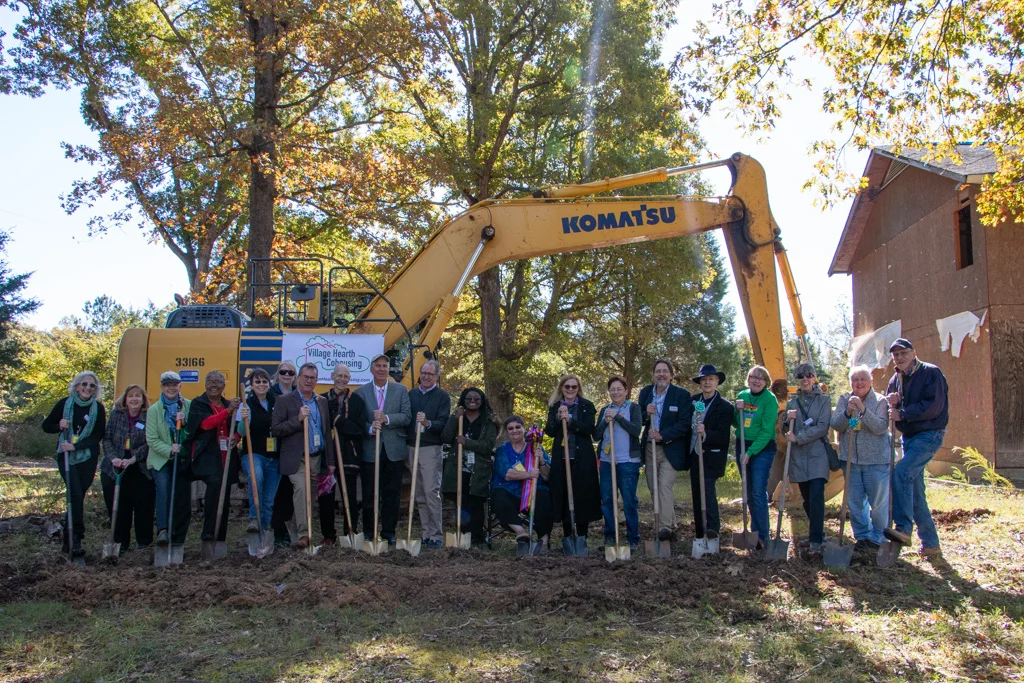
Affordable living and sustainable housing concerns are major issues confronting every age group in America today. Healthy, educated, proactive adults want to live in a social and environmentally responsible community. They also seek to maintain a quality lifestyle while stretching their dollars further into the future. Millennials looking for homes are finding traditional single family homes out of reach. Durrett is seeing family and specific populations building their own lifestyle-based housing, like LGBT Senior Cohousing in Village Hearth Cohousing in Durham, North Carolina, a community Durrett has helped initiate. This will be the first LGBT senior cohousing project in the US, and maybe anywhere.

Village Hearth Cohousing celebrated their groundbreaking. Photography by Luke Hirst.
Writer Pamela Biery caught up with Durrett and quizzed him on the “hows and whys” of 50+ cohousing.
Q: What are some of the unique characteristics of 50+ cohousing communities? A: One word: proactive. These communities are filled with individuals who are choosing to take control of their destinies through planning, not leaving things up to chance. For instance, accommodations are made for shared caregivers to live on site and long-term mobility and access issues are examined. Just the process of thinking things through as a group changes cohousing participants, preparing them with realistic views of their future. Q: What are some mature adult cohousing benefits?
A: Emotional well being, saving money through shared services and community and maintaining independence for much longer than is commonly possible. Today, more Americans live alone in their later years, a significant health concern. This is a reflection of our culture, and one that we have the power to change. New York University sociology professor Eric Klinenberg notes that social attitudes need to progress so older people can stay connected as they age.
“Our society is evolving quickly, but probably not quickly enough.”
The biggest cohousing benefit for any community is living with kindred and having a number of close friendships. But it cannot be overlooked that cohousing costs significantly less than other senior facilities and gives the longest possible independent lifestyle—good for living a full life and conserving financial resources.
Q: How does cohousing reduce an individual’s carbon footprint?
A: Cohousing takes an individual out of the single home mindset. Top of mind: better lifestyle, greener lifestyle. Seniors realize that it’s really okay to leave their ranchette and move closer to town knowing they will be living with people they are comfortable with and that they are creating a home they can easily maintain for the next 20+ years. Americans drive some 5 billion miles caring for seniors in their homes (Meals on Wheels, Whistle Stop Nurses, and so on). In our small, semi-rural county in the Sierra foothills, on-demand buses alone has made 60,000 trips in massive, lumbering, polluting vans-buses – usually carrying only one senior at a time – schlepping a couple thousand seniors total over hill and dale to doctor’s appointments, to pick up medicine, or to see friends. In our cohousing community of 21 seniors, I have never seen a single on-demand bus in the driveway. In cohousing it happens organically by caring neighbors: “Can I catch a ride with you?” or “Are you headed to the drug store?” This alternative is much more fun and inexpensive for all involved, and much less damaging to the environment. Site location that allows for walkable lifestyles is a large factor, as well. Wolf Creek Lodge, a senior cohousing community with 30 units, built on 1 acre, is within walking distance of downtown Grass Valley, population 12,000. Nevada City Cohousing is also a short stroll to the downtown historic district. Cohousing is a mind shift that is not just greener—it makes a better life.

Residents at Wolf Creek Lodge celebrate birthdays with one another!
Q: How would cohousing affect my retirement planning?
A: Cohousing is a proactive, realistic way of addressing issues. It's an ultra-responsible approach to assessing how to provide for one’s own future. Everyone in the process is dealing with understanding that mortality is real and that aging successfully means examining the whole person benefits—economic, emotional and physical well being.
Cohousers choose to place themselves in a fun, life-affirming and embracing community. The big thing here is that by living independently longer, money is saved at every juncture, so by taking control, resources can go much further. Turns out that an independent, quality life costs less than facilitated retirement.
Q: What kind of start-up process is involved?
A: First off, contact a cohousing company. They will find out what considerations and requirement are needed for your specific area. They will also be able to guide you in forming a group. Next, read the book. Then start talking to friends. Host a presentation in your town, secure a site. You may already know some of your new cohousing neighbors.
—Charles Durrett
Learn More About Cohousing
Hear Charles Durrett Speak at The National Cohousing Conference May 30-June 2, 2019 at the Downtown Portland Hilton.
Watch for his new book, profiling the successful development of Quimper Village Cohousing in Port Townsend, Washington and see other cohousing books here.
Cohousing events and speaking engagements, along with news on developing communities, can be found here.
Sign up for Cohousing Co. news and occasional updates, including the new book release, with the working title, Quimper Village Cohousing: How 40 Seniors Made A New Neighborhood to Suite Their Real Needs.
Growing Up in Cohousing
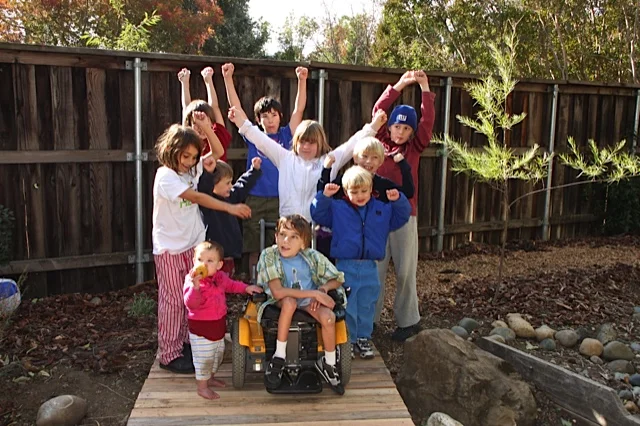
Lindy Sexton sat down with Joy Castro-Wehr in 2016, who was at the time a senior in high school and lived in Nevada City Cohousing with her family. She is a social activist and a worldly-thinker, and contributes much of this to living in cohousing.

Frog Song Cohousing in Cotati, CA. Architecture by The Cohousing Company
Lindy: How long have you lived in cohousing?
Joy: Since I was 8. My family was aware of cohousing and had a cohousing-esque relationship with neighbors in Oakland; we took down the property fence, had a common space, and shared things. We moved to Nevada City when I was 4 because of public Waldorf school. And lived on a large property in Nevada City. When we moved into cohousing, I initially missed my big backyard, but soon realized that I used the cohousing acreage behind the houses much more than my old backyard because I had more friends to share it with.
Lindy: What do you like about living in cohousing?
Joy: In cohousing, I am so filled with love, there is no room for anything else. Challenges do exist, but it is easier to deal with these challenges because of support from cohousers. Just as my neighbors have influenced me with their worldly perspectives, they also have taught me how to have opinions and ways to voice those so others aren’t offended. Most people living in cohousing are there because they share the same interest in and desire to contribute to community. Otherwise, why live in cohousing? Relationship building is much easier because of proximity in cohousing. It’s a lot less work to say “hi” because my neighbors are right across the sidewalk.
Lindy: How do you contribute to the community in your cohousing?
Joy: Every person in the community has an aspect of cohousing that they connect through. For some, it’s gardening. For others, it’s going on skiing trips with neighbors. The dinner table is my family’s “place of connection”. So common meals are how we become close to others around us. In fact, just the other night, I had a deep and inspiring conversation with some neighbors at a common meal.
I also know that the kids look up to me. I babysit for many of my neighbors and know the kids in my neighborhood like they were family. I am accountable for how I act around the three-year old that lives next to me, which is one of the reason’s I choose not to do drugs and get drunk.
Lindy: Do you still experience challenges outside of your community, for instance, peer pressure at school?
Joy: (sigh) Outside of our cohousing community, I deal with the same peer pressure that all teens deal with. Because of my family and cohousing, I feel that I am not missing anything in my life. I’ve learned to ignore the peer pressure I know is not good. I simply do not have time to pursue something that alters my sense of being.
I never needed to look beyond my community because there was always someone, some experience to fill the gap. People often get pressured into drugs and abuse alcohol because they are “lacking” in something. It’s like Play-Doh, filling holes in someone’s life, and Play-Doh doesn’t last for long. Cohousing fills in some of those holes. And community is more resilient.
That said, cohousers like to have social time and have parties. There is a group of cohousers that like to brew beer in our cohousing. They get together and play pool and try their new brews. And every once in awhile, someone will bring a nice bottle of wine to a common meal and shares it with others. Treating alcohol like a social treat, rather than a crutch teaches kids that it’s okay to appreciate every once in awhile.

Nevada City Cohousing in Nevada City, CA. Architecture by The Cohousing Company
Lindy: Why has cohousing made such an impact on your life?
Joy: I treat many of them like my own grandparents and relatives, but it’s a lot less work to say “hi” because they’re right across the sidewalk. This also means that I have gotten so many different perspectives on life – politics, culture, family, etc. Rather than believing everything my parents’ believed, I had other people to draw experiences from. I was surrounded by different perspectives of people who respected each other’s opinions.
Thanks to Joy for her insight in the abundance of cohousing! If you or someone you know has been influenced by cohousing and you’d like to share it with us, please let us know!
How Cohousing Adds To The Collective Good
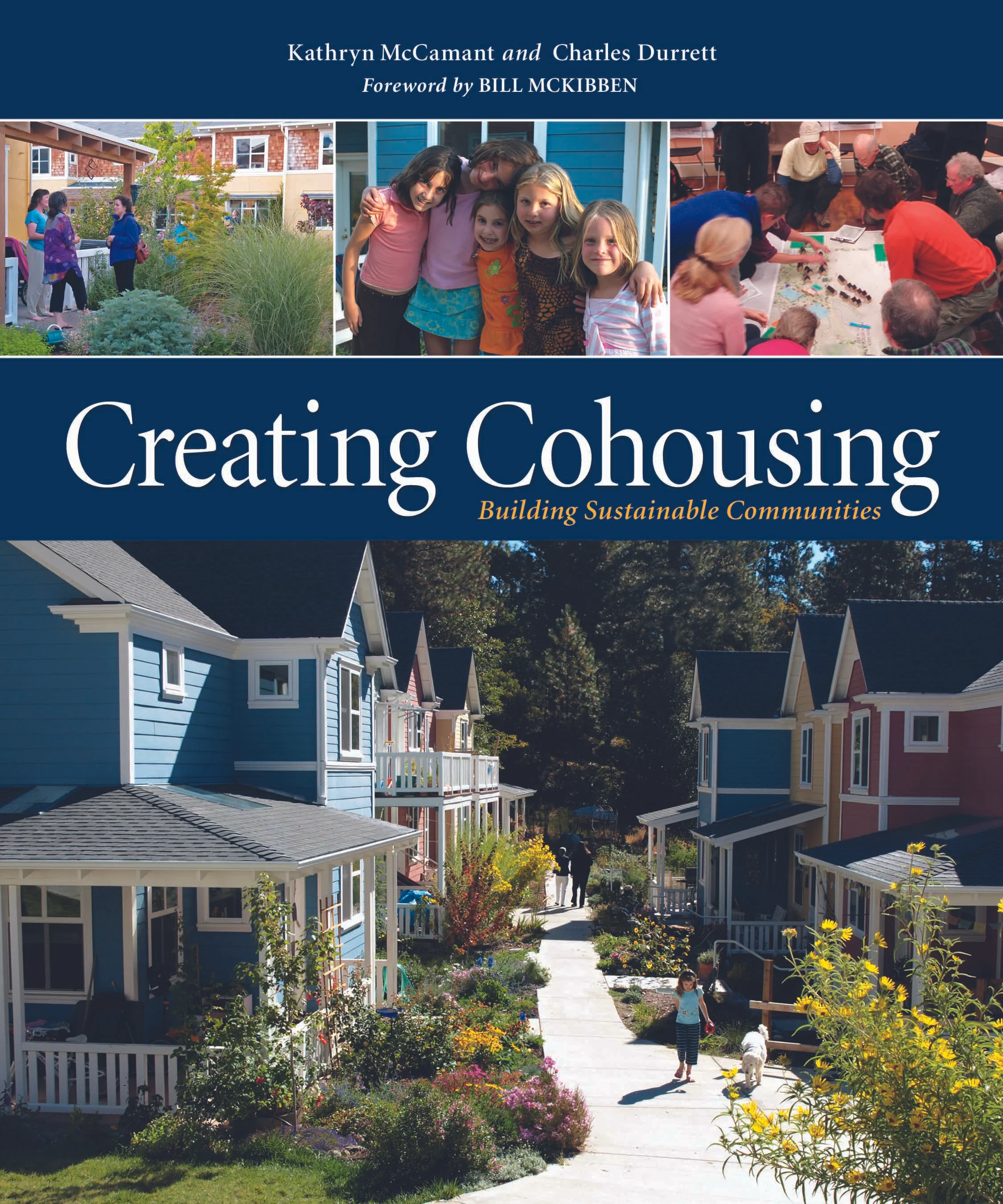
Written by Jessie Durrett, daughter of cohousing experts and authors Charles Durrett and Katie McCamant.
In this very insightful essay, originally written in 2017, Jessie describes how growing up in cohousing positively influenced how she relates in the larger world. Thank you Jessie, for sharing your childhood experience with readers.
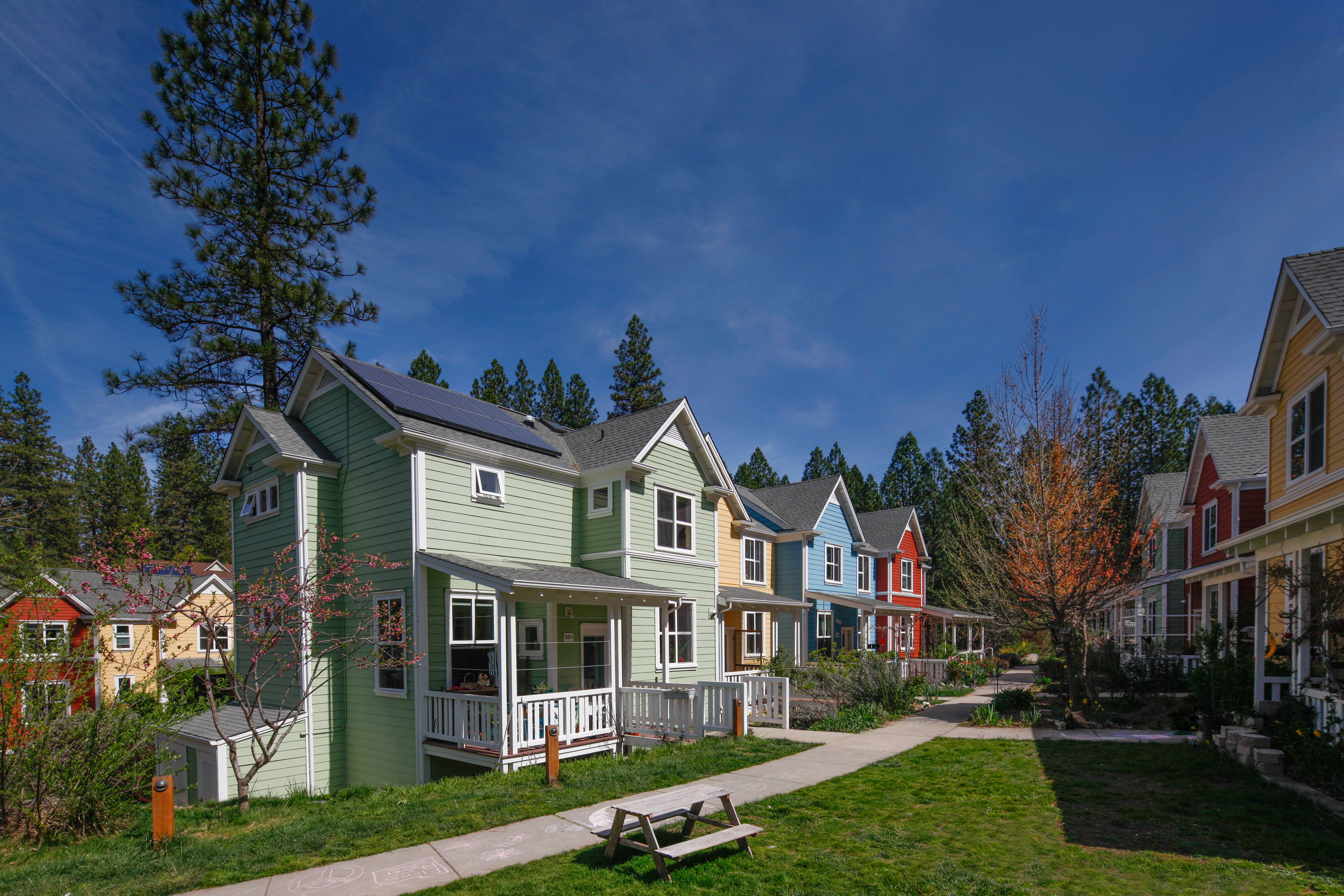
Nevada City Cohousing, Nevada City, CA
I am a big-picture thinker who contemplates how intersecting issues and policies affect real people, whether they share my office or are caught in a civil war on another continent. I take an inquisitive, enterprising, and collaborative approach to solving problems in my own life, broader community, and work.
I largely attribute my intellectual curiosity and prioritization of the collective good to my upbringing in cohousing (an intentional, intergenerational neighborhood of clustered private homes where people share meals and amenities). From an early age, I was participating in lively discussions about the Iraq War and cooking dinner for forty of my neighbors. Joining finance and landscaping committee meetings showed me the challenges and opportunities of building consensus and participatory decision-making. As a twelve-year-old, I advocated for community meal times that accommodated my athletic practice schedule and the needs of families with toddlers. My neighbors encouraged me to explore my interests, taught me about their careers, and invited me to their churches. Cohousing provided an exceptional venue for me to nurture my aspirations to effect positive change locally and globally.

Nevada City Cohousing, Nevada City, CA
Beyond living in cohousing, my parents dedicated their careers to designing, developing, and championing this type of multifamily housing. With them, I visited construction sites, attended planning commission meetings, and spent time with cohousing groups in Denmark, Japan, New Zealand, Austria, and Canada. Working in my parents’ office in high school, I compiled media stories and promoted cohousing to policymakers. Realizing the benefits that cohousing provided to me, I now lead workshops at national cohousing conferences on how to create a culture in which children can thrive. Community was the foundation of my upbringing, which explains the value I put on interpersonal skills and my conviction to advance the public good.
My desire to build community transcends personal, professional, and educational settings. As a Student Senator and Resident Advisor in college, I led efforts to improve the health services available on campus, arranged service projects, and worked to create inclusive learning and living environments. I have also become a leader within the ultimate frisbee community. After captaining my college team and playing for a club team in Washington, DC, I co-founded and captained a new women’s club team. We started from scratch in 2015 and quickly sold our vision to coaching staff and the hundreds of players who tryout each season. Today, we are ranked 27th in the country. I take pride in our collective drive and contributions to the national women’s ultimate scene. I have also fostered local community while thinking globally as chair of the Young Professionals in Foreign Policy’s gender discussion group in Washington, which analyzes gendered implications of conflict and informal mining in West Africa, among other topics.
The values and skills I learned through my unique upbringing in cohousing help me take on complex challenges in both personal and professional situations. As I advance my career in foreign policy, my deep-seated dedication to community will continue to inform my interests and decisions.
Original post from Alice Alexander can be found by following this link.