
Valley View Senior Housing receives certificate for Green Building
The Cohousing Company is pleased to announce that our recent project in American Canyon, California, has received the designation of being ‘Green Point Rated’ for its environmentally conscious design. The certification was provided Build It Green, a membership supported non-profit that promotes healthy, energy and resource efficient homes in California.
Construction was completed on Valley View in 2019, and the community includes 70-units that house low-income residents, all over the age of 55. From the beginning, the design was intended to be as environmentally conscious as possible. Important elements include:
· A passive heating and cooling system that includes units with double-pane windows on each side to slow heat from entering the houses
· Thick gypsum board and concrete slabs for thermal mass, taking advantage of diurnal temperature variations
· Cool roofs to reflect and emit heat
· Large porch designs that include ample shading
· Creative use of outdoor space that takes advantage of the moderate American Canyon climate
· A solar-covered parking area that helps offset the energy consumption of the community
· Native and drought-tolerant plants throughout the site, ensuring that watering requirements are as low as possible.
Valley View is also set up for a graywater irrigation system that will take wastewater from washing machines and repurpose it for irrigation use. This feature hasn’t been utilized yet but will in the future. They will also be receiving recycled water from the city in the future for irrigation use. Permeable surfaces are also located on the site, helping to replenish groundwater and aid in erosion and pollution control by allowing runoff to enter the underlying soil.
The rating system is administered by independent professionals who are trained and certified by Build It Green, and we’re proud to have met their high standards for sustainability! Cost control is always an important factor in our projects, and this award demonstrates that cohousing can be done in an environmentally conscious way and still be cost effective.
A Special Holiday Offer from the Cohousing Company
What could be a nicer gift than a new idea, or the impetus to change or grow? Books offer the power to think differently, invite culture change and unhinge stuck patterns.
It’s tough to sort through all those Black Friday deals, but how about bringing an old notion back into circulation? Books are wonderful holiday gifts—they are easy to wrap, ship, personalize and even re-gift! Plus they let you express something you care about to someone you know.
Let this holiday season offer more then turkey, lots of pie and spendy gifts. Books are the perfect solution to holiday giving that have the potential for meaning, and hey, if if you miss the mark, there is nothing easier to re-gift than a book. On the other side of this equation, books are also amazingly easy to personalize. What could be a nicer gift than a new idea, or the impetus to change or grow? Books offer the power to think differently, invite culture change and unhinge stuck patterns.
Just now many people are talking about living, cohousing, senior lifestyles and just how to find affordable housing or meaningful community. The Cohousing Co., with McCamant & Durrett Architects, is making it easier than ever to give books with new ideas that have the power to change culture and enrich lives.
Cohousing and coliving have been much in the news over the past year with references to “The Golden Girls” as retirees look for new ways to find meaningful and affordable ways to live during retirement. Then of course, there are families who want more than an impersonal, isolated suburban lifestyle.
If you or someone you know has thought about cohousing, is up for a life change or simply wants to learn about new trends, a book on cohousing could be the gift that opens a mind and shares real possibilities.
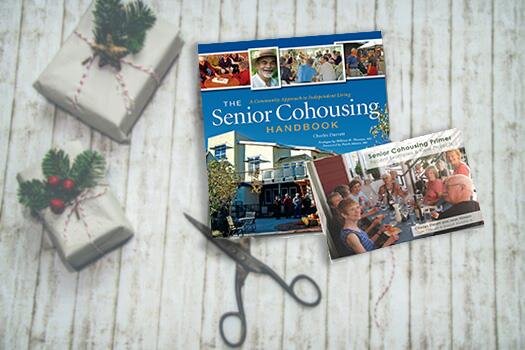
The Cohousing Company and McCamant & Durrett Architects want to help you share this big idea with a time and money saving promise: cohousing books The Senior Cohousing Handbook: A Community Approach to Independent Living or Creating Cohousing: Building Sustainable Communities can be sent to your friends gift-wrapped with no shipping or wrapping fees anywhere in The US or Canada. McCamant & Durrett Architects will wrap and send the book for free to the address you specify from November 25 until December 31, 2019. Please use the offer code COHOUSING on your order at http://www.cohousingco.com/products.
Is Communal Living A Better Option For Seniors To Have An Active Lifestyle?
By Guest Blogger, Jordan Fuller

Photo by Garry Knight
As we age, nothing is more important than taking care of our health. Now, that doesn’t mean we should only focus on our physical health. As the cliche goes, we must care for our mind, body, and soul to fully enjoy life as a senior.
But for most seniors, finding the best way to live could be the biggest boost to their overall health and life satisfaction. When faced with the choice of living alone or inside a communal environment or cohousing, it is vital to understand that experiencing life with others can lead to more happiness, a more active brain, and better nutrition.
Why Should I Live in a Community?
A study produced by the New England Journal of Medicine in 2010 found that individuals who continue to participate in social activities with friends and families as they get older show higher retention of cognitive abilities.
The type of programs, routinely found in senior living communities, allow residents to stay active. It is helping them to preserve a higher quality of life that keeps the mind sharp and the body active. There are some helpful activities such as playing golf, swimming, exercising, etc. that keep the seniors' lifestyle active.
There are several benefits to living in a senior community worth highlighting.
The first is the assortment of programs that are available to residents. The programs are designed to keep the individual active in a communal setting that encourages interaction with others. Even if you suffer from mobility or cognitive issues, the programs are built to be accommodating to everyone.
Another benefit of living in a communal environment is the opportunity to give back to other populations through volunteering. From reading to creating crafts, to helping children or other seniors at local hospitals, volunteering can be excellent for enhancing your purpose in life.
An overlooked aspect of living close to others is how beneficial it can be for your body through improved nutrition. Seniors are vulnerable to poor eating through isolation and lack of mobility, but this can be remedied by creating a support system that actively works toward creating balanced nutrition for the community.
The community exists to help everyone increase the quality of their own lives. Through enjoyable social interaction such as working out together and enhanced nutrition, individuals living in a senior community find a focus that improves their quality of life.
Why is Living in a Community Better than Isolation?
Isolation for seniors can contribute to a lack of social interaction that leads to depression and a drop in life satisfaction. If you are facing issues such as limited transportation, health issues, family and friends that live far away or the sudden loss of loved ones, living in a community can help alleviate significant burdens allowing you to concentrate on finding fulfilling experiences in a social setting.
Even if you prefer to live alone for privacy purposes, living within a senior community can provide a balance of individual engagement coupled with a collection of loving, like-minded people looking to support each other to create the best life possible.
Fighting loneliness and isolation is crucial for renewing your purpose in life as well as dramatically helping you maintain your independence as you get older, this is why community living is so appealing to seniors.
About the Author
Jordan Fuller is a golf coach and owns a golf publication site knows as https://www.golfinfluence.com. He got his passion for golf when he was a kid during the days when his parents bring him along to their play. He loves to teach amateurs, especially seniors, who needed to have an active lifestyle. https://www.facebook.com/golfinfluence/.

Jordan Fuller
Why Cohousing is Beneficial for Older Adults
Guest blogger Elise Morgan offers her thoughts on the value of cohousing, with a special focus on senior cohousing benefits.
Sharing the rent when in college or just starting out in your career is not uncommon. The lure of better accommodation and a shared responsibility for expenses is often the main driver for students to enter this kind of living arrangement. But what about the older generation? Many retirees are now considering cohousing for a wide range of reasons, not least of all the health benefits it can deliver. Below we take a look at why cohousing is beneficial for older adults.

Village Hearth Senior Cohousing residents in Durham, North Carolina enjoy a community dinner together.
The benefits of cohousing for seniors
Cohousing isn’t just about cutting down on expenses, although that can certainly help when we retire and are learning to live off our investments or a lower pension income. The myriad benefits of this arrangement are becoming more widely recognized in America and not before time either.
In many other cultures, the older generation is cared for by the younger; making multigenerational homes more common. This works to support the health and wellbeing of seniors. In our western culture, this is less common and could be a contributing factor to the growing health concern for America – loneliness.
Loneliness has been shown to contribute to poor health, increasing the risk of heart attacks, strokes, depression, anxiety and a host of other physical and mental illnesses. Cohousing provides the perfect antidote to loneliness – giving seniors a community of people who share spaces, look after one another and genuinely care about their neighbors..

Many senior cohousing communities provide for the activities residents design into the community. Shown here, active gardeners in Mountain View Senior Cohousing, California.
Freedom, independence and support
In senior cohousing communities, everyone becomes a caregiver, and receiver. Unlike an assisted living care home, there is no round the clock care. Instead, cohousing communities rely on a system of codependency. If someone can’t make it to the shop for groceries, another can take care of this. Similarly, if someone is heading away on holiday and needs a neighbor to watch their place another member of the community can do this and even ensure pets and gardens are looked after. These caring communities provide both support and freedom to the individuals within them.
The peace of mind and companionship provided to each member of the community is both an emotional benefit and one that aids physical health too. The meaningful relationships that are a necessity for cohousing communities to work provide the best solution to the health problems associated with loneliness. Community members still have the freedom they imagined for their retirement years without the isolation and higher risk of health issues that were unlikely to be part of their plans.
Cohousing arrangements have democratic decision making processes in place of hierarchical ones, meaning that each member of the community is encouraged to vote on how the spaces are managed. Community activities, additions to amenities, and care-taking duties are just a few of the areas where voting may be required. Activities that help build social capital are also common - pot luck dinners, movie nights and parties all provide opportunities for residents to get together socially and build friendships.

Cohousing offers as much privacy as you want, with as much interaction as you want.
Each individual within a cohousing situation still has their own personal space. These spaces can be decorated to an individual’s tastes and provide the necessary space for quiet activities or time alone. Home decor decisions, choices of furniture such as seating, bedroom furniture and mattresses that match their comfort needs are theirs alone. However, good cohousing communities ensure both personal and communal areas incorporate universal design concepts throughout all areas of a cohousing complex to support their aging habitants and some level of co-care for residents.
Although cohousing is still a relatively new trend in America, over 160 cohousing communities exist and a further 130 are being developed. For seniors looking to downsize and improve their health in their later years, cohousing is a lifestyle choice worth considering.
About the Contributor
Elise Morgan is a freelance writer from North Carolina who loves writing about realty, home design, and contemporary new ways to incorporate sustainability in our everyday lives. In her free time, she enjoys practicing yoga, and trying out new hole-in-the-wall restaurants around town.
THE BEST OF BOTH WORLDS: THE PROMISE OF COHOUSING
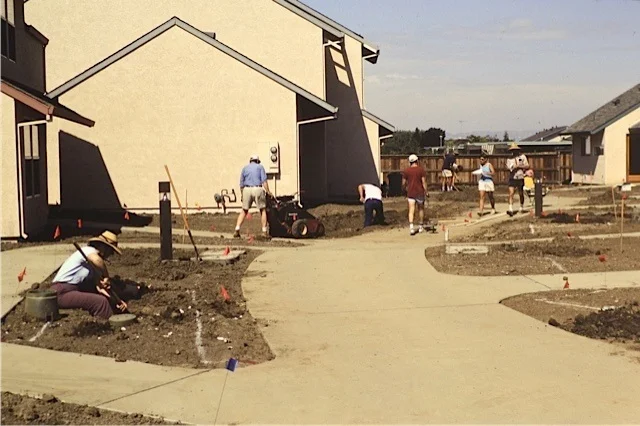
Muir Commons in 1991, credit Laurie Friedman
An article shared by filmmaker John de Graaf

Architect Charles Durrett and filmmaker John de Graaf are working on a film that tells the cohousing story through cohousing residents first-person observations. Photo, Pamela Biery.
Charles Durrett may be the best kind of entrepreneur, offering a product designed to address some of the biggest problems we face in America. With the tireless zeal of a much-younger man, the 63-year old Nevada City, California architect is always on the move, selling a concept called “cohousing” to audiences across the United States. Tall and lanky, but slightly stooped by a back problem he has had since childhood, Durrett describes his product as “the best of both worlds.” “With cohousing,” he says, “you can have as much privacy as you want and as much community as you want, and it has a lot of other advantages as well.”
There are now more than 150 cohousing communities scattered across the American landscape, primarily in the western states. Durrett has been a designer of 50 of them. When he started promoting the idea, there were none. He and his former wife, Katie McCamant, met in the early 1980s at the University of Copenhagen, where they were both architectural students. They returned to the United States determined to help spread the cohousing concept (they coined the term), which the Danes had developed in 1972.
The concept is simple: groups of people come together to design their own community, which includes private dwellings (single homes, apartment complexes and townhouses), each self-sufficient if small, with their own kitchens. But a large “common house” serves the entire community. Meals are offered there to everyone several nights a week. The common house has its own kitchen, and often, various meeting rooms, recreation or exercise rooms, children’s playrooms and other amenities including games and books, and a couple of guest rooms for visitors.
Members of the community are expected to cook at least once a month and share other everyday maintenance chores. Cars are kept outside the main living area, allowing for safe open space for children. Decisions are made wherever possible by consensus. Residents can spend as much time with others in the common spaces as they choose, always with the nearby option of privacy in their own homes.
Durrett and McCamant were impressed by the joy and sense of social connection they witnessed in Danish co-housing communities. The idea was slow to catch on there initially, but after a Danish TV documentary explored the subject, the number of cohousing communities mushroomed. Now the country of five million people boasts 700 such communities.
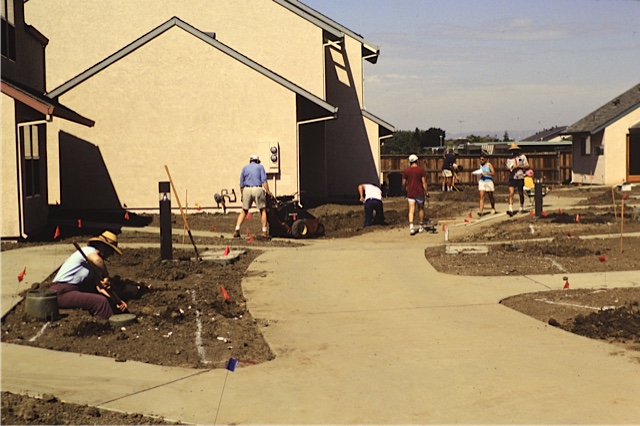
Muir Commons in 1991. Muir Commons in Davis, California was America’s first Cohousing community. Photo by resident, Laurie Friedman.
MUIR COMMONS: AMERICA’S FIRST CO-HOUSING COMMUNITY
Back in the US, Durrett and McCamant started promoting cohousing with lectures and a handbook. Together with friends, they planned a cohousing community in Emeryville, California, near their home in Berkeley. They moved into it in 1992. But by then, another California city, its plan developed together with McCamant and Durrett, was already boasting a functional community. It was easier and quicker to get permits and loans for the project in Davis, a city known for its commitment to sustainability (and its Danish-like propensity for bicycling!), and Muir Commons Cohousing opened there in 1991.
I am currently producing a film on cohousing, featuring Durrett and four communities in the Sacramento area. With photographer Doug Stanley, of “America’s Deadliest Catch” fame, I visited Muir Commons recently. Two of the original residents, Jane McKendry and Laurie Friedman, showed us around. Old photos of Muir Commons under construction show a place devoid of trees and greenery, but after 28 years the homes are almost invisible behind the lush canopy of trees, shrubs and flowers that offers welcome shade in Davis’ steamy summer climate, where temperatures commonly hit 110 degrees. Lines of bicycles, the Davis staple, can be seen throughout the community. Jane and Laurie showed us the orchard, which provides fruit for the entire community, and the small but robust garden plot. And with her husband, Ray, Jane played a mean folk guitar for us; many residents, she said, have similar skills that they share freely with others.
The early Muir Commons rang with the voices of children, but there are fewer of them now because most of the original residents, happy with their living arrangements, have stayed put and are nearing retirement or older. Their kids have moved on. A lovely, tree-shaded children’s playground on the property sat empty while we were there. But new families will be coming, Jane said. In keeping with Davis’ environmentalism, Laurie showed us the shed filled with bicycles, and the parking lot outside the community. Many parking spaces include electric charging stations.
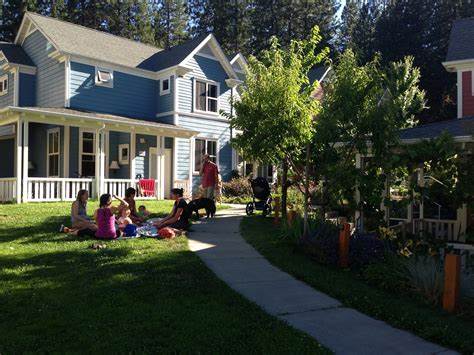
Nevada City Cohousing is a truly multi-generation community. Photo by Charles Durrett.
THE BENEFITS OF CO-HOUSING
From Muir Commons, we moved on to Nevada City’s Coho community, where Durrett and McCamant now live. Set on the edge of an impossibly charming Gold Rush town, it’s a beautiful village of pastel individual homes, a modern airy common house, and even a shared swimming pool. Flowers are everywhere. At Coho, many of co-housing’s benefits were clear. An array of solar panels heats all the homes and common space and produces a surplus of electricity for the power company, PG & E, keeping electricity bills low and sometimes even resulting in rebates. Children played happily in the pool, on the walkways and on the terrace of the common house. Several residents provided testimonials to the value of living there.
Stuart and Margaret Matthews family spoke of how there were numerous friendly neighbors to help look out for their two small children. Nancy Newman described the sense of support older residents received, especially at the passing of a spouse. Ingrid Holman, a single mother originally from Germany, told of the help she received in raising her 13-year old son, Christophe, who obliged us by masterfully playing “Pirates of the Caribbean” on the piano, and gushed eloquently about living in cohousing and having many friends so close by.
Interestingly, Ingrid first learned of cohousing ten years earlier when she picked up Robert Zeuner, an elderly man who was hitchhiking in the next-door town of Grass Valley. She offered to take him home and he told her he lived in the Nevada City cohousing community. She knew nothing about it but was intrigued—it seemed like something she might find in her native Europe—and Robert offered to show her around. Ingrid was hooked and found a rental in the community not long after. She’s been there ever since and is now buying her own place. Robert, meanwhile, lives right across from her, with his partner Bruce. They’ve become fast friends.
Coho boasts an attractive garden of vegetables and flowers, on the site of an abandoned hydraulic gold mine. Tony Finnerty, one of the gardeners, told us that the entire area was a maze of tall manzanita bushes and rocky ground when the community was built 15 years ago. The soil and compost had to be brought in. Signs in the garden let residents know when crops are ready and they are free to pick what they need. James, another resident, showed us the common workshop out by the parking lot, where he often crafts furniture. With such facilities, residents don’t need to own all their own tools, another cost-saving advantage of cohousing.

Conference room and library at McCamant & Durrett’s Nevada City office. Photo by Pamela Biery
SOCIAL CHANGE ARCHITECT
Doug and I visited with Chuck Durrett in his downtown Nevada City office, on the second floor of an old building dating to the 1800s. The office is small and filled with blueprints, artists’ conceptions of co-housing communities and the three-dimensional models Durrett loves. Christine Fantle, one of his assistant architects who also lives at Coho, showed me photos of many cohousing communities the firm had designed.
Durrett grew up in the nearby gold mining town of Downieville, a picture postcard village that attracts tourists as lamps do moths. He loved the feeling of growing up in a village where everyone knew everyone else, he says, and he’s found it again in cohousing. He bemoans the fact that when counterculture hippies discovered the Nevada City area in the late 1960s, they built their homes scattered all through the nearby woods. He remembers a Native American friend criticizing that pattern of settlement. “You white people build all over hell and back,” the friend told Durrett, “and you have no concept of the village.”
Cohousing offers a different model, much more sustainable than the counterculture’s, where people had to drive to get anywhere. Cohousing residents drive much less than typical Americans and use far fewer resources, especially water. And the Coho community is much safer from wildfires, a new normal in the age of climate change, than rural dwellers are.
But Durrett is clear: the biggest benefit of cohousing is that it offers community in an age of separation, when much of America suffers from loneliness and subsequent depression, often dangerously staved with opioids. This is particularly true for seniors, the fastest rising segment of the cohousing population in the US. Many senior co-housing communities are now being built. We visited one such community, Wolf Creek Lodge in neighboring Grass Valley, California. Like many cohousing villages, it has about 60 residents, but all are getting along in years.

Wolf Creek Lodge Senior Cohousing, Grass Valley, California.
SENIOR COHOUSING
When we were there, two couples were competing against each other in a lively game of petanque, a French sport much like bocce ball. Their neighbors sat on the steps of the common house, cheering them on. Durrett says seniors encourage each other to be active; in such communities it’s easy to find a partner to go walking with. It keeps everybody younger, and regular social contact with other residents provides an antidote for the chronic loneliness that a recent study showed 40 percent of senior Americans suffering from. Wolf Creek Lodge is an apartment-style complex with two wings radiating in a V from the common house. Every home has a porch where residents can look out at the neighbors, who they all know well, and shout out, “Hey, do you want to visit?”
Jacque Bromm, a youthful looking woman who loves to travel, showed us her beautiful apartment (more like a condo since she owns it) filled with memorabilia from her trips. Books about John Muir and the nearby Sierra Nevada mountains lay on her coffee table. Jacque loves the sense of community at Wolf Creek, but also the opportunity to travel knowing that neighbors will watch her home. Her friend, Casey Travis, a painter, uses her equally lovely apartment as a studio as well as a home. She says she gets lots of support for her artwork from other residents, who have many special talents of their own to share.
Wolf Creek residents are giving back to the town of Grass Valley, helping its parks’ department construct a trail down to and along the nearby burbling creek. We walked down 200 steep steps to the creek with Bob Branstrom, a resident and project leader. Eventually, switchbacks and pavement will make the trail accessible to all of the seniors in the community, even those in wheelchairs.
THE FUTURE
At the end of our trip, we went with Charles Durrett to Fair Oaks, a Sacramento suburb, where a new community of townhouses is being built. We visited with a young couple, Andrew May and Rachel Yamada, who are excited about moving in (with daughter, Freya and Rachel’s mother), to the home they were watching being built. It’s one of many cohousing communities now under construction, but Durrett wants there to be a lot more, and as soon as possible. He’s excited by many of the new communities, including one in American Canyon, California full of small houses for homeless veterans. Durrett is deeply interested in ways to make cohousing more affordable for the poor and to increase diversity of all kinds. Many cohousing residents are activists with a liberal bent, but after a visit to new project in Stillwater, Oklahoma Durrett says conservatives are taken with the idea as well.
He’s not Pollyannaish about it, however. Cohousing isn’t for everyone. You have to be willing to work with others, compromise, and, especially, listen to each other, sometimes during long meetings. That was the hardest part for Durrett to get used to, having grown up like the rest of us in an individualistic culture where if you don’t like something you just walk away. “I’ve come to realize that other people have some good ideas too,” he says with a smile. Some people never adapt to the consensus approach and drop out, but the attrition rate is dramatically less than that of other American communities. The great majority of residents stay on, happily. Creating a cohousing community can be tough in other ways. Groups looking to establish a community may quarrel over what land to purchase and some, especially in areas where the idea is new, may wait a long time for city permits and bank loans.
But the trend is distinctly positive and establishing the communities is getting easier. Charles Durrett and Katie McCamant saw the future in Denmark in 1980. Cohousing’s offer of community as well as privacy, has proven immensely popular and offers a way out of the lonely, unsustainable housing patterns that have for too long been the norm in American life.
John de Graaf has produced dozens of award-winning documentaries including the PBS hit, Affluenza. He is currently directing The Best of Both Worlds, a short film about co-housing.
You can support this film by visiting www.gofundme.com/cohousing-film and making a tax-deductible contribution.

Muir Commons Cohousing in Davis California today. Photo by Laurie Friedman.