

Alone in the Village
There are two early essential ingredients to successfully being in the community: be on time, be thoughtful of others. Both are easy to gauge and measure, whether you do them or not.

Illustration by Antoine Maillard
“A healthy social life is found only when, in the mirror of each soul, the whole community finds its reflection, and when in the whole community, the virtue of each one is living.” -Rudolph Steiner
Some folks thrive in community, others struggle. I used to feel a little guilty about organizing new cohousing communities that brought together the coolest, most responsible people in town. The can-do, type-A personalities into one ghetto. It usually takes very capable folks to pull off cohousing. The shipmate that navigates the large schooner to an entirely different land. S/he and cohorts must plan the journey, gather crew members, assess their skills, encourage participation from everyone, and set sail onto the vast, uncharted sea.
Public hearings, financing, building– in the planning phase, not everyone has to be gifted the aggregate shine of effort has to move things forward. I have learned that there is always something for people to do. Not until they move in do you realize that social dynamics change for some. Some folks have autism, Down syndrome, or ADHD or one of the other 200 DSM diagnoses. To weave them into a functioning community, cohousing or something as benign as a functioning neighborhood requires understanding, consciousness, empathy and a technique to help them plug in.
Weathering high seas and big storms and landing the boat may feel like a battle you won together, as a group. Then everyone gets into their own individual boats and settle. That’s when it gets tough on some folks, who worked hard like everyone else, but have a hard time fitting in. Apparently, when “can-do” was the order of the day, they did more than their share, but when it came to fitting in after the move, that was another question. They may be awkward conversationalists; they may be intimidated by those amazing conversationalists. That was probably why they shrank.
However, it is the larger committee’s responsibility to help them fit in by resonating with them at some level, and this requires a willingness. They do not need your sympathy. But to make the community work, they do require your empathy. How do we work this out together? Cohousing desires inclusion, but inclusion as a conscious act and it won’t happen as an accident.
In the context of writing my last book, One Life Live It!, I read so many fascinating stories about people who are “left out”, even when “let in”. One young man with high-functioning autism wrote, “I never went to recess my entire elementary school, because it was too hard having such unique emotions that no one else related to or could even imagine relating to. My heart was racing with a feeling of not fitting in, self-consciousness, wrought anxiety, isolation and loneliness--I couldn’t stand it. So, I stayed in the classroom; sometimes I talked to the teacher, sometimes I read; I tried to escape to another world, sometimes homework; you can imagine it was hard staying inside”.
Neurotypical people need patience. So, you should invite all those who are new to the meetings, and those who are or have been marginalized at any level. Just talk to them. Even at complicated committee meetings, like finance or energy savings, you will be surprised how useful they can be sometimes. Suzie volunteered to call rental companies to see what a three-yard refuse bin costs, for this weekend’s landscape clean-up! If you live in wildfire territory you know what I’m talking about.
There are two early essential ingredients to successfully being in the community: be on time, be thoughtful of others. Both are easy to gauge and measure, whether you do them or not. If you are chronically late for meetings, stop everything and work on that specifically. The Danes would say that cohousing started and thrived in Denmark because Danes came to meetings on time and started meetings on time even if they were fooling themselves. That is, tell yourself that the meeting starts at 6:00 PM even when it starts at 6:15 PM. Community may not be for you, although it probably is. But what people usually say is, “I couldn’t do it earlier but now I live with people I respect, so I’m on time all the time”.
There are so many reasons to live in a village. The winter solstice spiral with candles, the day-to-day sense of care, the knowing, the day of the dead; the internal TED talks; dinner with others, the star gazing in the hot tub, the singing; the strumming; the drumming, the dances, the support, the community and dozens more. All of these are, of course, voluntary, but most people come. More fun than they expected over and over again.
The highs are higher, and the lows are lower in cohousing because the more you know others, the more you care about them. Sometimes, as you walk by a stranger in the city, the only thing you think about is the level of threat. No perceived threat, no worry. Perceived threat keeps an eye on them. “The lows are lower in cohousing because you care, and the highs are higher, but I would not want to live anywhere else”, said a woman in cohousing.
There are so many high-functioning people in cohousing. I am not going to say they can’t tolerate people with shortcomings. But I will say that they tend to overlook the couple of people with atypical behavior. Those lucky enough to live in cohousing need to consider those who struggle but it’s a two-way street. I know from personal experience that those who struggle need to best assure that everyone is comfortable, the best that they can. This article talks about how to relate to others who might go unnoticed. It’s an important and fun challenge. Let’s start today.
What Do We Do About Waning Cohousing?: Smart anthropology is the secret.
It started with mindful discussion about why cohousing is such a great place to raise kids and to grow old. And went on to talk about how needs have changed, in particular mobility and some cognitive capabilities and the needs of the new and upcoming families.

Charles Durrett with Søren Skovland, 1985
Yes, as cohousing is making its way around the world, we see a new and predictable issue emerging. “Waning Cohousing.” The book Happily Ever Aftering in Cohousing along with Creating Cohousing were both written to help head off waning cohousing, but it happens on occasion.
Some cohousing communities that fired on all cylinders when they were brand new years ago, are now waning. Originally community dinners might happen 3-5 times per week, now it’s more like 3-5 times per month. Søren Skovland, a psychologist who moved into cohousing at 4 years old, left to go to college and to start his career but has now moved his new family back to finish raising his children and plans to grow old there.
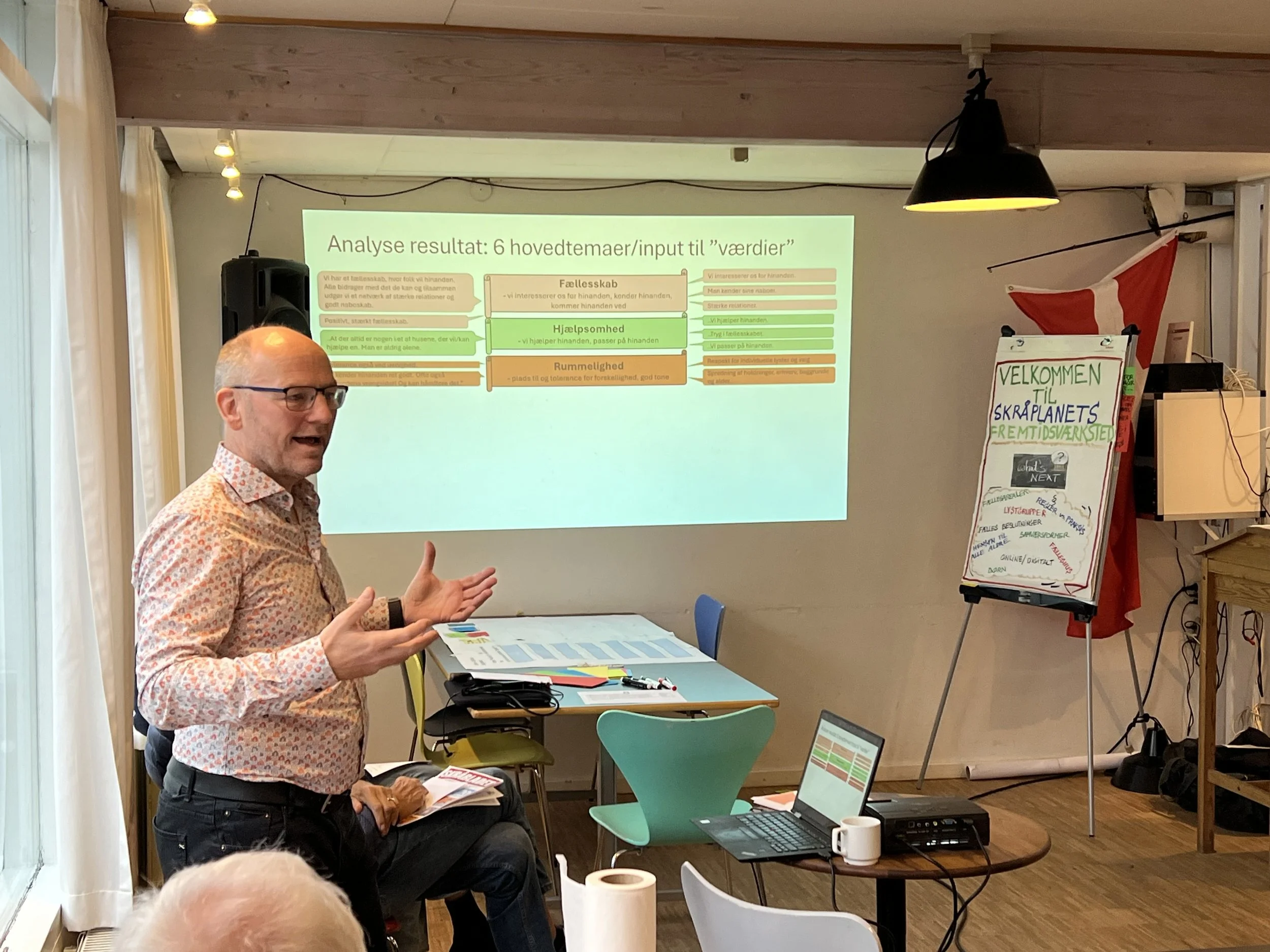
Søren asked me to start the revitalizing ball rolling at his community, Skraplanet last year. In a few hours workshop in June 2024. It started with mindful discussion about why cohousing is such a great place to raise kids and to grow old. And went on to talk about how needs have changed, in particular mobility and some cognitive capabilities and the needs of the new and upcoming families. For example, fewer kids per household warrants more activities in the common house. Søren has run subsequent workshops with the group– the big drill down in order to get to the bottom of what was really happening and to get back to the roots. For example, money and time fell away as an excuse. Obviously, we are going to save money, and time if we cook community dinner– not to mention committing more elsewhere because nothing facilitates community and dialogue more than breaking bread together. And early feminism goals have been compromised. The fewer common dinners, the more mom is making dinner again.

Søren Skovland at Skraplanet meeting, June 2024
This revitalization is the future. Spend the time, rebuild the relationships, and the creation story that brought them all together in the first place. Cooperation, save money, save time, sustain relationships, sustainability in general, live out our values, and even contributing to help build a better, more socially viable larger culture.
The Cohousing Company went to Vienna, Austria a few years ago. My daughter joined me, she was also born into cohousing and has opinions. They went from 12 out of 24 households making community dinner once per month, to 24 of 24 making dinner within one year. This was low-hanging fruit, and easier than building a new one.
I recognize that it seems odd that an architect would focus so much on the software as much as the hardware but you do if you’ve been born into cohousing like Søren, it’s in your DNA at that point, or if you have studied hundreds and hundreds of cohousing communities and functioning cohousing is more motivating than compromised– it causes you to do even better architecture– we’re not just making real estate here. We have a poster in our office that reads, “If it doesn’t work socially, why bother?”

This is a great excuse for what architects call “post occupying evolution.” And for an architect its perfect “how do we get better work.” What really worked to achieve said goals, what really didn’t, what detracts from the goals, and what part of the story are we just making up. And for this architect, the architecture is not an end in itself– just a method to a better stage set.
Objectifying community, exactly what works, is the beginning and end of building places that will have a long history. The beginning and end of not making preventable mistakes. I hope that many more people, in Denmark and the U.S. pick up the noble trade of helping groups fire on all cylinders and revitalize. The practicing anthropologist or as they call them in Denmark the “kuturarbejderne” culture workers suggest that’s how we evolve in a positive direction.
The bones are there, reignite the spark, put aside differences, rekindle the passion, rediscover the enthusiasm, resolve problems and make peace, find a way to make everyone happy– it is doable.
Why Books Matter: A Case for Books about Community Making
Without the right books, the cohesiveness of the information about cohousing is gone. Random, incomplete, chaotic, and piecemeal would best describe the info on the net at best.

Making a case for books.
The very first cohousing in the US, Muir Commons in Davis, California would not have happened if the book Creating Cohousing: Building Sustainable Communities had not been in every Davis bookstore and library. A dozen bookstores, new and used, and every library (almost 10) carried it. That project took exactly two years from the night of the public presentation to the morning of move-in. Every adult in the group read the book and we were always on the same page (at least figuratively).
State-of-the-art Southside Park Cohousing in nearby Sacramento would not have been built without the activism of my mother, Rosemary, the ultimate grassroots organizer (she organized her bra-making union during WWII!—“It was hard to get support for that project,” she would say...). She went to every Sacramento bookstore (about two dozen in 1991) and asked, “Do you have this book?,” “Can you order this book?,” “Can I leave this book on consignment?”
I know that I’m going counterculture here, but there seems to be a big correlation.
In this era of information chaos, it’s time to bring a little balance back into our information consumption.
A young journalist, Hannah Quinton, called about a month ago with a new and provocative question: “Why did cohousing have a much more rapid growth when your first book came out in 1988 than it does now?” She began to answer her own question. “Is it because in the beginning, there was only one book available, a book with a beginning, a middle, and an end? That is, a full story, a complete scenario of how to make it? It told readers: this is how you start a new project, launch it, manage it through rough seas, land it, and settle.”
Now, it’s common for folks to just go to the internet and get a helter skelter, mumbo jumbo, and almost entirely gobbledy gook of information. Some of it is by experts, most of it not. Most of it is anecdotal and under-considered. Some of it is contradictory to cohousing standards, but who knows the difference? People call things cohousing that are not. Nobody but The Cohousing Company seems to help nascent groups or developers course-correct when they say they are cohousing but are not. Luckily, Sage Cohousing, the senior cohousing nonprofit, certified what senior cohousing is and what it isn’t so that people can no longer get away with fooling seniors (see the book Cohousing Communities). One successful cohouser, Janet Palmer from Quimper Village, put it bluntly: “Get the books and read. Don’t get caught in a project with pretenders, imitators, and fakers.”
Hannah, the journalist, also observed, “Communication in getting projects built is the big complication.” Books make it easy to get on the same page with each other, compared to the worldwide net of infinite complications.
Hannah was entirely correct. Without the right books, the cohesiveness of the information about cohousing is gone. Random, incomplete, chaotic, and piecemeal would best describe the info on the net at best. I notice that, when asked about the same community, one person on the internet will say we have too little parking, and another person from the same community will say we have way too much parking. One data point or even two does not make legitimate data.
By contrast, in book form, work is checked and double-checked. I have a new book coming out about cohousing for the I/DD population (people with Intellectual/Developmental Disabilities). That book is now sent out to 15 different expert reviewers. Every statement is being checked, double-checked, and triple-checked.
You can barely find the definition of cohousing on the internet—and if you do, it’s usually not a smart one. See it on page 8 of Creating Cohousing, and in the introduction to Cohousing Communities. You can’t find the definition of Study Group One on the internet, but it’s in chapter 7 of The Senior Cohousing Handbook. Study Group One is the number one way that the Danes use to help seniors get into cohousing, because the various books set them up for success. There is no good important discussion of the optimal size of a cohousing community on the net. It’s on pages 99 of The Senior Cohousing Handbook, and 49, 101, 145, 175, 255, 295 of Cohousing Communities. (In Denmark, the size of the community is the number one consideration for the long-term success of a cohousing community). There is no discussion about the important metrics which ascertain whether a cohousing is functioning or not. See pages 364-392 in Cohousing Communities.
Read a book, know something. Search online for something about cohousing—get confused. Social science is harder to find on the net. The story needs a beginning, a middle, and an end.
The challenge is more than getting the book into bookstores. I guess you have to imagine helping people realize the benefits of reading the book, because we are so far away from the habit. Quimper Village Cohousing asks everyone who is considering buying a house there to read the book first. Everyone that I have asked there that read the book said that it helped them segue into cohousing successfully. They have plenty of copies to loan out. And there are many reasons why that project is considered “State of the Art of Senior Cohousing” in the US, but the fact that everyone comes to the table with foundational information, wedded to the notion and the understanding of a high-functioning neighborhood, and has both feet in the future, makes a huge difference.
Books have played a major role from the beginning in terms of getting cohousing to this country and built in your town, starting with our first book, Cohousing: A Contemporary Approach to Housing Ourselves (The European Story). Bookstores play a key role in culture change in general, and cohousing is no exception.
I’ll bet $100 that the next group that embarks on a project just based on the following three books: Creating Cohousing, Senior Cohousing, and Cohousing Communities, will finish their project in two to three years—just like the good ol’ days. Anyone want to take that bet?
Many groups have contacted the publisher (New Society Publishers and John Wiley & Sons, Inc.) directly to get bulk discounts, and I find that successful projects get started when lots of folks do this fun homework. I usually need to give a dozen copies of Creating Cohousing: Building Sustainable Communities, The Senior Cohousing Handbook: A Community Approach to Independent Living and Cohousing Communities: Designing for High-Functioning Neighborhoods away to planners, banks, neighbors, mayors, new residents, local architects, builders, and so on for any new project—to give them context. It saves the group thousands and thousands of hours, dollars, and delays, and most importantly makes for a better project. I just did this in San Luis Obispo County, including the Chair of the Board of Supervisors, and in my view, it got the project off to a fruitful beginning.[1]
Cohousing is more than a sound bite; it is cultural pivot, and it takes folks with curiosity doing some fun research first. Seattle and the surrounding areas have about a dozen cohousing communities today largely because the bookstores in town have sold more than 1,000 copies of Creating Cohousing: Building Sustainable Communities. The San Francisco area has over 20 cohousing communities largely because the book has sold more than 2,000 copies there.
Read a book, know something, share the book, and start the discussion—it is still worthwhile.
[1] See also Hannah Quinton’s article “It Takes a Village” in Klipsun Magazine, April 2024 (klipsunmagazine.com/spring-2024-connection/it-takes-a-village). It features Bellingham Cohousing, which arranged three book signings in the local bookstores when that project was being organized. Bellingham moved in full upon completion, all very affordable houses in a high-functioning neighborhood. They were affordable because all 33 households had read Creating Cohousing and knew how to do it. And it’s a very handsome cohousing.
Cross Laminated Timber: And the Importance of Carbon Sequestration
Perhaps if we capture as much carbon as possible, ennoble the wood, and ennoble our spaces, rather than burn it or let it rot, we can slow down global warming a tiny bit and buy ourselves some time, so that we can make serious progress to the other new technologies like carbon to clean energy so that we can then begin to cease global warming.

The East Vancouver Cohousing Design Team is working to sequester carbon as much as possible through Cross Laminated Timber (CLT) and other wood construction. Perhaps if we capture as much carbon as possible, ennoble the wood, and ennoble our spaces, rather than burn it or let it rot, we can slow down global warming a tiny bit and buy ourselves some time, so that we can make serious progress to the other new technologies like carbon to clean energy so that we can then begin to cease global warming.

Mass timber is a category of wood product that is made by nailing and gluing wood panels together. Some mass timber products include:
Cross Laminated Timber
Dowel-Laminated Timber
Nail-Laminated Timber
Glue-Laminated Timber
Mass Plywood Panel
Laminated Veneer Lumber
Parallel Strand Lumber
Laminated Strand Lumber

CLT is a strong, lightweight, low-carbon alternative to concrete and steel. The total CO2 emissions from material production for the entire CLT building were reduced by almost 50% compared to concrete and steel buildings. The product also consists of 50% carbon by dry weight, making it effective carbon stores well into the future, thereby lowering the global warming in real time.
Throughout its entire lifecycle, including the harvesting of raw materials, manufacturing, transportation, construction, and eventual disposal or recycling, CLT exhibits lower embodied energy, generates reduced air and water pollution, and leaves a smaller environmental footprint compared to the other structural materials.
“One train car holds 100 tons of coal, or 286 tons of atmospheric carbon.”
“Building a CLT building without a parking garage saves 24 train cars of coal.”
The solid wood wall, featuring a four-inch wood layer and an additional 6.5 inches of mineral wool on the exterior, effectively retains sound, particularly the bass tones.

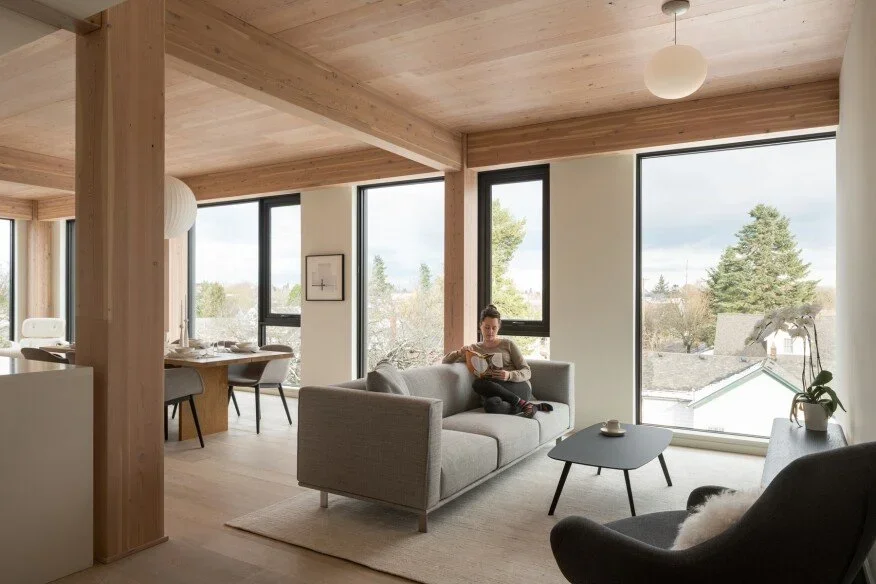
Warm and natural appearance of CLT adds a pleasing atmosphere to interior spaces. Its wooden texture can enhance the ambiance of a room when combined with natural light. Large windows and openings in CLT buildings allow ample sunlight to penetrate, creating a bright and inviting atmosphere.
CLT panels provide good air tightness when correctly installed. CLT is also a vapor permeable and vapor retardant construction material. Its vapor permeability allows it to regulate moisture levels and prevent the buildup of excessive indoor humidity, which can contribute to mold and mildew growth.

When exposed to fire, the outer layer of CLT creates an insulating barrier that protects the inner layers. This charring effect slows down the burning rate and maintains the main structure for a longer duration during a fire event.
And this is why we believe that CLT will meet the criteria for our most important design goals, such as sustainability, community, acoustics, light, air, low moisture, fire and more.
Sustainability: There is no underestimating the huge significance of carbon sequestrating in the short term – to buy us a little time until other technologies catch up – its existential.
Community: Warm and giving, I want to be there, “I love my community.” We did something together, that I could never do on my own.
Acoustics: Lower overall reverberation, better STC (sound deadening coefficient) and IIC (impact deadening coefficient).
Natural light: Easier to have high windows.
Air: Easier to not “baffle” the air – easier cross ventilation.
Moisture: The buildings are easier to quality control.
Fire: Outside charring.
Living in a Senior Cohousing Community: A Letter from Susan Burwen
The following is a letter from our dear friend, Susan Burwen, who is also a resident living in Mountain View Senior Cohousing with her husband—the amazing initiators of this beautiful community—and my related thoughts on the topic of co-care.

[Hi Chuck,] I think it’s important to set expectations for people going into senior cohousing communities about how the community is going to handle declining health issues of its members.
Our community has taken proactive steps to create a comprehensive database for each household, including information about care they might need, resources, and contacts, including information for heirs, so that community members know what to do in case of emergencies. Below is a partial list of categories that are covered.
Members of the community who are willing to serve as Care Coordinators
Information about who to contact in case of emergency
Support Tasks You Anticipate Needing
Support Tasks You Are Willing to Do
Information and Paperwork about wills, trusts, assets, keys, passwords, etc.—and where to find this information
Resources: Geriatric Care Managers, Personal Alert Systems, etc.
I hope these ideas are useful for you.
Warm regards,
Susan
Sue Burwen, Mountain View Senior Cohousing

Dear Susan, thank you.
It’s great to get this feedback and to have an increasingly nuanced conversation about co-care in senior cohousing communities—it’s important.
While the book The Senior Cohousing Handbook: A Community Approach to Independent Living does not describe official “co-caring” — it very much is a big part of the reality of senior cohousing—like it would be in any functioning village. See Chapter 7 in The Senior Cohousing Handbook for more on the topic of aging in place—including co-care and outside care.
From a practical point of view, no one is counting on co-care providing 100% of adequate care, especially without a spouse. One might think that it’s more than likely that those who receive co-care in their later years are those that have been giving some sort of care all along—in their more able years. A give and take so to speak—karma—whatever you want to call it. That said, the conversation and practical applications of co-care in all cohousing—senior cohousing and intergenerational cohousing alike—is absolutely ongoing and the care provided by the community is very organic and more or less almost never official.
The reality is that co-care, without a structured system of volunteering, is a bit like a village—that is more popular people get a little more than less popular people and one of the things that makes them popular is how much care that they have provided to others previously. That might sound harsh, but on some level it’s the case. The currency of consequence in cohousing is giving and is one good reason to keep track of the amount of care everyone gives and receives. For example, someone that moves in with Alzheimer’s is just not going to get as much co-care as others. But they most likely will receive much more care than they would in an institutional setting in the categories that are important i.e., emotional care, company, lunch, community gossip, cohousing stories and lore, new crutches or walkers as needed, care to their spouses and other co-care givers, and help at many other levels. Possibly the most impactful care they receive is emotional support of knowing that you and your caregiver are not alone. They would also most likely have to rely on paid care, if not institutional care, outside of the community for many things. In that case, it could be the choice of the community to have an organizational system that makes sure even the less popular get cared for as well, making the community intentionally more affordable and supportive to everyone, not just the most popular among us, which is what Susan was pointing to.
The currency of giving and contributing, as Charles Einstein argues in Sacred Economics, is “money in the bank”. But it shouldn’t feel like high school – when a pretty smile might carry the day. What Susan is saying is that this method works because if you officially volunteer to work for others, then others will officially volunteer to care for you. And that way everyone gets taken care of. It would be great to keep track—otherwise people feel like their anonymous contributions are lost. But I don’t expect this official co-caring to be adopted anytime soon in cohousing. Voluntary co-care will continue in more cohousing communities like it does in intact villages around the world—from the Amish to the Iroquois and other intact villages everywhere on all of the continents.
Chuck