
End Homelessness Now
In the early part of the 20th century, John Steinbeck described non-fictional accounts of a housing crisis during the depression. With help from the government, numerous villages were built in California, from Redding to San Diego in California. This initiative put a roof over the heads of thousands of people displaced by something they could not control. The effects went far beyond surviving: having a home and community enabled people get their feet back on the ground. These villages restored people's faith in a functional, viable society, and then went on to contribute themselves.

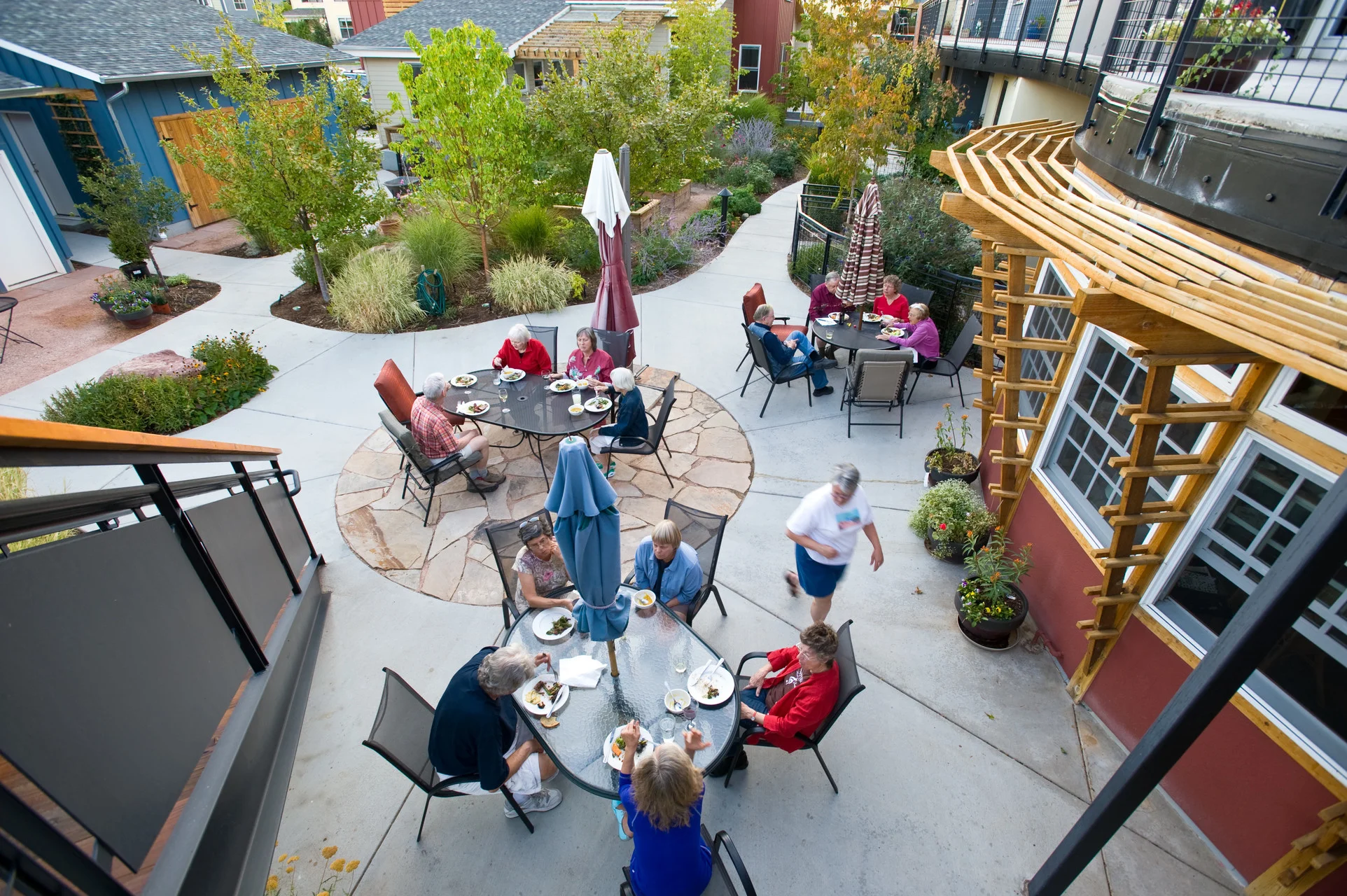
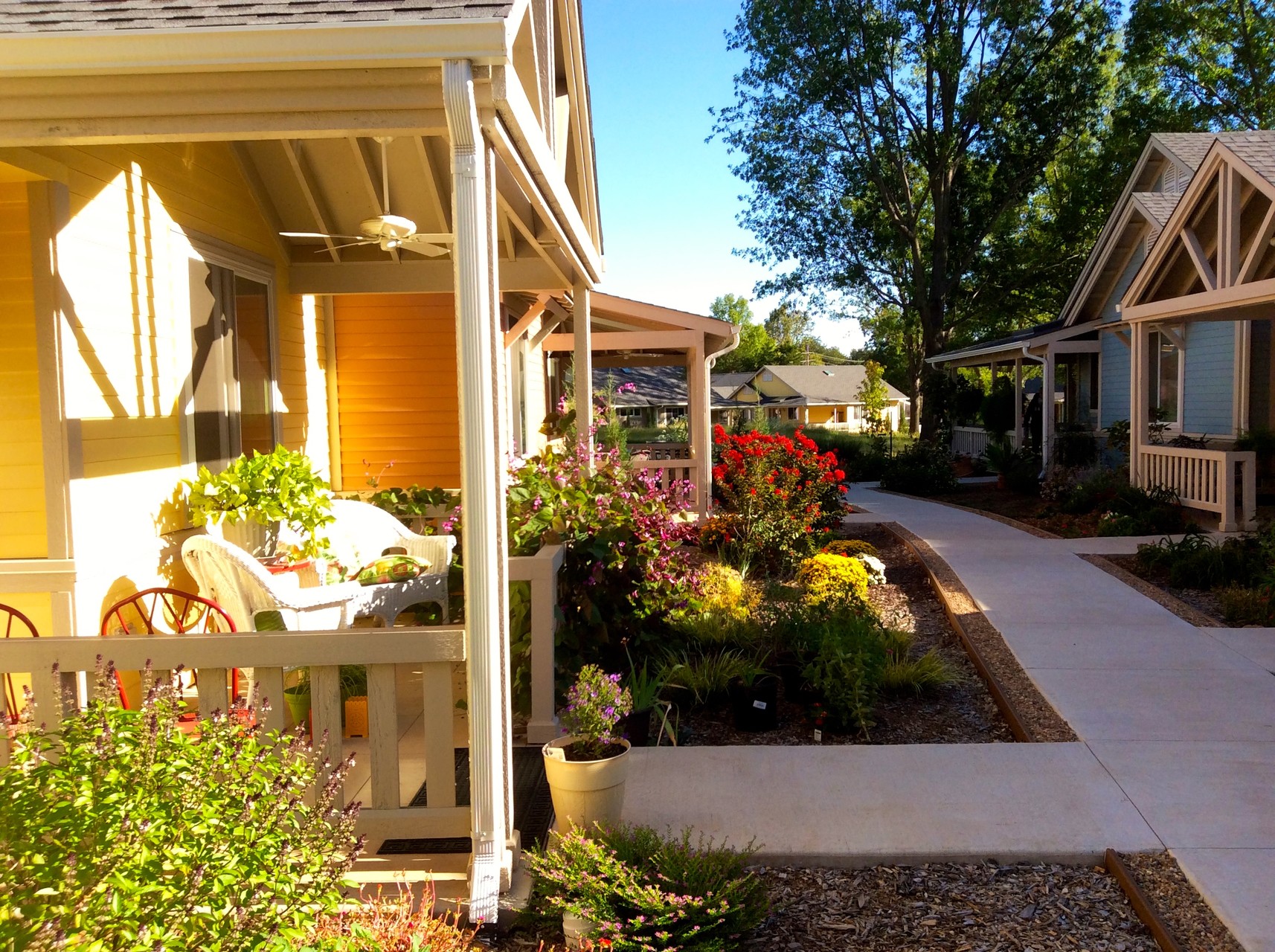
Courtyard where residents can work in the garden and enjoy each other's company.
For those advocating for an end to homelessness now, a change is in the air reminiscent of days of yore.
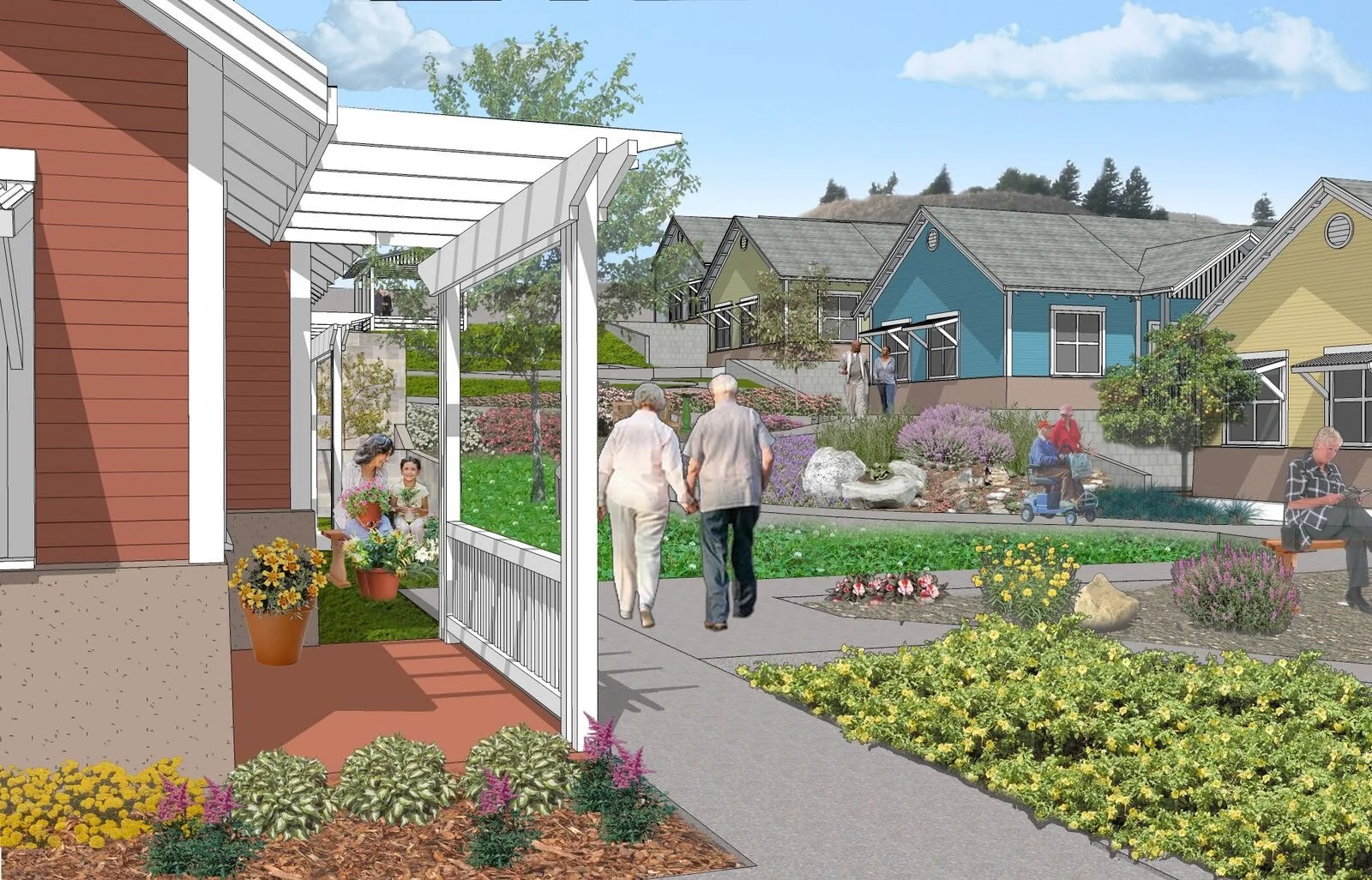
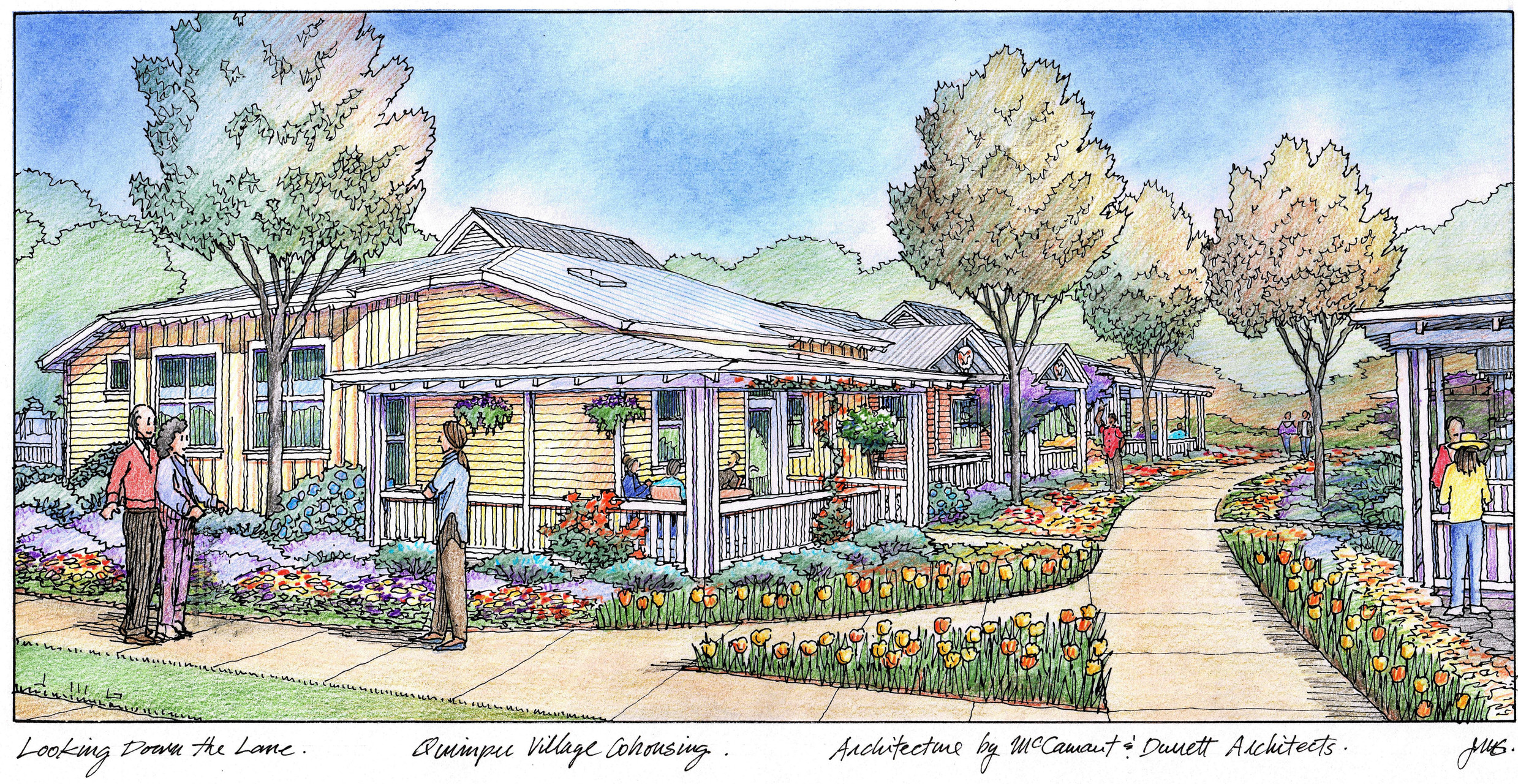
A tiny house village in Northern California designed by McCamant and Durrett Architects of Nevada City began construction in July. The Village consists of 70 units—22 for homeless veteran seniors, 17 for otherwise homeless seniors, and 31 for seniors at risk of being homeless or previously homeless. After the buildings are built, McCamant & Durrett Architects and SAHA will work with residents on programming to enhance community interaction. Residents will learn to listen to one another, make community-based decisions, and to work together as a team to ensure that everyone’s needs are met.

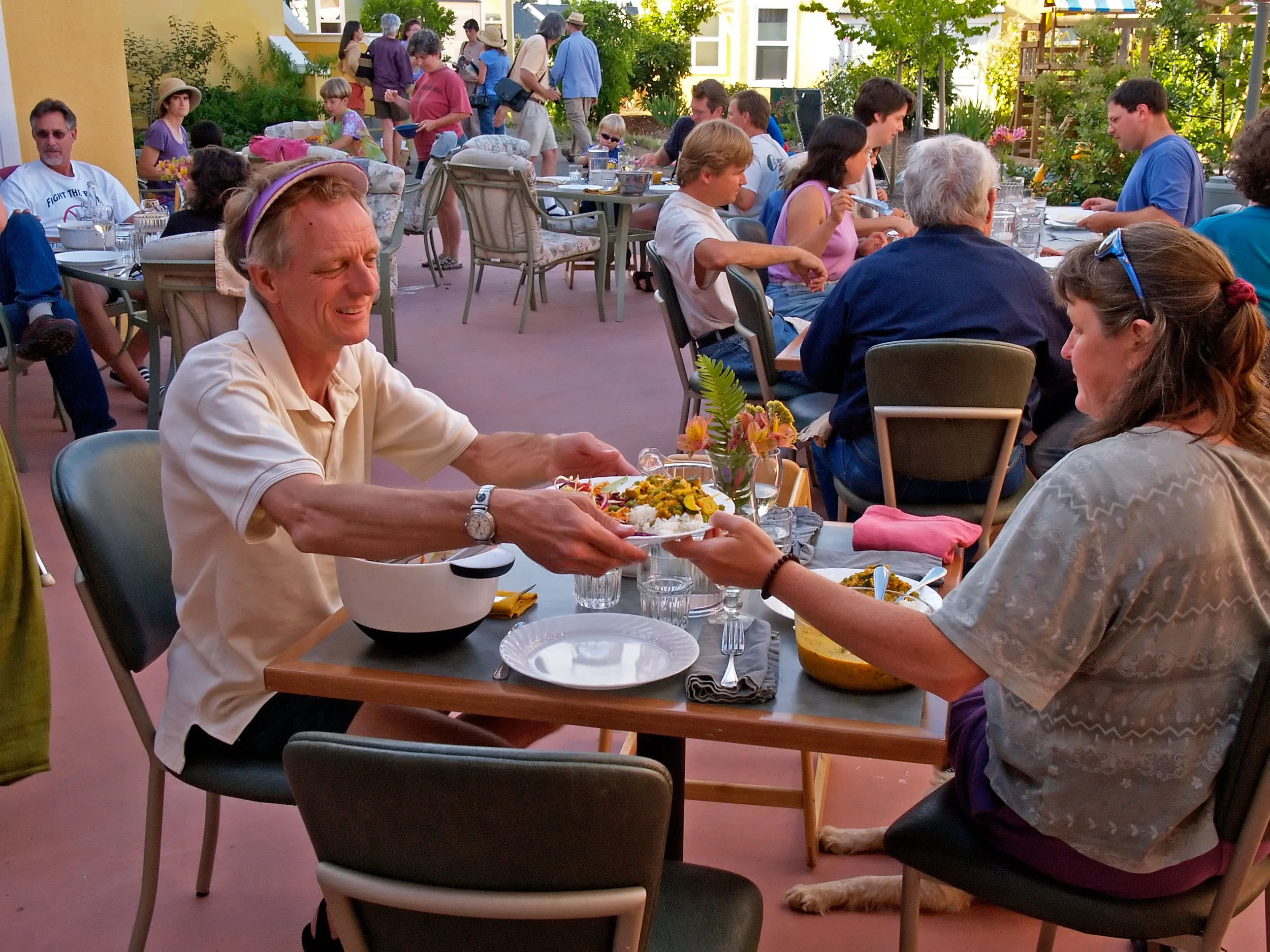
The Common House is where residents break bread together.
In the early part of the 20th century, John Steinbeck described non-fictional accounts of a housing crisis during the depression. With help from the government, numerous villages were built in California, from Redding to San Diego in California. This initiative put a roof over the heads of thousands of people displaced by something they could not control. The effects went far beyond surviving: having a home and community enabled people get their feet back on the ground. These villages restored people's faith in a functional, viable society, and then went on to contribute themselves.
The average homeless person dies at 49 in this country, a thirty-year curtailment of life, so in Northern California we are getting to many of these people just in time. This project may be one of the first, but it certainly isn’t the last and, once it is finished and the residents move in, we all will see the potential this model has. One such area that needs this type of housing badly is Nevada County.

Cottages nestled side-by-side with walkways connecting them. By having a roof over one's head, future residents will be capable of getting back on their feet and giving back to society.
If the County were to simply lease a property to the citizens (who are already prepared to build it,) a village like those described by John Steinbeck, could dramatically shift life as we know it. The plans have been drawn up and there is no shortage of citizen support. The last key, the key to a change for the better, lies in the hands of the County. With their full support, endemic homelessness will be a thing of the past as those who are without are welcomed into community, into a home.
In fact, these dwellings would save millions of dollars a year for the County, not to mention lives. If the County just let their “Darwinian” or “American Dream” (pull yourself up by your bootstraps) ideologies soften and listen to what people who actually listen to the stories (volunteers for Hospitality House, for example) we’d be in a much better place. Homelessness is not a disease, and it often effects those who need the most support (i.e. mentally challenged and those working paycheck to paycheck.) Once these folks belong to a functioning community, when their basic needs are met, they will become an enhancement to society and a model for those who are advocating for the wellbeing of all, everywhere.
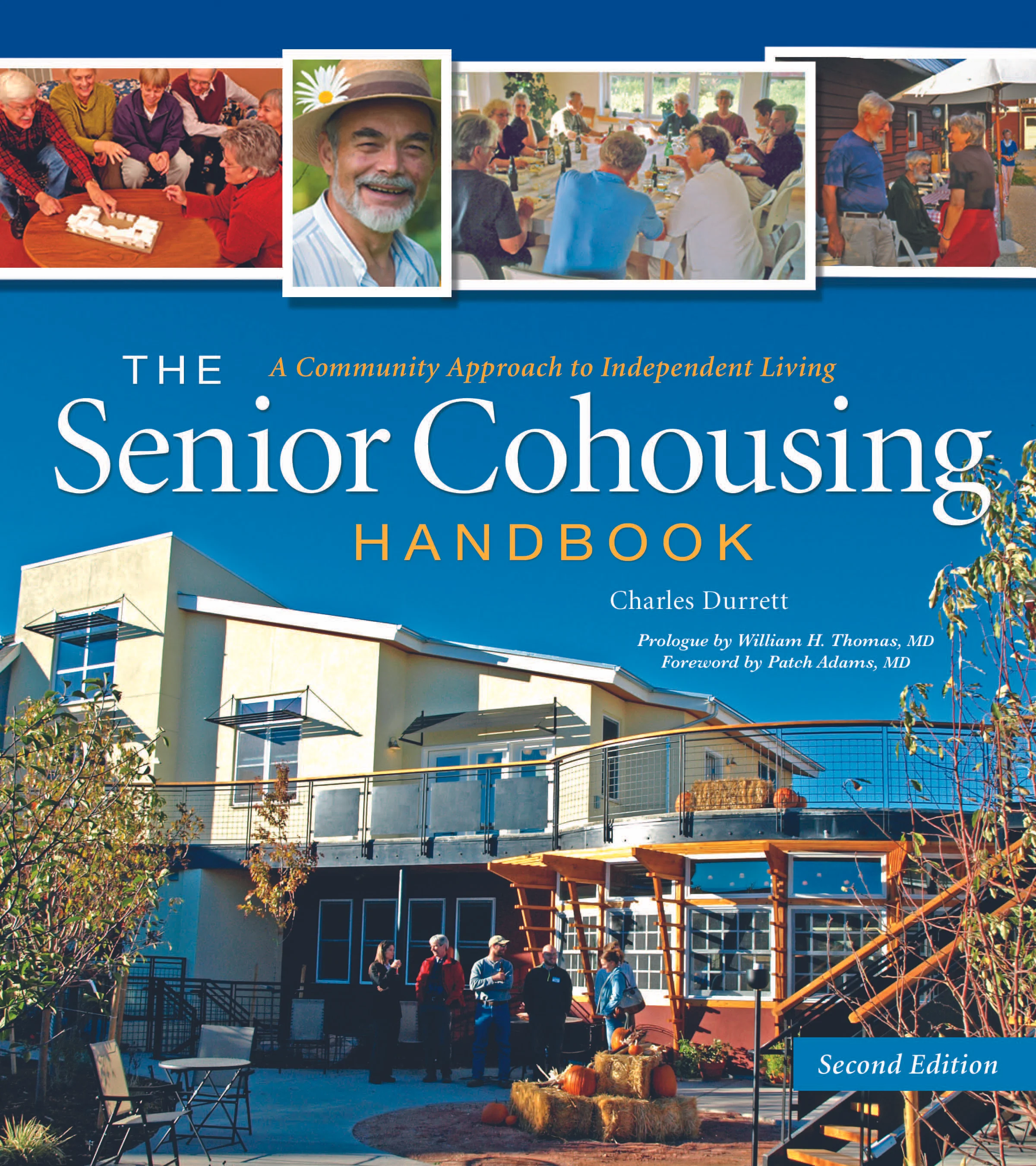
Senior Cohousing Video Featuring Charles Durrett
Senior Cohousing is in high demand as adults 55+ are wanting to stay active and have more control of their lives. It is a proven solution to getting seniors out of isolation and into a supportive community where everyone knows and cares for their neighbors.
Filmed by Terry Lamb of Videosyncracy
"Cohousing": A Term Whose Definition Must Be Respected

By Dominic Castro-Wehr
On the bright side, the concept of Cohousing is becoming increasingly entrenched in the American imagination— with every new project, what was once a culturally radical and shot in the dark neighborhood experiment is now an empirically supported investment into well-being and sustainability. Unfortunately, Cohousing's success has enticed others to appropriate the term for their own— entirely unrelated— housing projects, which do not adhere to Cohousing's Six Defining Characteristics.[1] While many of these individuals do so with positive intentions, at the end of the day, the flippant use of the term "Cohousing" does far more harm that good.
First and foremost, a liberal application of the word Cohousing dilutes the term such that it loses its influence as a proven, viable concept. In this country, getting any large housing project built that does not prescribe to the typical stick-built, muted, and grandiose American formula remains a challenge. Credibility— among lenders, developers, and buyers— is essential for these kinds of projects. Over the years, Cohousing has earned this credibility, but nonetheless cannot afford to be conflated with other alternative housing models, even if those models are admirable and effective in their own right.
Furthermore, a lax use of the term Cohousing puts the concept at long-term risk of alienating certain demographics that might otherwise benefit from such a neighborhood. Individuals often choose to detach the term from its actual definition because, for them, Cohousing suggests certain values that they want associated with their particular housing project. Unfortunately, this is a slippery slope. At its most basic level, Cohousing is simply a sustainable, democratic, and pragmatic neighborhood model— something most Americans across the political, geographical, class, and generational spectrum can respect, if not choose for themselves. If Cohousing is permitted to become a catchall term associated with the next edgy, alternative neighborhood experiment, the word may lose its universal appeal and therefore, its effectiveness. Cohousing— which is designed intentionally to be accessible to a wide variety of Americans— could become an exclusive, value-laden term.
Moreover, the misapplication of the term Cohousing is disingenuous to consumers, and often resembles an unethical bait-and-switch sales model. Though every neighborhood is unique, the base model of Cohousing is the product of numerous mistakes, countless experimentations, and literally hundreds of thousands of man-hours. The concept has been through the wringer and has emerged intact, even stronger. To slap the proven Cohousing label onto something dissimilar— especially onto the occasional half-baked housing project that is doomed to fall short of its goals— not only delegitimizes others' hard work, but is misleading to potential buyers.
Finally, in the uphill battle to create synergistic communities amid a culture of militant individualism, we owe it to ourselves to respect the work that has already been done. Cohousing is not the be-all and end-all of high-functioning neighborhoods— innovative neighborhoods of the future will continue to reveal new and important insights about effective community living. However, when we confound the triumphs and struggles of Cohousing with those of other, disparate housing models, we complicate the work of tomorrow's housing leaders. Cohousing means something, and when the term is watered down and divorced from its original intention, the housing, environmental, and justice movements loose an important nuance. Any short-term benefit that could come from this slip of language simply would not outweigh the long-term disservice it would be to the neighborhoods of the future.
While sticks and stones also make homes, words can hurt community.
[1] In order for the term "Cohousing" to apply to a particular community, the community must have the following Six Defining Characteristics:
1— Participatory Process: residents participate in the design of their community
2— Neighborhood Design: the physical layout of buildings encourage a sense of community
3— Common Facilities: includes a Common House; supplemental to private homes; designed for daily use
4— Resident Management: residents manage and do much of the maintaining of the community themselves
5— Non-Hierarchical Structure and Decision-Making: consensus is the primary means of decision-making; responsibilities are distributed according to skills, interests, and abilities.
6— No Shared Community Economy: the community is not a source of income for its members
Dominic and his family were founding members of Nevada City Cohousing, and have been active community members since 2006. Having recently graduated from Swarthmore College, Dominic has returned to Nevada City, where he can be found working at McCamant & Durrett Architects, enjoying the outdoors, or spending an egregious amount of time playing board games with his neighbors.
Bringing Back the Village

Chuck talked with Gregory Kellett of Common Grounding on the economics of sharing. Listen to this great interview: www.commongrounding.com
The True Costs of Senior Housing
Written by Lindy Sexton, based on an interview with Arthur Okner of Silver Sage Village in Boulder, CO

“We at Silver Sage strive to age-in-place. Given the caring support of our community, we can do so a lot longer than in many other aging care models,” says Art Okner. “Getting older is a long, fulfilling journey for most—you have a caring family, a good job, activities that you enjoy, and friends to share experiences with. These things ebb and flow in a thing we call life, and it’s hard to think of the future until one day you are there. The future belongs to those who recognize and prepare for aging.”
In his search for the optimal housing scenario Art found that, as a middle-class older adult, options are extremely limited. The current aging care model is an expensive process that promises little to no security or return on investment. Art researched a well-known Continuing Care Retirement Community (CCRC) in Boulder. The CCRC requires nearly $250,000 to get in (for a small studio), then $3,000 to $7,000 per month after that (depending on type of care needed), very little of which is returned if you move out or die. “They are very choosy about who they accept financially because if you run out of money they must keep you,” describes Art. In another “non-continuous” care model, Art found out that, if you do run out of money, the facility will “place” you in a government or other such program and forget about you.

Art chose to live in Silver Sage Cohousing in Boulder, Colorado. He owns his home and has a secure financial plan. Art has his independence, but most importantly, he is surrounded by caring neighbors, who as a group, discuss how they can support each other as they age and become frail.
Living in senior cohousing was a no-brainer for him. “Senior cohousing is planning for your future in wholesale terms because there is no profit motive. [It] is the cheapest option in town,” says Art, “clearly the social benefits are there [common meals several times a week, for instance], but it makes sense economically too. Even if a senior cohousing resident needs regular outside care “a la carte” the costs are cheaper than institutional options. Senior cohousing should be on the short list of housing options explored by everyone at this stage in life. You can’t afford not to.”
Join the conversation! On May 19, SAGE Cohousing International will facilitate Senior Cohousing: A Roadmap to Starting a New Community, an all-day intensive on senior cohousing. Participants will have the opportunity to listen to members of Quimper Village, a new senior cohousing community being built in Port Townsend, WA, and cohousing expert Charles Durrett. This is your chance to have your questions answered and begin to envision what aging in community looks like for you.
Sign up now by clicking here.

If you would like more information about Silver Sage Cohousing, visit www.silversagevillage.com or email Art at renko2828@gmail.com and arrange a conversation or a visit.