
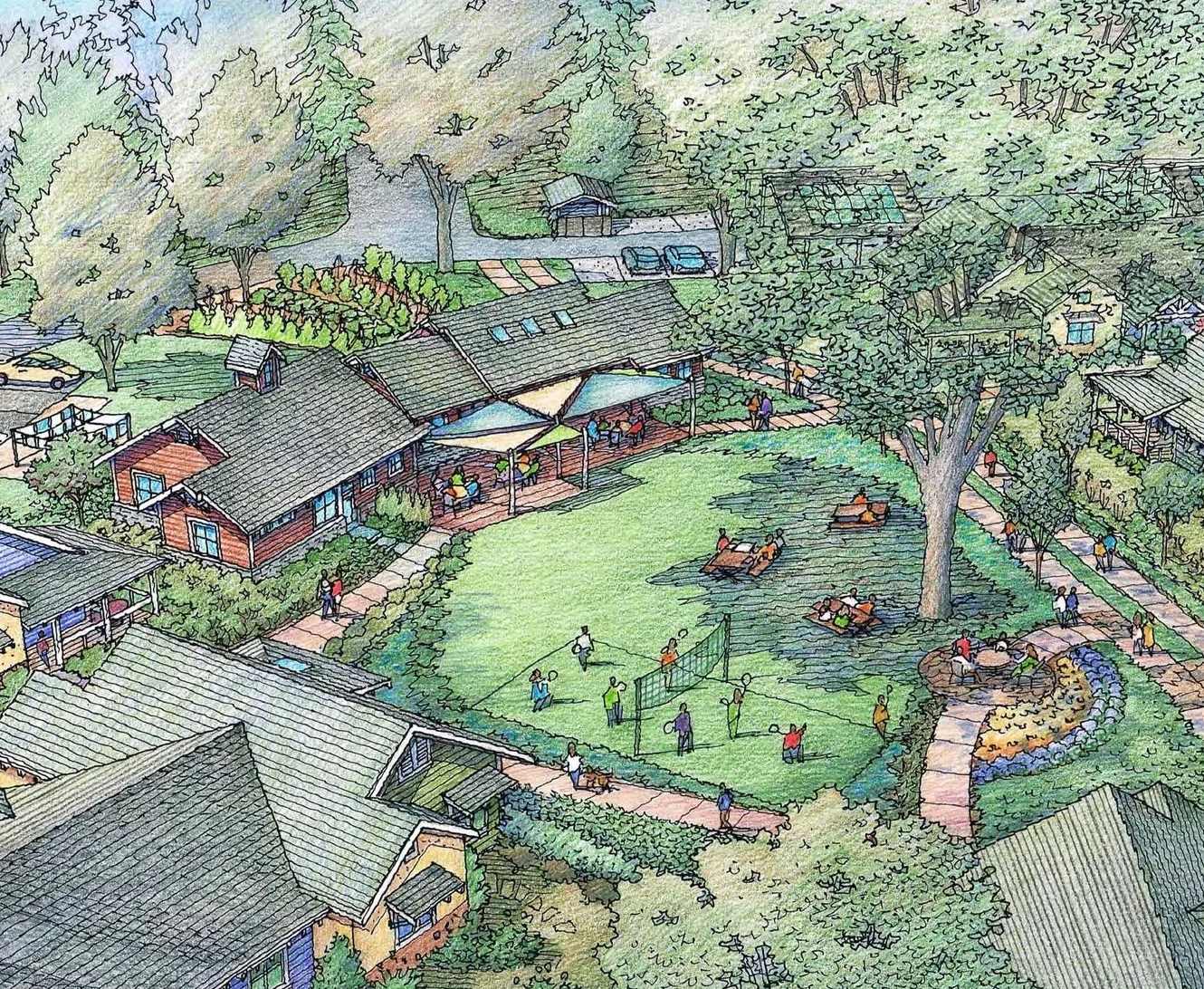
Cohousing in Great Britain - a tipping point
Charles Durrett is a leading expert in cohousing, not only because he knows and understands the process, but because he has the experience to back it up. With over three decades of experience, Chuck lives the cohousing process and can work with others to realize it in themselves. His impact is worldwide, reaching far across the Big Pond, where cohousing is being embraced.
Watch this video featuring OWCH.
In 2010, Chuck and Katie went to Britain and energized what is now a strong and supported cohousing movement. Old Women’s Co-Housing (OWCH). OWCH had been trying to get started for almost ten years and were dangerously close to giving up. Sarah Berger, and the UK Cohousing Network organized to have Katie and Chuck meet with OWCH and Hanover Housing Association, the involved parties. They worked through the nitty-gritty details—two hours of which was spent on trust alone—and in the end, they were able to move forward with the project, knowing that each side was going to uphold their side of the agreement. They walked up the ladder until finally a contract was signed, the project designed, and, at last, built.
In total, Katie and Chuck spent eight days in the UK, which included giving five public presentations. These presentations helped OWCH and other groups gather more members and move forward with their projects. The process that OWCH used and most of the new groups use is outlined in The Senior Cohousing Handbook: A Community Approach to Independent Living. Their efforts stimulated over 20 projects, to date, to be built in the UK, many with the support of a government and society who knows the value of community.
Since then, resources like SAGE Cohousing International (SCI) have been introduced to North America to provide resources to seniors interested in senior cohousing. SCI is a nonprofit organization whose board is comprised of experts in gerontology, cohousing, development, and team management. For more information on SCI, click below.
OWCH members realized that they must be proactive about their future and what a bright future they have! It goes to show that, if you follow the cohousing process that is outlined already, getting your cohousing neighborhood designed and built is possible and much less work than reinventing the wheel. It is hard work, a thrilling ride, but the result is well worth the journey and it lasts for years to come.
Tale of Two Units
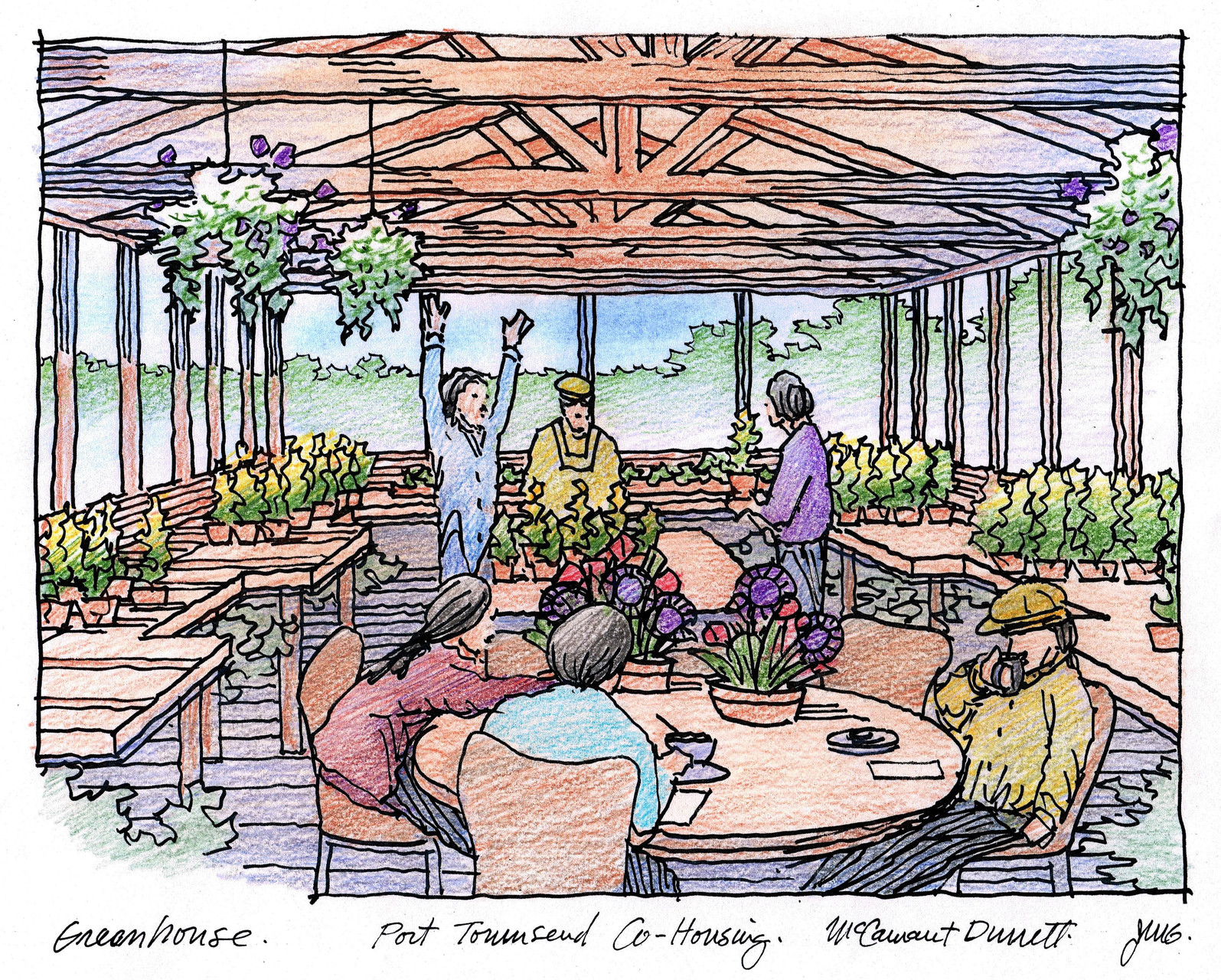
**Based on a letter from a former cohouser. Fictional names and places are used in this account.


Answer from Chuck:
Thanks very much for the very important note and observations. And yes, it’s true that in the book Happily Ever Aftering in Cohousing we talk a lot about establishing a minimum of committee participation of each participant in a given cohousing community. If you have the minimum participation (cook one common meal per month, belonging to at least two committees, and participate with your neighbors 30 hours per year in maintenance projects) then you wouldn’t be stuck with those who aren’t going to contribute and if you have stated minimums in your House Rules, then you don’t have to interview people as much (other than to be sure that they understand the minimums.) And, for sure, a palpable community makes the biggest difference in resales, but you’re in such a desirable neighborhood that you do need to aggressively do something to stem the ebb towards regular condos.
In Denmark the only units in cohousing that had a hard time selling were those that ebbed into regular condo land. In other words, of the 46 that we studied in great detail, the one where it was voluntary to cook, voluntary to be on a committee, etc., had a hard time selling units. It ebbed to that place that was dependent on a few busybodies, and broad and fair participation was not agreed on. And it ebbed to where females were doing more of the common cooking than males – just what they set out to avoid originally. Like in Denmark, the number one factor enhancing resale is, “Do you feel the palpable community.” The one in Denmark I refer to was neither fish nor fowl. It was neither cohousing or a regular condo. People want clarity so choose one and be that. Let people know what they are getting into. In that way you set the individuals coming in—and therefore the entire community—up for success.
Recently, one of the current Study Group 1 Facilitators asked a question similar to this during our training. I know it is a burning question for many who are interested in living in a community long-term, which is why I can’t emphasize enough that you embrace the cohousing culture that you create and set the community up for success long term.

Now in Denmark, almost half of the cohousing communities are limited equity coops, which means they can vet who comes in. That may or may not become the future here. In the meantime, we have to come up with interview provisions that help protect the community aspect and some semblance of affordability. In Berkeley, the cohousing self-imposed a 4.5% cap per year on equity. You can impose whatever covenants you want, but at the same time, you don’t want to limit the market too much. In Elder Spirit Cohousing, the third senior cohousing built in the U.S., when a unit is sold, 50% of the appreciation goes back to the community. It’s one way to best assure that you’re preserving affordability.
Other things that can be (and increasingly are being done):
1. The residents that live there (the community) gets first right of refusal and the unit is sold at appraised value. Then the community can sell it/rent it to whomever they choose. There is still an appreciation upside, just not as big. Since high functioning communities are a priority, the issue of huge appreciation is a real concern in this country and has made some cohousing communities unaffordable;
2. Serious, serious orientation. This is who we are and this is how we do things. This is best done with the Site, Common House, and Private House programs from the Participatory Design Process. Usually, someone from the membership committee discusses this in person with prospective buyer. Take them out for coffee;
3. Have a true elder in the group, someone who can talk directly about the norms and mores of your neighborhood. When I was a kid, going around making noise late into the night, I had at least one elder in the community sternly remind me that it was not acceptable at that hour. Similarly, I’ll never forget the time that we had a prospective buyer who suggested that he couldn’t cook for his neighbors on a monthly basis. Betty, an elder in the community walked him to the door and kindly said, “Jim, there’s an entire world out there for people who don’t cook for their neighbor. Here we cook for our neighbor.” Thank goodness Betty was at dinner that night or we might have been stuck with Jim;
4. These days, most cohousing communities, like Nevada City Cohousing, ask everyone to sign a participation agreement (I will cook, I will belong to two or more committees, etc.) Then we have four or five elders in our community who remind us all to play our part in making this community work long term.
The conversation needs to be amped up around this. Something needs to be done to best assure that people moving in are on board to contribute to the community. Some groups, like Berkeley Cohousing took it upon themselves to implement the cap, and those are the groups who seem to always be filled with happy, caring, neighborly community.

As we roll into the holiday season, we are surrounded by community. So much work to be done to get ready for the next party, cleaning up from the last, or maybe shovel the snow from the pathways. When you live in community, it is essential that everyone chips in -- it makes the load a lot lighter and the members much happier knowing that they have support.
The tragedy of the commons is real, but can be handily mitigated. No one moves into cohousing to take advantage of their neighbor but it does happen. To ensure that every community member is contributing, minimum participation must be agreed upon before moving in, as described at length in the book Happily Ever Aftering in Cohousing. The prosperity and longevity of cohousing depends on it.
The value of thinking about the "things"
Village Hearth Cohousing recently completed the Design Development and Prioritization Workshops (Workshops 5 and 6) with McCamant & Durrett Architects. Through the years, groups often ask me, “why do the workshops matter?” My answer is simple: Cohousing isn’t about reinventing the wheel. As you read on, you’ll see how the later workshops are just as important as the earlier ones and why each plays an integral role in the success of a cohousing community– in making it theirs, the one that fits like a glove, one that they own, emotionally. They are where trust it built. These participatory design workshops are where the community is built, not brick-by-brick but decision-by-decision.

Design Development:
At the surface, the Design Development Workshop (Workshop 5) is focused on stuff: hundreds of commercial products. The details and even the “stuff” have a profound impact on the success of communities, right alongside large-scale decisions like the site plan and common house design.
For example, consider your windows. A typical homebuilder in your area might select one window brand, while we might select another. There are many other reasons we have selected this window, but ease of operation and clarity of view alone make it ideal for senior cohousing; as you walk home and see a neighbor at the sink doing some dishes, you can wave to them, they can easily and quickly open the window, and you can chat or make a date to meet up at the common house. Altogether, the ensemble of products will form a tapestry that makes your house and your community feel like home.
This workshop is also important for the success of a community in the context of the development process. The Design Development Workshop is not just about energy efficiency, but that’s a big part of it. The process we facilitate -- based on years of experience and researching specifics to your region -- will enable you as a group to arrive at high-quality decisions by making effective use of your time and effort.

Prioritization:
This workshop is where costs that are perceived to be potentially above the budget are prioritized. Amenities are prioritized based on lifestyle, sustainability, facilitating community and all of the other goals and values of the group. Some amenities can be offered as options on a household-by-household basis (e.g. washing machines hook-ups, etc.) and others omitted completely (and others added.) The workshop process ensures that all members’ input is included and evaluated, at the same time, with all the necessary information on the table, using a very deliberate process.
The Prioritization Workshop is a very values-laden workshop. While reconciling little creature comforts, it will be important and sometimes challenging to keep the big picture in mind (community, cost, aesthetics). Though these little creature comforts are equally important because if we’re going to make community real, we have to make it even more comfortable than typical homes—which turns out to be very easy to do.
Both Design Development and Prioritization Workshops symbolize a huge step forward to getting a cohousing community built, including maintain a control on budget and finding what works for the entire community. This structured and intentional process allows groups to arrive at high-quality decisions in a matter of months, rather than other communities we have watched arrive at lower-quality decision after years of wasted time and energy, too much acrimony, and too many people dropping out of the group as a result.

If you’re interested in learning more about how the design workshops can influence the creation of your community, let’s talk.
Stewarding Your Environment

This window works great now, but what about 2 years from today? How can I keep it working great for years to come?
Quimper Village residents are packing their belongings. The group will open the doors to their new home, the first move-in being October 21 (almost three years to the day after they did the Getting-It-Built Workshop with Katie and me which at the time they still didn’t have land for.) Their home, a community that they helped to create. A community designed to support aging in place, where everyone knows and cares about one another. A community with a perfect balance of community and privacy.
As with all types of ownership, upkeep is of the utmost importance. Cleaning the gutters and the windows might seem like tedious tasks, but knowing how to do it (and how often) can make a great impact on performance. It also makes you as an owner proud of where you live.
So how do I keep my home running smoothly for years to come? What do I need to be aware of? A couple of weeks ago, I went to Port Townsend to hang out with the beautiful Quimper Villagers and take them through the final workshop, the Physical Plant Maintenance Program (PPMP.)
"It doesn't pay to design an organ if no one knows how to play it." Or in this case, it is an orchestra—dysfunctional if everyone is playing a different score. When it comes to the long-term social success, this workshop is just as important as every other. Deferred maintenance saddles subsequent years with less happiness. And the meetings that go along with deferred maintenance are never fun, “Now why didn’t we deal with this two years ago?”

Quimper Village is ready for its villagers!
Over a long day, Quimper Villagers toured the new neighborhood as we discussed the right way to refinish the wood tables or maintain the grass and concrete. Though this wasn’t surprising (in the past 3 years of working with them, I grew accustomed to their attention to detail,) I found that this workshop was important to them. It is important to anyone living in a community with common areas. As you know our office mantra is, “If it doesn’t work socially, why bother?”
Although most of you have successfully maintained your own houses for years, doing so in a cohousing community is different and requires additional skills and systems. I’m not claiming to be a maintenance expert, but I know a think or two about the “tragedy of the commons.” This is real – don’t let it happen to you. "Oh, I thought that someone else was going to take care of this,” or “Oh, I thought you were," or “I thought somebody would notice that.” Or my favorite, “Oh I just assumed that that was being taken care of.” In this way, deferred maintenance inadvertently happens all the time, but it can be mitigated with just a couple of skills. That’s what this weekend was all about (also described in Happily Ever Aftering in Cohousing.)

Quimper Villagers listen intently to a lecture on how to maintain the toilets, windows, and the kitchen sink, plus more. Though it may seem like a no-brainer keeping up a community requires organization and guidance.
The PPMP Workshop addresses tasks that need to be performed regularly as well as signs that a problem has occurred. Every individual needs to know what they are responsible for and how what red flags need to be addressed immediately.
Maintenance is too often the Achilles heel of cohousing because “someone else volunteered to take care of it,” so, therefore, I have no responsibility. Wrong—your responsibility is to set those volunteers up for success. So, this workshop is the absolute best way of solving these problems—with knowledge. When everyone does this workshop the knowledge becomes common, and it is much less of an issue later.
Everything in the project is of the earth, and it is in a hurry to get back to the earth—that’s entropy. Being a part of a cohousing community means you are the stewards. Maintenance can be a positive and community building experience if you prepare for it.
A new look at getting older: Inspiring adults 55+ to support one another and the positive impact it has on housing and livelihood.

Article by Charles Durrett and Lindy Sexton
The last nails are being hammered in. Fresh paint still clings to the damp air. In Port Townsend, Washington, residents of the newly-built Quimper Village Senior Cohousing eagerly await moving into the neighborhood that they co-designed. The neighborhood that not only symbolizes their desire to take an active role in their aging scenario, but also their commitment to supporting, listening to, and living in community with each other.
Communities like Quimper Village are cropping up around the world as older adults are discovering the value of taking control of their lives. Socially, financially, and environmentally it makes sense to live near people who care about you, but until you can work with others to create this scenario, it is just a good idea and nothing else. Senior cohousing communities, and groups inspired by cohousing, grow from that need to move things forward into a collective of organized and forward-thinking activists. The result far exceeds expectations, in many cases.
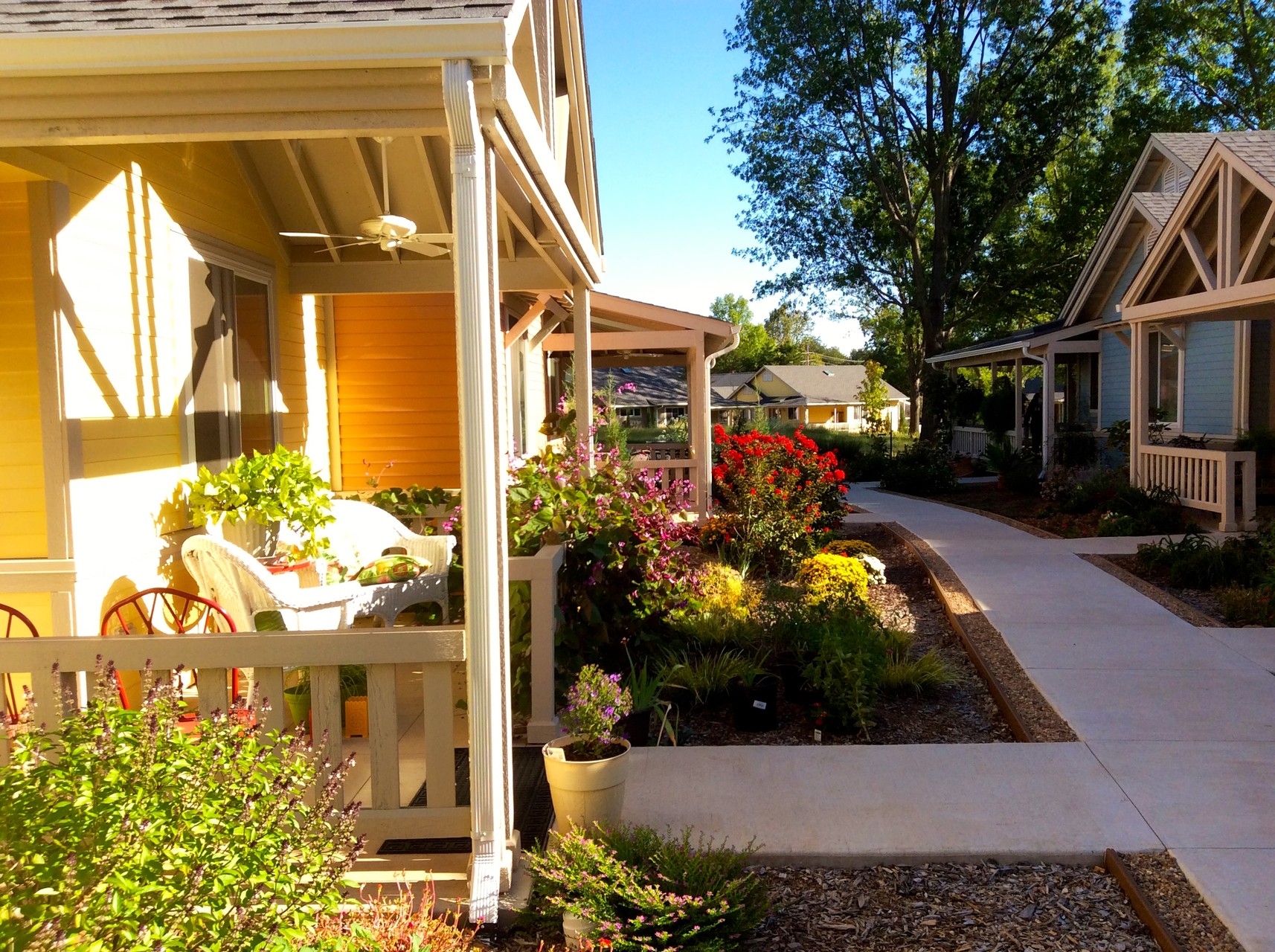
Oakcreek Community Senior Cohousing in Stillwater, OK is a good example of a neighborhood where people spend more time on their front porch talking with their neighbors than in their private home. It happens naturally, because the group works together to design their community based on the values they create as a team.
Being organized is being in control. While senior living facilities are taking steps to support their residents more than ever before, they still cannot offer what senior cohousing groups can. One way to begin this process is by taking Study Group 1, or SG1, (discussed below and in Chapter 7 of The Senior Cohousing Handbook: A Community Approach to Independent Living ). Participants recognize that they actually have a lot of say in their aging scenario and only in community can they express what they want in a proactive way. In SG1, facilitators take groups through various aspects of their “getting older” scenarios. In a period of 10 weeks, the group discusses how they, as a consortium, can be the solution, planning for their years ahead so when the time comes, they are supported by people they know and trust.
After SG1, senior cohousing groups go through a series of workshops which develop cohesiveness and clarity within, along with setting expectations and later co-designing the community of their dreams. It is important to note at this point that none of this can happen without the group being on the same page and out of denial. Cohousing communities aren’t created by one visionary, but by many who share in the vision and, through consensus and being prepared, can decide what is best for all.
What is Senior Cohousing
Senior cohousing communities like Quimper Village are being built across the U.S. The U.K., Europe, and Canada have also seen an upsurge in cohousing groups coming together, and other countries are not far behind. The concept originated in Denmark in the latter part of the 20th century as older adults began voicing their desire to live independently, in community. In the 1980s, Charles Durrett (Principal Architect, McCamant & Durrett Architects) and Kathryn McCamant (CoHousing Solutions) coined the name “cohousing” and popularized it in the U.S. with their book, Cohousing: A Contemporary Approach to Housing Ourselves. Durrett later authored The Senior Cohousing Handbook: A Community Approach to Independent Living, a book that is used by many senior cohousing communities around the world, including those in Denmark. He has since designed about a dozen 55+ cohousing communities and has consulted on many more.
Senior cohousing is a type of community for adults 55 and older that are:
1. Co-created and co-managed;
2. Physical design and orientation that encourages community interaction and supports aging in place including extensive common facilities and private homes;
3. Regular common meals;
4. Mutual support systems that include interdependence during illness and convalescence;
5. Continued “saging” and embracing the aging process;
6. Decisions based on consensus;
7. No shared income and community is not a source of income for members.
From the outside, senior cohousing has many different shapes. Some are suburban while others are in high-density cities. For example, Oakcreek Cohousing in Stillwater, Oklahoma consists of 24 private homes on 7.5 acres, whereas Mountain View Cohousing, in Mountain View, California has 19 units on 0.9 acres. Each has unique qualities within the neighborhood, but all adhere to the proven criteria that make up senior cohousing—and for good reason.
While “cohousing-like” developments are being erected (developer-designed senior housing with common amenities is a common example,) these projects tend not to work as efficiently as cohousing, from a community standpoint. The cohousing process is one that requires the input of the group from the start. It has been developed over decades and has proven to be effective in creating trust and dependability within the group. This topic has gained a lot of traction lately as more people are preferring community models over single-family homes, which is why it is more important than ever that people know what works and what doesn’t. It is important to clearly define what cohousing is instead of reinventing the wheel if it is to continue to have the same positive results generation after generation.

In addition to sticking to principles, successful communities learn from experts who know what they’re doing. Though the product is a community that is co-designed and co-managed by its residents, consulting with experts during the process is also very important. Durrett and McCamant are recognized as the top experts in cohousing, not because they took a weekend course or dabbled in cohousing. They spent over a year studying with the experts in Denmark before they would take a penny from any group. As a result, they can work efficiently and effectively with groups to ensure that nothing is left out. Senior cohousing communities that work with cohousing professionals in all stages of the game result in getting their projects built on budget and on time.
Some of the natural results of going through the design process are that seniors learn to work together, to identify and advocate for their needs, and to listen to one another. On several occasions, senior cohousing residents take more active roles in their larger community, once they’ve completed their own senior cohousing projects. Pat Darlington of Oakcreek Cohousing, for example, has taken up a position in the city council. Needless to say, senior cohousing not only takes care of providing homes for older adults, it also inspires senior cohousing members to live life to the fullest.
With the number of people over 65 projected to double in the next 20 years, it is more important than ever to think ahead and plan for one’s own aging scenario. In addition, the needs and wants of seniors are changing, and societies across the globe must respond in ways that will support their needs.
Working together: what’s in it for me?
The phrase, “Pull yourself up by your bootstraps,” rings strong for many, especially in the U.S. From an early age, we are taught to be strong and that independence equals success. While this can be useful in some cases, the more appropriate (or perhaps sustainable) life lesson is to live among those who you care about, those who listen to and learn from, and those who inspire you to be a better person.
When creating a cohousing community, no doubt members run into disagreements. Through mediation and consensus-based decision-making (techniques learned early on in the cohousing process,) the result will not only be a community that functions physically but socially as well because neighbors have space to voice their needs and wants without being ridiculed. That’s why being organized from the start is so important. Working together is at the core of senior cohousing. From idea to reality, the process is very involved and requires that everyone is up for thinking like a community.

Breaking bread together is at the heart of cohousing.
The result of having a community that responds in-line with the values of each individual is success from a macro and micro point-of-view. Residents know they can trust one-another and that their voice is being heard. Furthermore, being included in something bigger increases self-efficacy and inspires each member to live more fully.
Fears and misconceptions
Many people fear getting older because they equate it with being alone and being rendered useless. In senior cohousing, you have a good balance of social time and privacy. It’s like being in the college dorms again, without the shared bathroom and bad food. Together with your community you have fun, share experiences, plan outings, support each other, and give each other space when needed. Fears can paralyze us or cower us into giving up control, which is why doing Study Group 1: Aging Successfully (SG1) is one of the first steps in getting the community of your dreams built.

Study Group 1: Aging Successfully
SG1 began in Denmark with senior cohousing communities recognizing that the barriers to entry often were held in a set of fears about the future. Through the course of 10 weekly sessions, these groups noticed that fears dissipated as people recognized the value of community in aging. Senior cohousing communities who do SG1 are more likely to get their projects done more quickly, with less difficulty than those who didn’t. Quimper Village is a great example of the positive impact that SG1 had on the residents, who are just about to move into the community of their dreams.
SG1 facilitators can be found in the U.S., Canada, and in South America, and the world could use more. What does it take to become an SG1 facilitator? McCamant & Durrett Architects invites those interested to attend Aging Successful: Study Group 1 Facilitator webinar, which runs each fall. Participants gain a clear vision for how to conduct Study Group 1 in their local area while getting the opportunity to talk with Durrett in a small group setting. This participatory webinar readies those with the passion to make a difference.
For more information, visit www.cohousing.com
Where do I start?
The number one reason that senior cohousing has taken off in the U.S. like it has is that people are reading The Senior Cohousing Handbook: A Community Approach to Independent Living. (Durrett) Not only does the book give important information on how to create a senior cohousing community, it showcases inspiring stories of senior cohousing projects being built in Denmark, Canada, and the U.S.
Having the book is beneficial in two big ways. The book provides essentials on senior cohousing so those interested can make educated decisions on whether it is right for them. Having the book sitting out on your coffee table is also an unobtrusive way to tell others about it. How many times have you told your significant other about a great idea only to have them come up with the same idea, based on something they saw in the newspaper or heard from a friend? Sometimes good concepts have to simmer awhile before they are accepted.
Once you’ve got the book into the hands of a few keys figures in your area (potential members and city council for example) it’s time to have fun talking with your neighbors and others in your area who, like you, want to age-in-place in a community they know and support. Bring everyone together for an informal meeting where you discuss what your senior neighborhood looks like. Do an SG1 shortly after that. The main point is to keep the momentum high, you’ll find that most people don’t have time to waste. McCamant & Durrett Architects can assist in, finding SG1 facilitators in your area or prepare you to do it yourself.
How Do I Learn More?
McCamant & Durrett Architects has designed over 50 cohousing communities and the firm continues to be recognized as the leading architecture and design company for affordable and high-functioning cohousing.
CoHousing Solutions specializes in the development of cohousing communities. The company trains cohousing developers and works directly with cohousing groups.
SAGE Cohousing International is a non-profit organization dedicated to informing, coaching, and equipping people and groups who are interested in senior cohousing.