
MDA Cohousing Architecture Internship

Cohousing was catapulted into success in Denmark with the collaboration of two cohousing architects, Jan Gudmand Hoyer and Vandkunsten, a Danish architecture firm. The idea, it takes a village to raise a child, was the force behind this movement and getting there was going to involve future residents in the decision-making process. Their project Trudeslund knocked it out of the park. In fact, they did so well, they inspired more cohousing communities to be created across the country. Suddenly, several cohousing communities were successfully built and architects were trained, based on this model. I was fortunate to be one of these architects.
In the early 1980s, I lived in Denmark, studying at the University of Copenhagen. It was on my walks to and from class that I began to see the comprehensive social movement of cohousing. Every day, I immersed myself in the sea of possibilities that cohousing groups brought to the table, what worked, and what didn't. In 1988, upon returning from our study, Katie McCamant (CoHousing Solutions) and I released our first book Cohousing: A Contemporary Approach to Housing Ourselves and began what is now a thriving movement in North America. Our efforts as architect and development consultant have influenced many and I am pleased to know that we facilitated cohousers in successfully designing the neighborhoods of their dreams. I couldn't have done any of this without the intense period of mentorship I received from the experts (who were at the time only in Denmark.)

I invested my entire adult life to this concept of community-designed living because I saw how it improved the quality of life for those who participated in it. I know that other architects have the same mindset - in fact, I have trained a few over the years. But having the desire to help cohousing groups get started is a complicated process, especially if you are new to the world of development, architecture, and consensus-making. Projects that work with untrained architects might look in-fashion, but the glue that holds the community together often falls apart, if it is there at all. Homes in successful cohousing communities have the same handsome appeal and they work socially. As cohousing becomes more desired, it is important that the architects who will facilitate future projects are mentored, just as I was, by successful cohousing architects. That way, they too can contribute to bettering the future lives of their city and larger community.
Cohousing projects don't succeed just because the future residents are motivated. They don't succeed just because the architect is a nice person. Each project needs the guidance of someone who has experience and knowledge. Groups that hire cohousing professionals save money and time. They live every day the satisfaction that they did it the right way.
For the past 30 years, MDA has offered internships to architects who aspire to get cohousing into their towns or cities. We've trained several architects who are now guiding cohousing communities across the U.S. and around the world. Most of our 50 interns to date have been from overseas (seven from Denmark, ironically); five from Germany; two from Indonesia (interesting); one from each of the following Iraq, France, South Korea, Columbia, Australia; and so on. Only about ten from the U.S. and none from Canada. Although I like helping other countries see some of the in-depth tricks of designing high-functioning communities, America still has a huge negative ecological footprint.
Demand continues to grow and MDA has decided that it makes sense, socially and environmentally, to focus on training architects in North America. Our next internship starts this fall - a six-month on-the-job training - and we're looking for architects in the U.S. and Canada who want to learn how to think outside of the box and create eco-groovy, socially-sustainable housing.
Interns learn specific facilitation techniques and successful design elements that are fundamental in cohousing. They receive specific instruction on how to move projects from beginning to end and how to replicate this while adhering to the nuances of future groups. It's not about recreating the wheel. Instead, cohousing thrives in the knowing that the technique is proven effective.
What is the future in cohousing? It lies in the hands of professionals sharing knowledge with professionals. When more trained architects adopt cohousing as a modality in their practice, those who are interested will make themselves known. It's already happening - we receive several inquiries with regularity, from groups looking for a trained professional in their region. When more interest grows in an area, local government and businesses will also jump onboard, if they're not already in support of creating high-functioning neighborhoods. Once the wheel gets going, there's no telling how big the reach. Adding cohousing to your offering of services as a trained architect will lead to growth in your firm.
Now, more than ever, it is important to see the potential in the cohousing movement and join in. A six-month internship is a drop in the bucket when it comes to the value you'll add back into your community. Trust me, I've seen it clearly in mine. So, if you're interested in learning how you can become a cohousing architect, we'd like to hear from you.
Retirement Communities Lure Boomers With Eco-Friendly Message
Retirement Communities Lure Boomers With Eco-Friendly Message

More 55-plus developments are promoting their energy efficiency—and they say retirees are willing to pay the price
Published in the Wall Street Journal on April 22, 2018. By Julie Halpert.
Tennis, golf and an attractive clubhouse have long been staples in the universe of 55-plus communities selling an active lifestyle to retirees.
But a growing number of such communities are trying a different message directly geared toward baby boomers: highlighting the eco-friendly features of their developments.
As boomers retire, downsize, or just look for new homes that better fit their current needs, more 55-plus communities are competing based on features like solar panels, water reclamation, energy-efficient appliances, and windows with low-reflective glass, says Samantha Reid, a spokeswoman for 55places.com, an online resource for information on active-adult communities.
Houses with eco-friendly designs may cost more than similar homes without them. But developers of 55-plus communities say many baby boomers are willing to pay the price.
Jeff McQueen, president of Scottsdale, Ariz.-based Shea Homes Active Lifestyle Communities, a division of privately held Shea Homes, says his company makes a considerable effort to design and build energy-efficient homes, based on an internal study of boomers that indicated 50% desired energy-efficient and sustainable features in their homes.
Consider Mary Anne Graf, age 70, and her husband, Paul, 71, who bought a home in a Shea Homes Trilogy-branded 55-plus community in Denver, N.C., last August for $515,000. The Grafs paid more than they would have in slightly less-expensive active-adult communities, in part because of a $29,000 solar-energy package. But they say they chose their home partly because of that solar option.
“We’ve been very satisfied and love the solar,” says Ms. Graf. The Grafs’ average electric bill is $36 a month for their 1,850-square-foot home. “We’re saving ourselves money and benefiting the environment.”
Similarly, at Robson Resort Communities , a company focused on 55-plus buyers in Arizona and Texas, Chief Financial Officer Steve Soriano says his company’s research shows more than a third of its prospective buyers seek an energy-efficient and environmentally friendly home. All new homes in Robson’s Sun Lakes, Ariz., development are Energy Star-certified, a federal measure of high energy efficiency that takes into account such features as insulation, building materials and window types.
Robson communities also design their landscaping and golf courses to reduce water runoff and evaporation, and have their own wastewater-treatment plants that reclaim and reuse water. According to the company, the use of reclaimed water reduces the cost of irrigating the golf course and community landscaping for each community by 50%.
Environmentally friendly designs have become necessary to compete, says Marshall Gobuty, developer and majority owner of Mirabella, a 55-plus community under construction in Bradenton, Fla. To that end, Mr. Gobuty and other developers are increasingly pursuing so called LEED certification, an official stamp of approval from the U.S. Green Building Council that says a building or development meets the council’s Leadership in Energy and Environmental Design standards. LEED certification requires meeting a long list of conditions, including proximity to transportation, water efficiency, energy usage and sustainable materials. Mirabella has received LEED certification for all of the 90 villas it has built so far (out of a total 160 to be built.) Energy-efficient features in the villas include LED lighting, double-pane vinyl windows and extensive insulation. For the last 25 homes to be built, there also will be a community charging station for electric vehicles and solar panels.
Mahesh Ramanujam, president and chief executive of the U.S. Green Building Council, says his organization has seen a steady uptick in 55-plus communities seeking LEED certification in recent years. Last year, 24 developments received LEED certification, and 16 are already in the process so far this year, he says. Mr. Ramanujam says his group expects that the number of projects being certified will double each year over the next five years.
LEED-certified projects see an average 25% reduction in energy costs, says Mr. Ramanujam. At Mirabella, Mr. Gobuty says LEED certification has added 12% to 14% to each certified home’s cost. But, again, in the company’s view, that extra cost pays for itself. All but 22 of the project’s planned 160 villas have been sold.
Mr. Gobuty says he is also developing a 55-plus community in Ellenton, Fla., that will feature 600 net-zero-energy homes, a type of home that is largely energy-self-sufficient. In net-zero-energy homes, the total amount of energy used in a year roughly equals the amount of energy created on site—mostly through use of solar panels. Thus, in theory, depending on the utility, residents of net-zero-energy homes may not have to pay an electric bill.
Meanwhile, it isn’t just 55-plus communities that are focusing on green living. There is also a growing movement in senior housing known as cohousing, in which homeowners have their own units but share a common living space and other resources. Currently, there are about a dozen senior cohousing communities in the U.S., according to the Cohousing Association of the U.S.
Charles Durrett, a Nevada City, Calif., architect who specializes in cohousing units, says “living lighter on the planet” is a big goal for every senior cohousing community he encounters. At Village Hearth Cohousing , under construction in Durham, N.C., homes will be clustered on 15 acres, preserving 10 acres of green space.
Pat McAulay, a member of that community, says that although boomers have always valued environmental sustainability, “a lot of us ended up walking the normal corporate path. ”Cohousing,” Ms. McAulay says, “gives us the chance to go back to those things that were really important to us when we were younger. It gives us a chance to redeem ourselves.”
Ms. Halpert is a writer in Michigan. Email her at reports@wsj.com.
Create Senior Cohousing for Yourself (Psst! Here's How)

Living and growing older in community is gaining popularity for many important reasons. The alternative, living alone is expensive and more taxing on the environment (as compared to living in community and sharing resources). The resources that older adults need (or will need), like Meals on Wheels, are scarce or poorly funded. Loneliness and isolation is just as harmful as smoking 15 cigarettes a day. There is a revolution taking place and it’s proving to be a solution to our ever-looming challenge of housing adults 55 and older. This revolution, senior cohousing, is a movement to not only live in community, but to be proactive about one’s future, living in a place that is supportive. No matter how young you are, now is the time to take an active role in your aging process.

Mountain View Cohousing, Mountain View, CA
That sounds great, right? It might even inspire you to pick up a copy of The Senior Cohousing Handbook: A Community Approach to Independent Living, but what happens next? How do we move from dream to reality? Talking about solutions is futile if there is no action. Not walking-the-talk leads to frustration and, in many cases, wasted time and money. Action is needed and that is why McCamant & Durrett Architects and Quimper Village are joining forces to host a weekend intensive workshop on June 15, 16, and 17 on Bainbridge Island, WA.
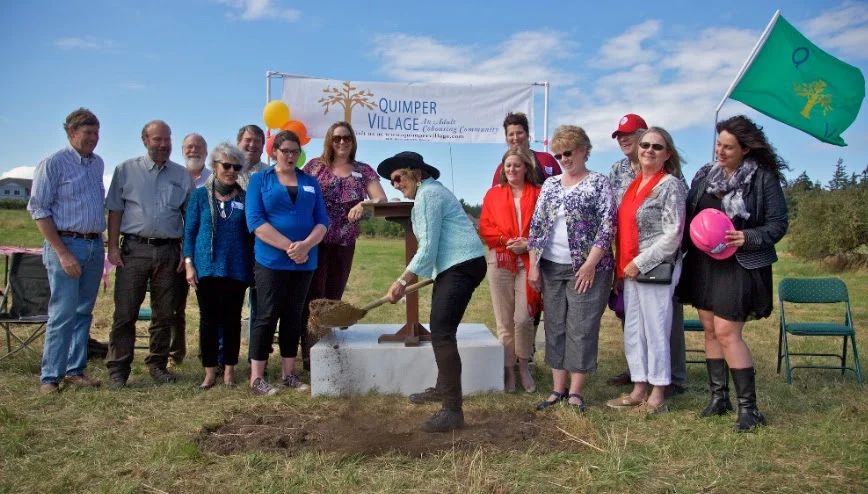
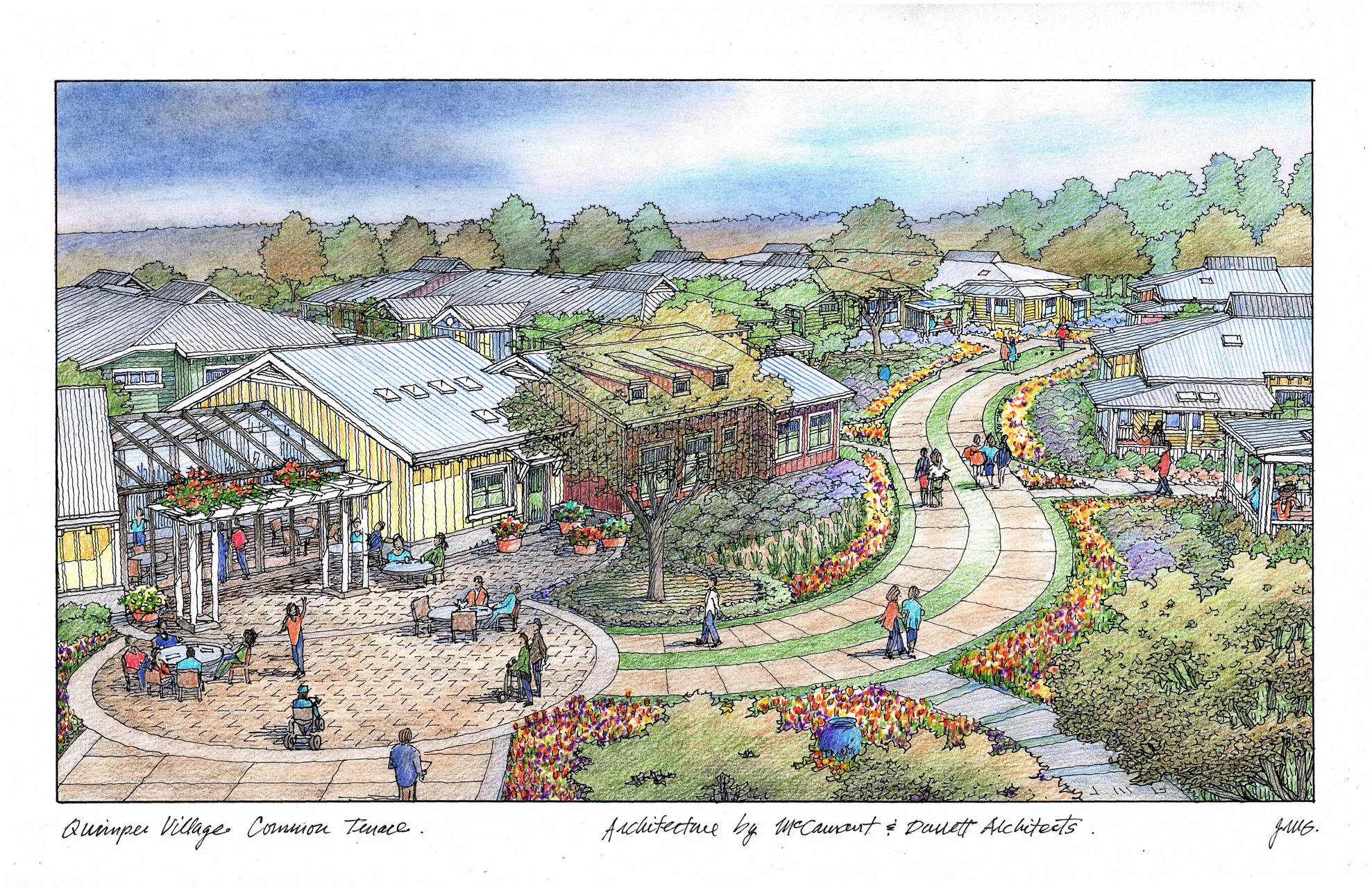
Over three days, participants will spend time with cohousing expert Charles “Chuck” Durrett (McCamant & Durrett Architects) and the residents of Quimper Village, a Senior Cohousing group in Port Townsend, WA, learning how the Quimper Village Group made their project happen. In a small, intimate setting Quimper Villagers will discuss with participants what they did, how they did it, and lessons learned. Time will be spent talking about the financial, legal, and social considerations, plus how groups can market their project where they live. Those who attend will tour Quimper Village, meet the residents, and join them for common lunch.
What makes this different from other cohousing conferences? Cohousing Conferences are great for people to get a taste of what cohousing is. They offer perspectives across the board from people who are living in cohousing to those who are new to the concept. The feedback we hear from people who attend is that the information provided at the conferences is inspiring, but for those who already know about cohousing, it doesn’t get deep enough. Others are overwhelmed with theory and not enough action. Those interested aren’t getting the tools they need to actualize their projects. We’ve listened to your concerns and have designed the June Weekend Intensive to respond to them.
This is your opportunity to share your project with others — challenges, insights, and more — and get your questions answered by those who have successfully gone through the process of creating their own Senior Cohousing Community. Along with members of Quimper Village, Chuck will walk through how they would get cohousing in your town, if they were living there. Every voice will be heard, and all scenarios considered.

Silver Sage Cohousing, Boulder, CO
Concerned that you’re not old enough? The benefits of Senior Cohousing are best felt by those who live there and are part of it. By moving into a senior cohousing community before you need real assistance, you give yourself time to ease into it, to create bonds, to plan ahead with others. You are more willing to help your neighbor than a stranger, right? In cohousing, you have several neighbors each contributing the health of their community. Why would you want to wait for this when you can have it now?
“Cohousing is so much more than a sound bite,” says Chuck, cohousing architect and owner of McCamant & Durrett Architects, “this weekend will be all about setting older adults up for success in their hometown.”
The Senior Cohousing Weekend Intensive is open to 20 people who are ready to get their senior cohousing project going. If you have been thinking about starting your own senior cohousing, if you are looking for a site, or if you have a small group of interested people who are talking about living in a supportive neighborhood where you have a balance of private and community, then this is for you!
“I’m amazed at how people help each other out with immediate needs and take on tasks that they see need be done without being asked first. Although there are differences of opinion, it’s not acrimonious. We’re learning how to make it work,” says Pat Hundhausen, resident of Quimper Village, as she talks about how she is settling into cohousing. Pat helped to make Quimper Village a reality and will be one of the key moderators during the June event.

Finally, an opportunity to talk about solutions! The chance to work directly with cohousing experts and with cohousing residents on your project doesn’t happen every day. Think about your future, a future that’s more supportive, more economical, more environmentally-friendly, and more fun. Sign up for the Senior Cohousing Weekend Intensive before April 28 to take advantage of the Early Bird Discount!
More information at www.cohousingco.com/events/seniorintensive2018.
Article Review: A Cure for Disconnection

Review by Charles Durrett
Original article by Jennifer Latson in Psychology Today
You know that we’re getting somewhere when the renowned magazine Psychology Today publishes a feature-length 10-page article about the importance of personal connections. They refer to loneliness as a disease and warn that we are in the midst of an epidemic—and apparently to everyone’s surprise, it can be deadly. It’s a bigger risk factor than obesity or smoking 15 cigarettes per day. Yes, even the married with family might be lonely and today according to this article, it’s a bigger threat than obesity or smoking, because it’s “hidden in plain sight.”
It’s now time for a serious intervention, suggests a Harvard physician, and cohousing is cited as being an example of such an intervention—but more on that later.
It is now proven that lonely people die more frequently from every other disease as well. Loneliness is strongly correlated with dementia, Alzheimer’s, and most obviously, depression. The stress and anxiety caused by loneliness produces anger, which in turn increase loneliness. One woman told me that her widowed grandfather shot himself “because no one came to visit.” It happens.
Our need for connection is so hardwired that loneliness hurts just like a physical wound and has similar physiological properties to the pains of extreme hunger, thirst or injury and eventually people will medicate to ameliorate that loneliness wound, leading to other long-term issues. A teenager from Nevada City Cohousing once wrote, “I can’t imagine a coho teenager using drugs—they just don’t have any wholes in their heart.” Perhaps simplistic but important to pay attention to nonetheless.
Everyone is lonely once in a while, but sustained loneliness puts people on edge and overly vigilant about being judged or rejected, which actually sabotages their ability to connect. I’m going to argue that some people are proactive and don’t wait for symptoms—they set themselves up for success earlier in life. Some folks actually believe that they will never get lonely and that may or may not be true—people even get lonely in cohousing—just not for sustained periods of time.
Then there’s the fact that a higher percentage of Americans are living alone than ever before. For the first time in American history more women over 18 are living without a husband, than with a husband. Among other things our ability to listen and empathize with others diminishes which will end up making you even more alone. If there is anything that teaches you to listen and learn, it’s living in community. A lot of people look at a home’s closets and kitchen, but the key question is where do neighbors gather to discuss the issues of the day. That’s a much more important quality of life question. That’s where cohousing comes in—meaningful sustained contact makes quality of life a lot easier. That’s why just visiting a nursing home doesn’t mitigate loneliness. The bonds that come from being your authentic self with others takes time and is also what I believe cohousing is particularly good at. It seems that the best we can do is to create community.
“We need communities that deliberately foster close social bonds. There’s a growing cohousing movement in which residents share chores and tend to common spaces together… There are about 700 in Denmark (population 5 million) and 160 in the U.S. (population 350 million) and more are being built,” – Psychology Today.
Just getting together with individuals on occasion is not enough.
In conclusion, 40% of the American population is feeling lonely today compared to 20% in 1980. That skews our ability or interest in living sustainably and makes it easier to pervert the body politic—divide and conquer is simply easier in the absence of community. It seems that people have 1/3 as many to confide in than they did in 1985. It seems that loneliness, just like the disease described earlier, is in fact extremely contagious—and “then the social fabric unravels.”
Sardinians live three decades longer than Americans. Why? Connection. The key to mitigating loneliness is reciprocity—I’ll make dinner on Monday, you make dinner on Friday—that’s cohousing—and fosters deep meaningful relationships.

Finally—how did we get here? Social media has played a role—but moving around a bigger role. What has Congress done—passed legislation to continue to make hearing aids more accessible—probably a good idea. Loneliness is not a chronic disease, it can be cured, but like most diseases, the longer it goes untreated the harder it is to cure—then it can become chronic. Next steps—make more community.
Katie's Insights on "The Cycle of Life" as seen through the lens of cohousing
From CoHousing Solutions' newsletter published Dec 2017.

Advent Circle, Nevada City Cohousing
As we approach the Winter Solstice, I’ve been thinking of the full cycle of life we get to experience here in my intergenerational community, Nevada City Cohousing. I suspect that I am not the only one that finds this to be one of the more profound appreciations for living in community, for ourselves and for our children.
The Winter Solstice Spiral is a beloved tradition at Nevada City Cohousing that inspires contemplation on every stage of life...
In the last weeks my community has been holding so much love for so many. For one neighbor who recently died, too young as she was just in her early 50’s, the community has been there to support her and her family in any way we can. And in return she shared and taught us so much. Another neighbor mentioned that her mother, who lives a few blocks away, had become close with this woman, and that sharing her passing has opened up an opportunity to talk with her mother about death. “What a gift (our neighbor) has given me,” she tells me.
On a recent Saturday night, another neighbor held his 46th birthday party in the common house with a rock-and-roll band made up of his fellow junior high teachers. Softening us up, he fed the community tacos and his new home-brew, made from hops grown here and brewed in the common house. Can’t get much more local than that! And that also helped to soften any complaints about the rock and roll band later…good technique.

Breaking bread together is at the heart of cohousing.
And then Sunday afternoon, all the women of the community, from 3 to 80, gathered in the common house to celebrate another neighbor’s pregnancy. We are all so excited to have a new baby coming! We shared stories, wishes, cake and tea. One neighbor is coordinating our community quilt for the baby. Another neighbor is knitting blankets for the new baby, and the baby’s older brother, while she worries about her husband’s cancer returning.
In cohousing, all of these major life events can happen at home with much more support from the community.
Written by Katie McCamant of CoHousing Solutions.